A woman continued to experience severe back and leg symptoms months after a two-week hospital stay. Reassessment identified significant muscular findings, and her function improved over several treatments. This case explores why the original cause of pain and the factors maintaining it may not be the same.
> View articleCategory: following dr win huang Treatment and diagnosis


Follow Dr Win Huang through real clinical cases and see how the patient’s history, pain pattern, physical findings and response to treatment are brought together. This series focuses not on fixed treatment formulas, but on the clinical reasoning behind assessment and treatment decisions.
> View article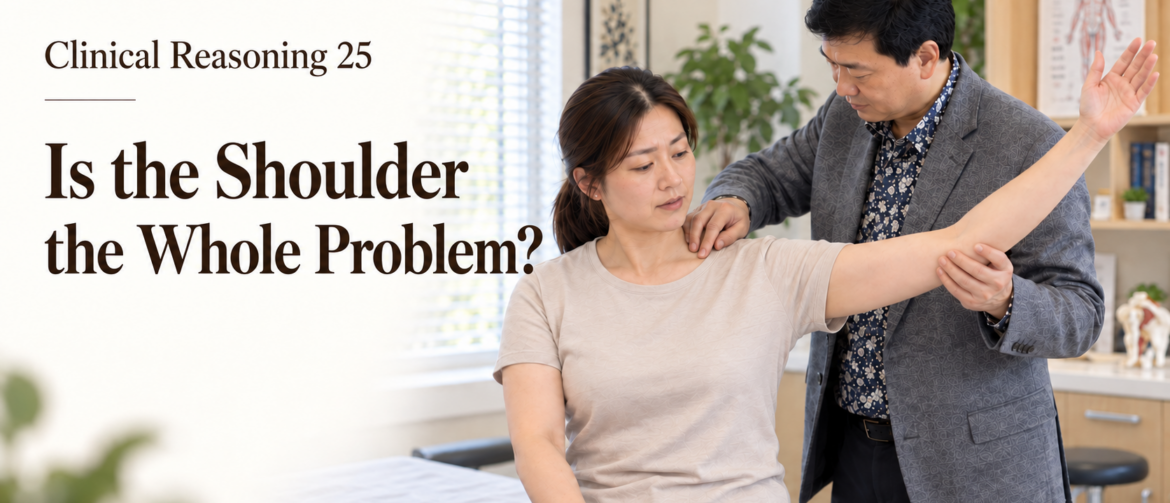
Shoulder pain, restricted movement, local tenderness and an ultrasound abnormality appeared to form a complete diagnosis. However, several examination findings did not fit. Those inconsistencies became the reason to look beyond the shoulder.
> View article
When pain disappears after one treatment, the result may be genuine—but what does it actually prove? Dr Win Huang reflects on immediate treatment responses, clinical reasoning and why doctors must distinguish real outcomes from explanations that go beyond the evidence.
> View article
Pain below the kneecap may immediately suggest the patellar tendon. In this patient, however, the pain was worst in the morning, eased with movement and disturbed his sleep. The history and examination gradually shifted my attention towards the
> View article
A diagnosis is rarely found by chance. Experienced clinicians follow clues, develop diagnostic hypotheses, test them through history taking and examination, and gradually narrow down the possibilities. Dr Huang shares the clinical thinking developed over more than forty years in practice.
> View article
Pain throughout the shoulder does not necessarily mean that every painful area is a primary injury. By comparing the injury mechanism, neurological findings, rotator cuff tests, weakness and local tenderness, I gradually focused on the long head of the biceps tendon.
> View article
Is every painful shoulder simply a torn rotator cuff? This case demonstrates why ultrasound findings alone cannot explain every patient’s symptoms. Learn how multi-layer diagnosis and multi-layer treatment can lead to more accurate clinical decision-making.
> View article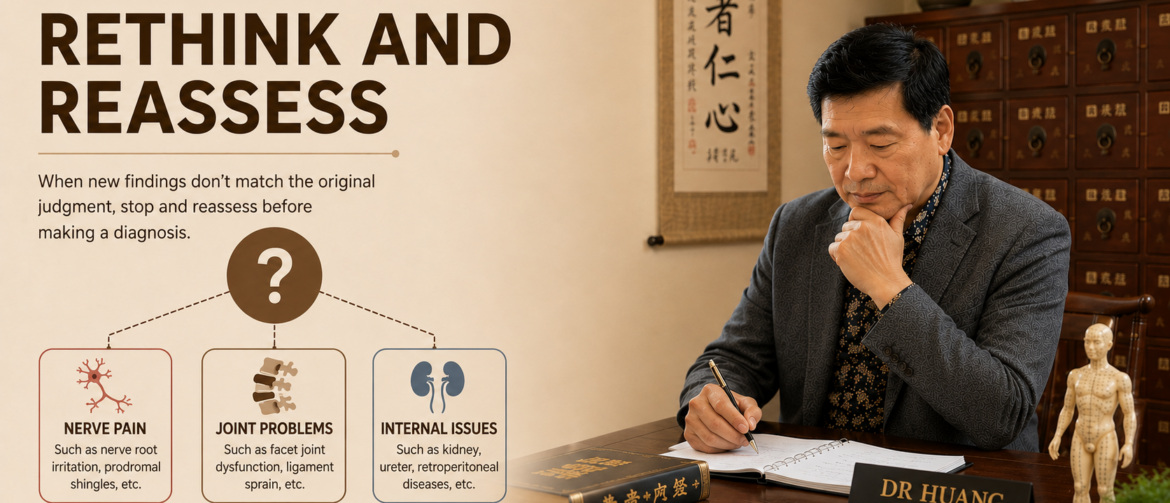
Not every patient with low back pain should receive acupuncture immediately. This patient initially appeared to have a psoas muscle injury, but conflicting examination findings suggested another possibility. Rather than confirming his first impression, Dr Huang reconsidered the diagnosis and referred the patient for emergency evaluation. Clinical reasoning is not about proving yourself right—it is about recognizing when new evidence
> View article
After decades of clinical practice, Dr Huang noticed an interesting pattern. Patients with the same degree of recovery often describe their improvement in completely different ways. This reflection explores what those differences may reveal about culture, recovery, doctor-patient communication, and human nature.
> View article


 中文微信:nzacupunctureclinic