
Follow Dr Huang’s Clinical Reasoning 23
Why Did I Not Treat This Knee Pain as Patellar Tendinopathy?
One morning, a construction worker in his fifties walked into my clinic with a noticeable limp.
He sat down slowly and said:
“Dr Huang, my knee has been hurting for three or four months.”
I asked:
“Where does it hurt?”
He pointed to the area below his kneecap.
As soon as he did that, my mind began to work.
Many people assume that once a doctor sees the location of the pain, the diagnosis is already clear.
It is not.
Several possibilities immediately came to mind:
The patellar tendon? Meniscus? Synovitis? Osteoarthritis? Pes anserine region? Medial collateral ligament? Cruciate ligaments? Or a nerve?
An experienced clinician does not begin with only one possible diagnosis.
The real work is to compare the possibilities and gradually exclude those that do not fit.
A Pain Pattern That Did Not Behave Like the Patellar Tendon
I continued:
“When is the pain at its worst?”
He replied:
“In the morning.”
“When I first get out of bed, it is very painful. I limp for the first few steps, but the more I walk, the easier it becomes. By the evening, it feels almost normal.”
That information was important because it began to change my judgment.
When the patellar tendon is the main problem, pain is commonly related to loading. Walking, running, jumping, squatting or repeated traction may aggravate the symptoms.
This patient showed almost the opposite pattern.
His pain was worst when he first started moving in the morning and gradually eased after he had walked for a while.
The patellar tendon therefore began to move lower on my list of possibilities.
However, I could not exclude it completely.
One feature in the history is not enough to establish a diagnosis.
Night Pain Changed the Direction Again
I then asked:
“How do you sleep at night?”
He said:
“The pain often wakes me up. It also hurts when I turn over.”
This shifted the direction again.
Pain at rest and pain that woke him during the night were not the most typical pattern for an isolated patellar tendon problem.
The likelihood of the patellar tendon being the main cause decreased further.
At the same time, a possible nerve-related problem began to move forward.
I still did not tell the patient:
“This is definitely your saphenous nerve.”
The diagnostic process was not yet complete.
The history had helped me reorder the possibilities. Examination was still needed to test them.
If I Suspected a Nerve, Why Did I Still Examine the Knee Joint?
Some people may ask:
If I was beginning to suspect a nerve, why did I continue examining the other structures?
An examination is not only used to find evidence supporting the diagnosis we favour. It is also used to look for evidence that supports or weakens the other possibilities.
I examined the menisci, anterior and posterior cruciate ligaments, and medial and lateral collateral ligaments. I also assessed for joint effusion, synovial irritation and restricted knee movement.
These examinations did not reveal convincing findings to support those diagnoses as the main explanation.
As the other possibilities moved backwards, my examination became more focused on the saphenous nerve.
The Important Finding Was Not Simply Tenderness
I first examined the skin sensation below the kneecap and then compared it with the areas above and below.
The result was interesting.
Only a small area below the kneecap was unusually sensitive. Sensation in the surrounding areas was largely normal.
A sensory change limited to a particular region did not fit as well with an isolated tendon or joint problem. It was more consistent with an abnormality involving a sensory nerve distribution.
That was the first piece of evidence.
I then applied pressure around the region known in acupuncture as Baichongwo. Anatomically, this was close to the area where the saphenous nerve travels beyond the distal adductor canal and becomes more superficial.
The patient immediately frowned.
“That is the place.”
I maintained light pressure.
He then said:
“The pain is going down.”
He pointed to the same area below the kneecap that had been troubling him.
At that moment, I was not simply looking for tenderness.
Many structures can be tender when pressed.
The more useful question was:
Could pressure at this location reproduce the pain that the patient recognised as his usual symptom?
Pressure at this particular point immediately sent pain towards the familiar area below his kneecap.
This was more than general local tenderness.
It connected the examination finding, the anatomical path of the nerve and the patient’s main symptom.
The Response to Treatment Also Tested My Reasoning
I did not begin by needling the painful area below the kneecap.
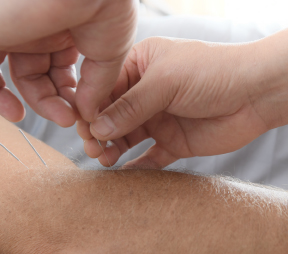
Instead, I treated the region near Baichongwo, corresponding approximately to the distal adductor canal area. I used acupuncture and local release techniques together with cupping.
A few minutes later, I asked the patient to stand.
“Try squatting again.”
He slowly lowered himself into a squat, paused and then looked up at me.
“Dr Huang, that feels much easier.”
I asked him to walk several steps.
The limp that had been obvious when he entered the clinic was already less pronounced.
When he returned the following day, he told me:
“The pain did not wake me last night.”
This increased my confidence in the original clinical direction.
However, improvement after treatment does not by itself prove that a diagnosis is correct.
What increased my confidence was that the history, sensory examination, reproduction of the familiar symptoms and response to treatment of the suspected region were all pointing in the same direction.
They were not isolated observations. Together, they formed a developing chain of clinical evidence.
Why Did a Construction Worker’s Knee Pain Make Me Think About the Saphenous Nerve?
After the patient left, I thought about several other patients I had seen.
One was an electrician. Another installed air-conditioning systems. Several others were also construction workers.
They had one feature in common:
They spent long periods working while standing on ladders.
Many people think standing on a ladder simply makes the legs tired.
From a clinical perspective, I consider another possibility.
To maintain balance on a ladder, the muscles of the lower limb may remain under continuous tension rather than contracting and relaxing normally.
The hip stabilisers, quadriceps and medial thigh muscles may all remain active for long periods.
The tissues around the adductor canal may therefore also be exposed to sustained tension.
The saphenous nerve passes through this region.
If the surrounding tissues become persistently tight, the nerve may be repeatedly irritated. The patient may not feel pain at the adductor canal itself. Pain may instead appear farther down, including around the area below and medial to the kneecap.
This is a clinical observation from my own practice. It should not be assumed to apply to every patient or every case of knee pain.
However, when a similar occupation, history and group of physical findings appear repeatedly in different patients, the possible relationship deserves closer attention.
Dr Huang’s Clinical Reflection
The message from this case is not that pain below the kneecap must come from the saphenous nerve.
It reminds us of something more important:
The place a patient points to tells us where the symptom is felt. It does not necessarily tell us where the problem began.
The clinician still needs to ask:
When is the pain at its worst? Does movement aggravate it or ease it? Does it disturb sleep? Is there a change in sensation? Can pressure at another location reproduce the patient’s familiar pain?
History-taking is not simply waiting for the patient to finish telling the story and then searching for an answer.
The clinician first develops several diagnostic hypotheses. Focused questions are then used to reorder those possibilities. The history guides the direction of the examination, and the examination helps support or challenge the earlier hypotheses.
Experience does not mean drawing a conclusion after seeing something once.
Experience is recognising the same pattern after observing it repeatedly in different patients.
Follow Dr Huang’s Clinical Reasoning—not simply to learn the name of a condition, but to learn a way of clinical thinking.
Seven: English Appointment CTA
Has Your Knee Pain Continued Without a Clear Explanation?
Knee pain may arise from a tendon, ligament, meniscus, joint degeneration, synovial irritation, muscle or a nearby nerve. The place where pain is felt is not always the place where the problem began.
At PhD Win Acupuncture Clinic, we consider the pain pattern, occupational demands, functional limitations and physical findings before deciding whether acupuncture is appropriate and what the next step should be.
https://drwin.co.nz/online-booking/
Disclaimer
This article is based on a real clinical case. Some non-essential details have been adjusted to protect patient privacy. It is intended to share general clinical reasoning and health information and does not replace an individual consultation, physical examination, imaging assessment or medical diagnosis. Pain below the kneecap does not necessarily arise from either the patellar tendon or the saphenous nerve. Knee pain following significant trauma, progressive pain, marked swelling or heat, locking or instability, inability to bear weight, significant sensory changes, or persistent night pain should receive appropriate professional assessment.



 中文微信:nzacupunctureclinic

Leave a reply