
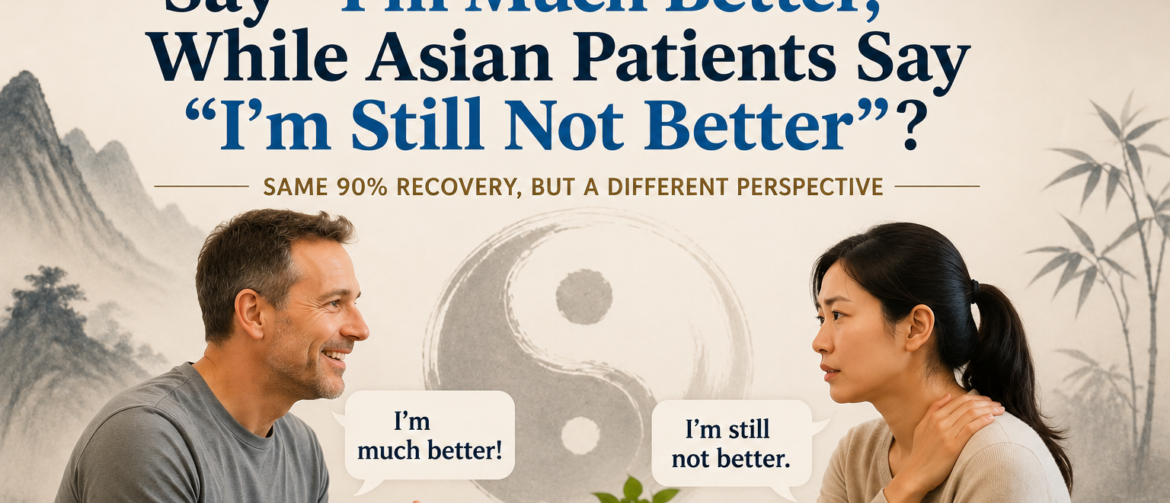
Why Do Some Patients Focus on Progress, While Others Focus on What’s Still Missing?
Over the years, I have noticed an interesting pattern in my clinic.
Two patients may experience almost exactly the same clinical improvement, yet describe the outcome in completely different ways.
One patient smiles and says,
“Doctor, I’m much better.”
Another says,
“I’m still in pain.”
The more I observed this, the more I realized they were often describing the same recovery.
The difference was not necessarily the result.
The difference was where they chose to look.
The First Layer: Culture Shapes How We See Improvement
This was the first explanation that came to mind.
Some people naturally notice how far they have come.
Others instinctively notice how far they still have to go.
Imagine pain improving from 10 out of 10 to only 2 out of 10.
One patient says,
“I’m about 80% better.”
Another says,
“There’s still some pain.”
Objectively, both statements describe the same recovery.
The reference point is simply different.
Perhaps this way of thinking begins much earlier than we realize.
Many Western educational systems tend to reinforce encouragement, confidence, and visible progress.
Children are praised for improvement.
They are told,
“Well done.”
“Great job.”
“Excellent improvement.”
Many Asian educational cultures, on the other hand, place greater emphasis on identifying weaknesses, continuing to improve, and striving for perfection.
Neither approach is necessarily right or wrong.
They simply teach people to measure success differently.
The Second Layer: How Feedback Changes the Clinical Experience
As a clinician, I have also noticed how differently these conversations feel.
When patients begin by telling me what has improved, the consultation naturally becomes a shared celebration of progress.
We both recognise that treatment is moving in the right direction.
Trust grows.
Confidence grows.
The consultation feels collaborative.
Other patients begin by listing everything that still bothers them.
Only after further discussion do they acknowledge that many symptoms have actually improved significantly.
The treatment outcome may be identical.
The emotional experience is not.
Sometimes the difference lies less in the recovery itself than in the way recovery is described.
The Third Layer: Could This Influence Recovery?
This question has stayed with me for many years.
Healing is not simply tissue repair.
Recovery also involves expectation, confidence, emotion, behaviour, and motivation.
A patient who notices improvement may become more willing to move, exercise, participate in treatment, and trust the recovery process.
Another patient who constantly focuses on remaining symptoms may become increasingly aware of pain and physical limitations.
I cannot say with certainty that one mindset heals faster than the other.
Medicine is rarely that simple.
But I do believe that what we pay attention to influences how we experience recovery.
And our experience often shapes our behaviour.
Behaviour, in turn, may influence healing.
The Fourth Layer: Beyond Medicine
Eventually I realised this reflection extends beyond healthcare.
Some people spend their lives noticing what they already have.
Others spend their lives noticing what they still lack.
The first group may find satisfaction more easily.
The second group may achieve more, but perhaps at the cost of greater fatigue and self-criticism.
Perhaps the conversations I hear in my clinic simply reflect two different ways of looking at life.
One person sees the 90% already completed.
Another sees the remaining 10%.
Both are looking at the same journey.
They are simply facing different directions.
Clinical Reflection
The longer I practise medicine, the less I believe recovery is only about symptoms.
It is also about perception.
Two people can experience exactly the same improvement while living completely different emotional experiences.
One celebrates how far they have come.
The other worries about how far they still have to go.
Perhaps neither is entirely right or wrong.
But as clinicians, it reminds us that listening carefully to how patients describe their recovery may tell us as much as measuring the recovery itself.
Sometimes the most revealing part of a consultation is not how much pain remains.
It is how the patient chooses to describe the journey.
More Dr Huang Clinical Reflections
Clinical Reflections (1) Where Does All the Phlegm Come From? Why Did an Elderly Woman’s Morning Phlegm Drop from 80ml to 10ml After One Treatment?
Clinical Reflections (2) Why Are Rotator Cuff Tests So Accurate in Textbooks Yet Increasingly “Inaccurate” in Clinical Practice?
Clinical Reflections (3) The Dizziness Patient Already Had an Answer, But I Still Said No
Clinical Reflections (4) Why I Like My Low Back Pain Patients to Lie Face Down and Move Their Hips
Clinical Reflections (5) – What Is the Responsibility of a Good Doctor?
Clinical Reflections (06) – From Unhappy to Happy: How a Long-Collapsed System Restarted Itself
Clinical Reflections (07) –
Clinical Reflections (08) –Why Do Some Patients Focus on Progress, While Others Focus on What’s Still Missing?
Book an Appointment
If you are living with persistent pain, dizziness, sleep problems, functional limitations, or symptoms that have not responded to previous treatments, you are welcome to book a comprehensive assessment at PhD Win Acupuncture Clinic.
Online Booking:



 中文微信:nzacupunctureclinic

Leave a reply