
Key Message
Some patients are not suffering from a single disease.
They may be living with a system that has been under pressure for so long that it has lost its ability to regulate itself normally.
Pain, insomnia, fatigue, anxiety, low mood, and emotional distress may appear to be separate problems, but sometimes they are different expressions of the same underlying imbalance.
Doctors may help create the conditions for recovery.
But the healing itself often comes from the body’s own remarkable ability to reorganise and restore balance.
Her Real Problem Was Not Back Pain
Some time ago, a woman came to my clinic seeking help for low back pain.
At first glance, it seemed like a fairly straightforward musculoskeletal problem. However, the longer we talked, the clearer it became that her situation extended far beyond her back pain.
Five years earlier, she had experienced a very difficult childbirth. Multiple attempts at epidural anaesthesia had failed, and eventually she underwent a Caesarean section under general anaesthesia.
The following day, she developed severe physical reactions. Although she gradually regained her ability to function, she never felt that she had truly returned to her previous self.
Over the following years, she struggled with persistent low back pain, fatigue, insomnia, anxiety, and low mood.
Later, her family experienced the loss of a loved one, adding further emotional stress to an already overwhelmed system.
Life continued.
Children still needed care.
Work still had to be done.
Responsibilities never stopped.
But she felt increasingly exhausted.
During our first consultation, I quickly realised that this was no longer simply a case of low back pain.
She seemed like someone living in a state of chronic vigilance and chronic tension.
The back pain was only one expression of the problem.
The insomnia was another.
The fatigue was another.
The anxiety was another.
Although these symptoms appeared different, they all seemed to point toward a single system that had been struggling for years.
The One Sentence I Cannot Forget
During that first consultation, she spoke for a long time.
She described the childbirth experience.
She described the physical changes that followed.
She described years of suffering and years of trying to continue functioning despite it.
But what stayed with me was not her description of pain.
It was one sentence.
She said:
“I’m actually not happy at all.”
Then she added something even more striking.
She said she had learned to pretend she was happy.
In front of her children, she acted cheerful.
In front of her parents, she did not want them to worry.
In front of friends, she avoided constantly talking about her struggles.
To everyone around her, she appeared to be functioning normally.
Only she knew how much she was suffering.
That statement stayed with me for a long time.
Patients often tell doctors where they hurt.
They tell us where they cannot sleep.
But very few people say:
“I haven’t been happy for years.”
What affected me most was that almost nobody around her seemed to notice.
She had hidden her suffering so well that others assumed she was fine.
Pretending to be okay for years is exhausting.
A Change After an Ordinary Treatment
During the first consultation, she spoke extensively and cried for much of the session.
I listened carefully to her story while providing acupuncture treatment and supportive care.
At the end of the appointment, I did not feel that anything particularly dramatic had happened.
My main impression was simply that this person was profoundly exhausted.
A few days later, she returned for follow-up.
She looked noticeably different.
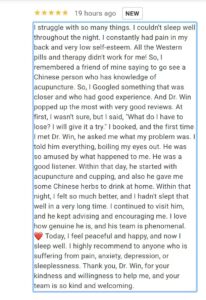
Later, she wrote in a Google review:
“I struggle with so many things. I couldn’t sleep well throughout the night. I constantly had pain in my back and very low self-esteem.”
For years she had experienced poor sleep, chronic back pain, and low self-confidence.
She then wrote:
“I told him everything, bawling my eyes out.”
That was exactly how I remembered the consultation.
She told the story of the previous five years while crying openly.
But what affected me most was the next sentence:
“Within that night, I felt so much better and I hadn’t slept that well in a very long time.”
That night she slept well.
Perhaps better than she had in years.
Finally, she wrote:
“Today, I feel peaceful and happy, and now I sleep well.”
When I read those words, I sat quietly for a long time.
Because during the first consultation she repeatedly told me she was unhappy.
Yet only days later, she was describing herself as peaceful and happy.
What Restarted the System?
This is the most interesting question in the entire case.
What actually changed?
Was it acupuncture?
Was it herbal medicine?
Was it finally having the opportunity to tell her story?
Was it being listened to without interruption?
Was it the release of years of accumulated tension?
Or was it simply that her body already possessed the ability to recover and merely needed an opportunity?
Honestly, I do not know.
And as I grow older, I become increasingly comfortable admitting that I do not know.
Because the human body is extraordinarily complex.
Especially in patients like this.
This was not simply a back pain problem.
It was not simply insomnia.
It was not simply anxiety.
Pain pathways, sleep regulation, autonomic function, emotional processing, immune responses, and life stress had become intertwined over many years.
Such cases are difficult to explain with a single diagnosis.
And they are equally difficult to explain with a single theory.
A System That Had Been Struggling for Years
The longer I practise medicine, the more I feel that some patients are not suffering because one organ has failed.
They are suffering because an entire system has lost balance.
Chronic pain.
Chronic stress.
Sleep disturbance.
Anxiety.
Emotional suppression.
When these factors accumulate over many years, the entire system can gradually shift into an abnormal state.
On the surface, it appears that everything is wrong.
Yet the real problem may not belong to any single organ at all.
It may belong to the system itself.
But sometimes the system is not truly broken.
Sometimes it is simply stuck.
I often compare it to a computer displaying multiple error messages while becoming progressively slower and less responsive.
Everything appears to be malfunctioning.
Yet the underlying problem may not be a damaged component.
The system has simply lost its ability to function normally.
Once a key process is restored, the entire system may begin adjusting and repairing itself again.
Perhaps the human body is similar.
A person who has not felt happiness for years can suddenly experience happiness again.
A person who has not slept properly for years can sleep again.
A person who has lived in constant tension can relax again.
Sometimes these changes occur faster than doctors can explain.
What This Case Taught Me
This case also raised another question.
What if this patient had first seen an outstanding psychologist?
Perhaps she would have improved.
What if she had seen an excellent physiotherapist?
Perhaps she would have improved as well.
What if she had seen a skilled rehabilitation physician, chiropractor, or another experienced clinician?
Perhaps a similar outcome could have occurred.
In that situation, each practitioner might naturally believe that their own method was responsible for the improvement.
And that belief would not be unreasonable.
After all, the patient genuinely became better.
But perhaps the deeper reality is that the human recovery process is more complex than any individual theory.
The older I become, the less comfortable I am claiming that my method is the best, my theory is the most correct, or my system can explain everything.
Because whenever I begin thinking that way, another patient arrives and reminds me how complex human beings truly are.
Doctors matter.
Treatment matters.
But in the end, the work of healing is often performed by the body itself.
Perhaps the doctor’s role is simply to help the patient find the button that allows the system to restart.
What that button actually is, we often do not know.
And perhaps that is one of the most fascinating—and humbling—parts of medicine.
Related Clinical Reflections
Clinical Reflections (1) Where Does All the Phlegm Come From? Why Did an Elderly Woman’s Morning Phlegm Drop from 80ml to 10ml After One Treatment?
Clinical Reflections (2) Why Are Rotator Cuff Tests So Accurate in Textbooks Yet Increasingly “Inaccurate” in Clinical Practice?
Clinical Reflections (3) The Dizziness Patient Already Had an Answer, But I Still Said No
Clinical Reflections (4) Why I Like My Low Back Pain Patients to Lie Face Down and Move Their Hips
Clinical Reflections (5) – What Is the Responsibility of a Good Doctor?
Clinical Reflections (06) – From Unhappy to Happy: How a Long-Collapsed System Restarted Itself
Book an Appointment
If you are experiencing chronic pain, insomnia, fatigue, anxiety, emotional stress, or persistent symptoms that seem difficult to explain, you are welcome to book an assessment at Dr Huang TCM Clinic.
English Booking:
https://drwin.co.nz/online-booking/



 中文微信:nzacupunctureclinic

Leave a reply