
Follow Dr Huang to Learn Clinical Diagnosis (20)
Why I Chose Not to Treat This Low Back Pain Patient with Acupuncture
Yesterday, a middle-aged man came to my clinic complaining of acute low back pain.
Two weeks earlier, he had twisted his back while working in his garden. Since then, he had experienced persistent pain on the right side of his lower back. The pain radiated into the groin and occasionally extended into the front of his right thigh. Walking was painful, lifting his leg was painful, and even turning over in bed caused significant discomfort.
Interestingly, the day before his visit, the pain had suddenly improved to only two or three out of ten. He thought he was almost recovered. However, the following morning he woke up with the pain back to its original severity, which prompted him to seek treatment.
After listening to his history, the first diagnosis that came to my mind was a psoas muscle injury.
Psoas dysfunction commonly produces lower back pain, groin pain and pain during hip flexion, all of which closely matched his symptoms.
The First Examination Reinforced My Initial Impression
I first examined him lying on his back.
Palpation over the right psoas region produced extremely severe tenderness. He described the pain as almost ten out of ten.
At that moment, I felt reasonably confident about my initial impression.
If I had stopped my examination there, I probably would have started acupuncture treatment for a psoas muscle injury.
However, one positive finding should never be allowed to make the diagnosis by itself.
A positive sign tells us that something is abnormal.
It does not necessarily tell us what the underlying cause is.
The Second Examination Made Me Stop
As part of my routine assessment, I asked him to turn over so I could examine his back.
What I found immediately caught my attention.
The tenderness over the right costovertebral angle, around the L2-L4 region, was even more severe than the tenderness over the psoas.
Gentle pressure was enough to make him almost unable to tolerate the pain.
I then reassessed his lumbar movements.
Surprisingly, lumbar flexion caused only minimal discomfort at the very end of range. Extension was almost painless, and side bending was only mildly restricted.
These findings no longer matched my original diagnosis.
If this were truly a severe psoas injury, why was lumbar movement almost normal?
Why was the tenderness behind the kidney region more severe than the tenderness over the psoas itself?
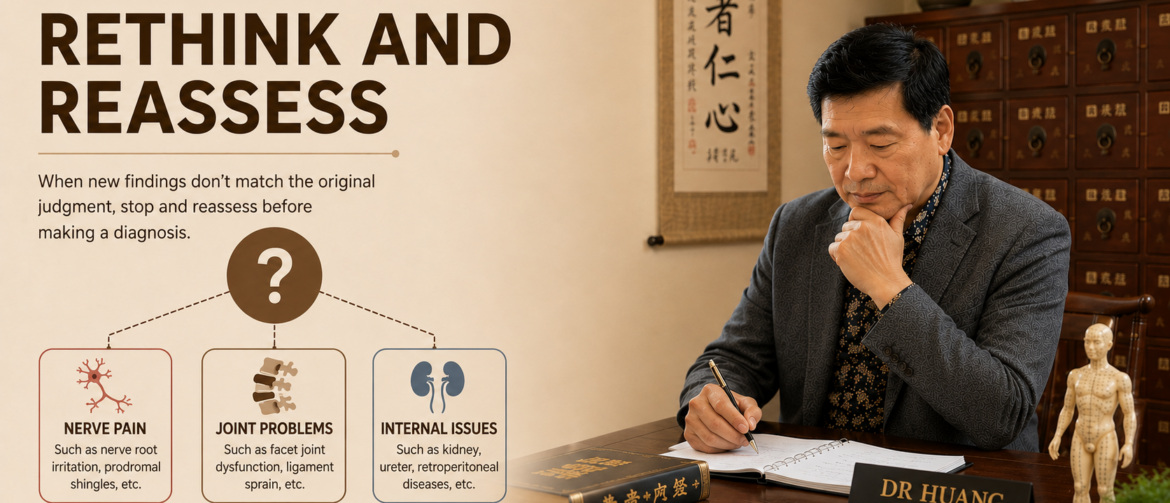
At that point, I deliberately stopped following my original line of thinking and started the diagnostic process again.
Reconsidering the Whole Case
My first alternative consideration was nerve-related pain, including lumbar nerve root irritation or even the prodromal stage of shingles.
Further examination failed to support either possibility.
There was no sensory loss, no hypersensitivity, and no skin changes.
Next, I considered lumbar facet joint dysfunction.
Again, the findings did not fit.
The painful area was broad rather than localized, lumbar extension did not reproduce his symptoms, and palpation over the facet joints failed to provoke the typical pain pattern.
Gradually another possibility became more concerning.
What if the primary problem was not muscular at all?
Could this be related to the kidney or ureter?
I re-examined the costovertebral angle.
Gentle percussion immediately produced excruciating pain.
That single finding completely changed my diagnostic direction.
Psoas Tenderness Does Not Always Mean a Psoas Injury
This case reminded me of an important clinical lesson.
Finding tenderness over the psoas muscle does not necessarily mean the psoas itself is the source of the problem.
The psoas lies within the retroperitoneal space, surrounded by important structures.
Diseases involving the kidney, ureter or surrounding retroperitoneal tissues may also produce lower back pain, groin pain and even marked tenderness over the psoas region.
In other words, the location of tenderness is not always the location of the disease.
One positive examination finding can support several different diagnoses.
The real task is to integrate every piece of information rather than building a diagnosis around a single positive sign.
Why I Chose Not to Continue with Acupuncture
In the end, I advised him to go directly to the Emergency Department.
My recommendation was to begin with a urine examination, followed by imaging if necessary, in order to rule out kidney or ureteral pathology before considering musculoskeletal treatment.
If no significant pathology was found, he could always return for acupuncture later.
I never told him that he definitely had a kidney stone.
Nor did I say that he definitely did not have a psoas injury.
I simply believed that these potentially serious conditions needed to be excluded before proceeding with acupuncture.
Acupuncture can help many patients with low back pain.
But before choosing any treatment, a doctor must first decide whether the patient is actually suitable for that treatment.
Sometimes the most important clinical decision is not what treatment to perform.
It is deciding not to treat until a more serious condition has been excluded.
Dr Huang’s Clinical Reflection
This case reinforced two important lessons for me.
First, although the patient came seeking acupuncture for low back pain, I would rather delay treatment than risk overlooking a condition requiring emergency assessment. If necessary investigations are completed first, acupuncture can always be performed later.
Second, and perhaps more importantly, our first impression is not always correct.
When new examination findings clearly contradict the original diagnosis, we should not force them to fit our initial thinking.
This patient’s severe costovertebral angle tenderness and relatively normal lumbar movement simply did not fit a straightforward psoas muscle injury.
Many diagnostic errors occur not because doctors fail to examine the patient, but because they become reluctant to abandon their first impression after completing the examination.
The finding that made me stop was not the psoas tenderness.
It was the even more severe tenderness over the kidney region.
That contradiction was enough for me to withhold acupuncture.
I have always believed that a mature clinician is not someone who guesses the correct diagnosis at the first attempt.
A mature clinician is someone who has the courage to change direction when new evidence appears.
Because in real clinical practice, we are treating people—not textbooks.
That, to me, is the essence of clinical reasoning.
Postscript
After the consultation, I sent the patient a message hoping to learn the outcome of his investigations, but I never received a reply.
I later tried calling him, but was unable to reach him.
My guess is that he may have returned to Australia, or perhaps we simply lost contact.
As a result, I never learned the final diagnosis.
Some people may see this as an incomplete case.
I see it differently.
I wanted to record this case not because I could prove my diagnostic reasoning was correct, but because it represents the reality of clinical practice.
Medicine is not always about having the final answer.
More often, it is about continuously questioning, reassessing, and adjusting our thinking as new information becomes available.
That is exactly what I hope to share through this series.
Follow Dr Huang to Learn Clinical Diagnosis is not about learning disease names—it is about learning how clinicians think.
Book an Appointment
If you have persistent low back pain, groin pain, or pain that cannot be clearly explained, it is important to have a proper clinical assessment before starting treatment.
At PhD Win Acupuncture Clinic, we focus on identifying the source of pain rather than simply treating the symptoms. When necessary, we will recommend further medical investigations or specialist referral before beginning acupuncture, ensuring that treatment is both appropriate and safe.
If your condition is suitable for acupuncture, we will develop an individualized treatment plan based on a thorough history, physical examination, and clinical reasoning.
Book your appointment here:



 中文微信:nzacupunctureclinic

Leave a reply