
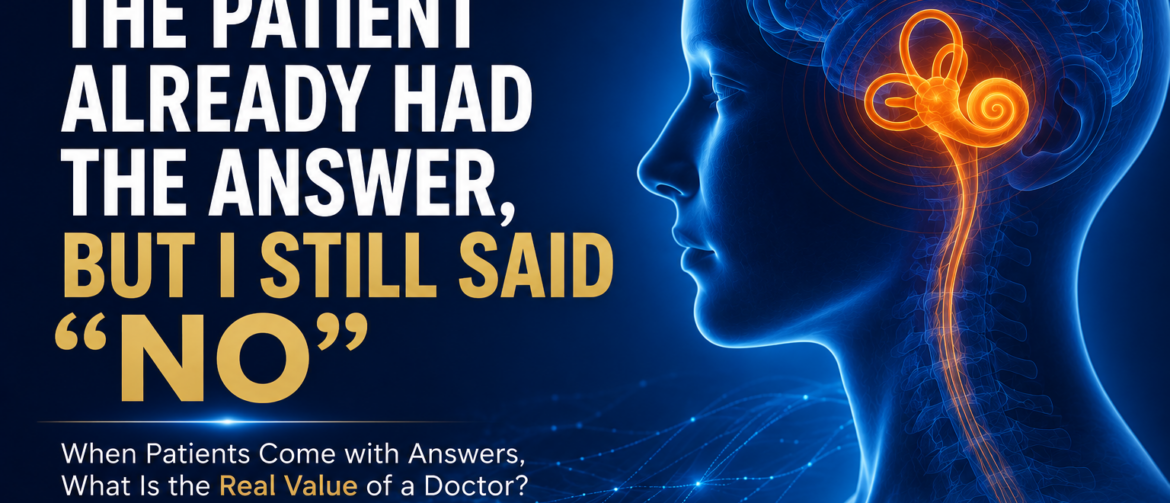
A Patient Who Came Specifically for BPPV Repositioning
A few days ago, a patient with recurrent vertigo booked an appointment with me online.
After making the booking, he added me on WeChat and sent me a message.
His request was very clear:
“Dr Huang, I would like to have a BPPV repositioning procedure.”
I replied:
“Sure, come in and let’s have a look.”
From the very beginning, the purpose of this consultation seemed obvious.
It was not about diagnosis.
It was not about finding the cause.
It was about treatment.
More specifically, it was about performing a canalith repositioning maneuver for BPPV.
In the patient’s mind, the diagnosis had already been made.
What he needed was simply someone to perform the treatment.
The More I Asked, the Less It Sounded Like BPPV
As always, I started with a detailed history.
The patient had been experiencing vertigo for three to four years.
Initially, episodes occurred once or twice a year.
Over time they became more frequent.
Now they occurred once or twice a week, and sometimes even twice in a single day.
What caught my attention was how consistent the attacks were.
Every episode followed almost exactly the same pattern.
The patient told me that before each attack, he experienced a warning sensation.
He found it difficult to describe.
He simply felt that his head became “blocked,” “heavy,” or “not quite right.”
Then he knew:
“It’s coming.”
Within a few minutes, true spinning vertigo would begin, sometimes accompanied by mild nausea.
Several minutes later, the episode would stop on its own.
After that, he returned completely to normal.
As if nothing had happened.
The deeper I went into the history, the more uncertain I became about the diagnosis of BPPV.
Several features simply did not fit.
First, there was no clear positional trigger.
Many classic BPPV patients report vertigo when:
- rolling over in bed
- getting up
- lying down
- looking upward
- bending forward
This patient did not.
Most attacks occurred while walking or driving.
They were not associated with any particular head position.
Second, he had a warning phase.
He could sense that an attack was about to occur.
Typical BPPV usually begins suddenly without any noticeable prodrome.
Third, he had no residual symptoms.
Many BPPV patients continue to feel off-balance, lightheaded, or “as if they had been drinking” for hours after an attack.
This patient did not.
Once the episode ended, he felt completely normal.
I then performed positional testing.
The findings did not support a typical BPPV pattern.
At that point, I became increasingly convinced that this was not BPPV.
Instead, it seemed more consistent with a paroxysmal neurological condition.
Possibly something involving abnormal neural activity rather than a disorder originating in the inner ear.
I advised him to seek further neurological assessment.
Saying “No” Is Harder Than Most People Think
At the end of the consultation, I told him:
“I don’t think this is BPPV.”
That sentence sounds simple.
In reality, it was not.
The patient came specifically for repositioning treatment.
If I had agreed with the diagnosis, the process would have been easy.
Perform the maneuver.
Finish the consultation.
Everyone leaves satisfied.
But my clinical judgment suggested otherwise.
Continuing down the BPPV pathway did not seem appropriate.
Many people assume that saying “No” is easy.
In reality, it is often one of the hardest things a doctor can do.
The First Difficulty: Convincing the Patient
This patient was not uninformed.
In fact, he was highly informed.
He had consulted doctors.
He had spoken with friends.
He had searched Google.
He had watched YouTube videos.
He had even asked AI.
All roads seemed to point toward one conclusion:
“I have BPPV.”
When he arrived, he was not asking:
“Doctor, what do I have?”
He was saying:
“Doctor, I have BPPV. Please treat it.”
When I disagreed, I was not merely challenging a diagnosis.
I was challenging years of accumulated beliefs.
The Second Difficulty: Convincing Yourself
As clinicians in private practice, we also live in the real world.
The patient is sitting in front of you.
The treatment is easy to perform.
The patient expects it.
The clinic benefits from it.
Everything would be simpler if I just followed the existing narrative.
But if I genuinely believe the direction is wrong, continuing treatment no longer makes sense.
Sometimes saying “No” means turning away not only the patient’s expectations, but also your own immediate interests.
The Third Difficulty: What Happens Next?
Once you tell a patient:
“I don’t think this is BPPV.”
The next question is inevitable:
“Then what is it?”
And often, that is where medicine becomes difficult.
Sometimes we can confidently exclude a diagnosis.
But we cannot immediately provide a definitive alternative.
That uncertainty is part of the price of saying “No.”
Why Younger Doctors Often Struggle to Say “No”
Looking back, I probably would not have handled this case the same way thirty years ago.
Not because I lacked courage.
But because I lacked today’s knowledge structure.
Many younger doctors do not struggle to say “No” because they are afraid.
They struggle because they do not yet know what deserves a “No.”
“No” is not an attitude.
“No” is a capability.
It comes from experience.
It comes from knowledge.
It comes from pattern recognition developed over years of clinical practice.
Young clinicians often focus on asking:
“What is this disease?”
Experienced clinicians become increasingly skilled at asking:
“What is this not?”
Those are two very different ways of thinking.
The reason I could say “No” in this case was not because I was braver.
It was because years of experience allowed me to recognize that this presentation simply did not behave like BPPV.
What Are Patients Really Paying For?
This case also made me think about another question:
What exactly are patients paying for?
Earlier in my career, I believed patients were paying primarily for treatment.
Now I am not so sure.
Sometimes what patients truly need is not treatment.
It is direction.
An incorrect treatment remains incorrect no matter how long it is continued.
An incorrect diagnosis remains incorrect no matter how confidently it is repeated.
A correct direction, however, can save years of unnecessary detours.
I did not give this patient a new diagnosis.
I simply explained that continuing down the BPPV pathway might not be the right direction.
Strictly speaking, I did not sell him an answer.
I sold him a better question.
A New Challenge in the AI Era
This case also highlights a larger issue facing modern medicine.
In the past, patients obtained most of their medical information from doctors.
Today, information comes from everywhere:
Google.
YouTube.
Social media.
Short videos.
AI systems.
Health influencers.
Expert interviews.
In many ways, this is a positive development.
Patients are more informed than ever before.
But information is not the same as judgment.
Knowing more does not necessarily mean understanding better.
Sometimes the opposite happens.
The more information people consume, the more confident they become in an incorrect conclusion.
The physician’s role is therefore changing.
In the past, doctors held an advantage because they possessed information.
Today, information is available to everyone.
The future value of doctors may lie less in knowing what is possible and more in recognizing what is unlikely.
Patients can arrive with answers.
Patients can arrive with enormous amounts of information.
But doctors cannot allow themselves to be led by those answers.
A physician’s responsibility is not simply to repeat what the patient already believes.
Sometimes it is to challenge it.
Happy for the Patient — and for Myself
A few days later, the patient contacted me again.
He had consulted a neurologist.
The neurologist’s opinion was largely consistent with my concerns and considered a diagnosis of vestibular paroxysmia rather than BPPV.
I was happy for the patient.
And I was happy for myself.
Because one of the most valuable assets an experienced clinician develops is not the ability to remember disease names.
It is the ability to recognize the right direction.
Many years ago, patients came to doctors looking for answers.
Today, more and more patients arrive already carrying answers.
One of the most important skills of a modern doctor is not providing answers.
It is knowing when to say: “No.”
Related Clinical Reflections
Clinical Reflections (1) Where Does All the Phlegm Come From? Why Did an Elderly Woman’s Morning Phlegm Drop from 80ml to 10ml After One Treatment?
Clinical Reflections (2) Why Are Rotator Cuff Tests So Accurate in Textbooks Yet Increasingly “Inaccurate” in Clinical Practice?
Clinical Reflections (3) The Dizziness Patient Already Had an Answer, But I Still Said No
Clinical Reflections (4) Why I Like My Low Back Pain Patients to Lie Face Down and Move Their Hips
Clinical Reflections (5) – What Is the Responsibility of a Good Doctor?
Book an Appointment
If you are struggling with chronic pain, dizziness, functional limitations, or persistent unexplained symptoms, you are welcome to book an assessment at Dr Huang TCM Clinic.
English Booking:
https://drwin.co.nz/online-booking/
Chinese Booking:



 中文微信:nzacupunctureclinic

Leave a reply