
Dr Huang Clinical Reflection (2) | Why Do Rotator Cuff Tests Seem Accurate in Textbooks but Less Reliable in Real Clinical Practice? | Auckland acupuncture clinic

Why Do Rotator Cuff Tests Seem Accurate in Textbooks but Less Reliable in Real Clinical Practice?
Today I watched a short video about rotator cuff examination.
The video demonstrated many of the classic orthopedic tests taught in textbooks, including the Empty Can Test (Jobe Test), External Rotation Resistance Test, Belly Press Test, and several impingement tests.
The purpose of these tests is straightforward: to identify which muscle or tendon may be involved.
For example:
- Supraspinatus → Empty Can Test
- Infraspinatus / Teres Minor → External Rotation Resistance Test
- Subscapularis → Belly Press Test
The video was excellent and explained the concepts clearly.
However, it also reminded me of a question I have often asked myself in clinical practice:
Why do these tests seem so useful in textbooks, yet often appear much less useful when dealing with chronic shoulder pain patients?
My answer is simple.
These tests are useful.
In fact, they can be extremely useful.
But they work best when the condition is still relatively early and uncomplicated.
When a patient presents within days or weeks of an injury, there is often only a single structure involved. A positive Empty Can Test may genuinely indicate a supraspinatus injury. A positive Belly Press Test may genuinely suggest subscapularis involvement.
In these situations, the diagnostic value of special tests can be remarkably high.
I completely agree with that.
The challenge is that many patients who walk into a clinic are no longer in that early stage.
Some have had symptoms for months.
Others for years.
By then, the condition has often evolved far beyond its original presentation.
Disease Evolves and Diagnosis Becomes More Complex
Following an injury, the body naturally develops protective and compensatory responses.
What may begin as a single tendon injury can gradually involve multiple muscles.
A single irritated tendon may eventually lead to secondary tendon involvement.
Joint structures, bursae, fascia, and movement patterns may all become part of the picture.
The condition becomes increasingly complex.
At this stage, special tests often lose some of their original specificity.
The Empty Can Test hurts.
External Rotation hurts.
The Belly Press hurts.
Impingement tests hurt.
Eventually, almost everything becomes positive.
And when every test is positive, the diagnostic picture becomes less clear.
Is it the supraspinatus?
The infraspinatus?
The subscapularis?
Or all of them?
Even I have questioned these tests at times because they seem to produce positive findings everywhere.
Eventually I realized the problem was not the test.
The problem was the stage of the disease.
Textbooks often describe conditions at their earliest and simplest stage.
Clinical practice often deals with conditions after months or years of progression.
These are fundamentally different situations.
An Example Showing Why Special Tests Still Matter
Despite what I have just described, I do not believe special tests are useless.
Far from it.
Sometimes a simple test can reveal the real problem.
A good example is subscapularis injury.
The subscapularis lies on the anterior surface of the scapula and is often overlooked.
I have seen patients whose shoulder pain persisted despite treatment directed toward the supraspinatus, infraspinatus, and deltoid.
The major symptoms improved.
Yet the shoulder pain remained.
In these situations, performing a Lift-Off Test sometimes immediately changes the picture.
Suddenly the patient reproduces the familiar pain.
The diagnosis becomes clearer.
Because the subscapularis is deep and anatomically hidden, it can easily be missed.
In such cases, special tests are extremely valuable.
Targeting the subscapularis often produces significant improvement.
This is why I still believe these tests have an important place in clinical practice.
Particularly in early or relatively uncomplicated cases.
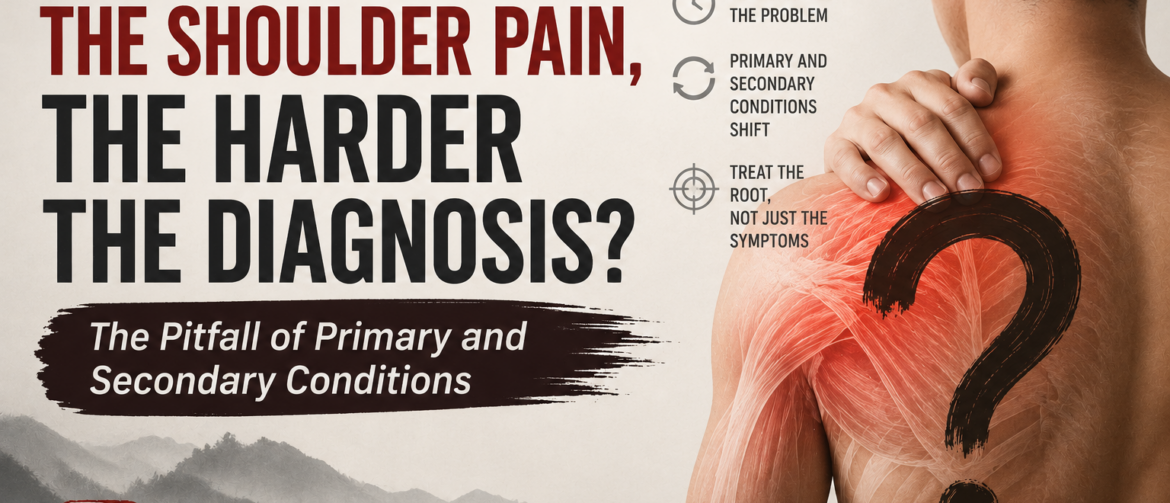
Primary Conditions and Secondary Conditions
There is another situation that I find even more interesting.
Sometimes the shoulder is not the original source of the problem at all.
The primary issue may involve:
- Cervical nerve root irritation
- Brachial plexus irritation
- Thoracic outlet syndrome
- Peripheral nerve entrapment
These upstream neural problems can initially present as shoulder pain.
Over time, however, pain leads to protective muscle guarding.
Muscle guarding leads to compensation.
Compensation alters movement patterns.
Eventually the rotator cuff becomes involved.
Tendons become irritated.
Bursae become inflamed.
The shoulder gradually develops its own local pathology.
When the patient is finally examined, the presentation resembles a classic rotator cuff disorder.
Yet the original problem may have been elsewhere.
Distinguishing the primary condition from secondary changes becomes increasingly difficult.
A Patient Who Changed My Thinking
One shoulder pain patient left a lasting impression on me.
At his first visit, he presented primarily with shoulder and upper back pain.
Based on the examination, I suspected brachial plexus irritation caused by scalene muscle tension.
The shoulder pain appeared to be a consequence rather than the root cause.
I treated the scalenes.
The symptoms improved significantly.
The pain disappeared.
The patient stopped attending treatment.
Had the story ended there, I would likely have concluded that this was a straightforward scalene syndrome case.
Several months later, however, the patient returned.
This time the symptoms were much worse.
He reported shoulder pain, upper back pain, numbness extending into the anterior arm, daytime pain, and night pain.
During re-examination, the clinical picture had changed.
Spurling’s Test became clearly positive.
Neck movement reproduced arm symptoms.
At that moment, my diagnostic thinking shifted.
I began to suspect that the cervical spine itself might be the more important problem.
Further CT or MRI investigation was recommended.
Looking back, the original treatment was not wrong.
The scalenes were genuinely involved.
They were part of the patient’s symptom pattern.
But they may not have been the primary driver.
The more upstream problem may have been present all along.
It simply had not fully revealed itself during the first consultation.
This case taught me that the first diagnosis does not always reveal the whole story.
Sometimes it only reveals the outermost layer of the disease.
Why I Increasingly Value Palpation
In chronic cases, I often find palpation more useful than special tests.
Special tests may all become positive.
Tenderness patterns, however, often differ.
Some points are mildly tender.
Others reproduce familiar symptoms immediately.
Some trigger radiating pain.
Some recreate the patient’s exact complaint.
These findings often provide more meaningful clinical information.
For this reason, I have come to value palpation and tenderness assessment more and more in chronic pain cases.
Of course, severe sensitization can eventually affect palpation as well.
Some patients become tender almost everywhere.
Even then, understanding the stage of the condition remains essential.
Disease stages matter.
Diagnostic tools also have stages.
The same test may have very different meaning at different points in the disease process.
Treatment Can Also Be Part of Diagnosis
One observation has become increasingly important in my practice.
Treatment itself can help reveal the diagnosis.
When many chronic shoulder pain patients first arrive, everything hurts.
The front hurts.
The back hurts.
The top hurts.
The side hurts.
Every movement hurts.
Every palpation point hurts.
It is difficult to identify the true origin.
As treatment progresses, however, something interesting happens.
Secondary pain begins to disappear.
Compensatory pain begins to disappear.
Protective pain begins to disappear.
A large painful area gradually becomes a smaller one.
Eventually only a single focal area remains.
That remaining area often represents the primary problem.
In this way, treatment is not only therapeutic.
It can also become diagnostic.
By removing secondary layers, treatment gradually exposes the underlying source.
Clinical Reflection
When I was younger, I hoped that a single special test would provide the answer to every shoulder pain case.
Over time, I learned that chronic pain rarely works that way.
Diseases are not static.
They evolve.
They spread.
They compensate.
They hide.
And eventually they reveal themselves.
For chronic pain patients, examination, treatment, recovery, and even recurrence all contribute to diagnosis.
The progression of disease is part of diagnosis.
The recovery of disease is also part of diagnosis.
Sometimes a recurrence reveals truths that were invisible during the first consultation.
This is why I have gradually come to believe that diagnosis should never rely solely on a single special test.
Many conditions change as they evolve.
And sometimes the most accurate diagnosis does not emerge during the first examination.
It emerges gradually as the disease progresses, responds to treatment, and reveals its deeper layers.
Related Clinical Reflections
Clinical Reflections (1) Where Does All the Phlegm Come From? Why Did an Elderly Woman’s Morning Phlegm Drop from 80ml to 10ml After One Treatment?
Clinical Reflections (2) Why Are Rotator Cuff Tests So Accurate in Textbooks Yet Increasingly “Inaccurate” in Clinical Practice?
Clinical Reflections (3) The Dizziness Patient Already Had an Answer, But I Still Said No
Clinical Reflections (4) Why I Like My Low Back Pain Patients to Lie Face Down and Move Their Hips
Clinical Reflections (5) – What Is the Responsibility of a Good Doctor?
Book an Appointment
If you are struggling with chronic pain, dizziness, functional limitations, or persistent unexplained symptoms, you are welcome to book an assessment at Dr Huang TCM Clinic.
English Booking:
https://drwin.co.nz/online-booking/
Chinese Booking:



 中文微信:nzacupunctureclinic

Leave a reply