
One of the common conditions I see in clinic is tennis elbow.
Despite its name, many people who develop tennis elbow have never played tennis.
Office workers, computer users, tradespeople, gardeners, and people who spend long hours using a mouse or mobile phone may all experience this type of elbow pain.
Many patients tell me the same story.
The pain improves for a while.
Then it comes back.
Sometimes it becomes a problem that lasts for months or even years.
This naturally raises an important question:
Why does tennis elbow keep coming back?
Looking Through a Traditional Chinese Medicine Perspective
From a Traditional Chinese Medicine perspective, tennis elbow is not simply a problem of the tendon.
The location of pain often corresponds closely to the Yang Ming meridian pathway.
The Large Intestine channel travels from the hand, through the forearm and elbow, then continues toward the shoulder, neck, and face.
When the flow of Qi and Blood within the channel becomes disrupted, pain and tenderness may develop around the outer side of the elbow.
This is one reason why treatment may focus not only on the painful area itself but also on the meridian pathway.
Qi Stagnation, Blood Stasis, and Cold-Damp Obstruction
In Traditional Chinese Medicine, one of the most common patterns seen in chronic tennis elbow is Qi stagnation and Blood stasis.
When circulation becomes impaired, pain may persist.
A classical saying in Chinese Medicine states:
“Where there is blockage, there is pain.”
In some patients, cold and dampness may also contribute to symptoms.
Pain may feel worse during cold weather.
The elbow may feel stiff in the morning.
Recovery may become slow and frustrating.
When Qi, Blood, and the meridian pathways are not moving freely, symptoms may continue to return.
Modern Lifestyle and Repetitive Strain
Many cases of tennis elbow today are related to modern lifestyles.
Long hours using a computer mouse.
Frequent typing.
Repeated scrolling on mobile phones.
Repetitive gripping and lifting.
Over time, these activities place ongoing stress on the muscles and tendons of the forearm.
From a Traditional Chinese Medicine perspective, prolonged strain may gradually lead to stagnation of Qi and Blood within the channel.
This is one reason why symptoms often become chronic.
Treatment Along the Meridian Pathway
One feature of Traditional Chinese Medicine is that treatment does not always focus only on the painful area.
In addition to local treatment around the elbow, acupuncture points along the Yang Ming meridian may be selected.
Distal points on the hand or forearm are often combined with local points.
Patients are frequently encouraged to gently move the elbow and wrist following treatment.
The goal is to help restore smooth movement within the channel and support recovery.
Bloodletting, Cupping, and Ginger Moxibustion
For some patients, I may combine acupuncture with bloodletting and cupping therapy.
From a Traditional Chinese Medicine perspective, bloodletting and cupping are used to invigorate Blood, reduce stagnation, and improve local circulation.
When Blood stasis is reduced, pain may become easier to relieve.
For patients with signs of cold and dampness, ginger moxibustion may also be used.
The warmth of moxibustion helps warm the channels, disperse cold, remove dampness, and support the body’s natural healing process.
These traditional techniques have been used for generations and continue to play an important role in modern clinical practice.
Clinical Reflection
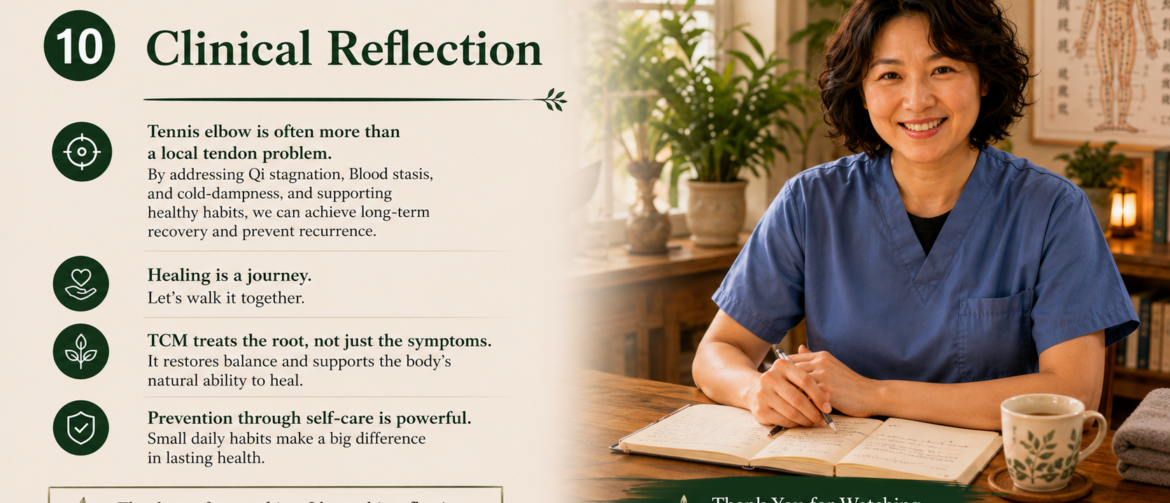
One lesson I continue to learn is that tennis elbow is often more than a local elbow problem.
The condition may involve meridian imbalance, Qi stagnation, Blood stasis, cold and dampness, repetitive strain, and lifestyle factors.
For this reason, successful treatment often requires a broader perspective.
Acupuncture, meridian-based treatment, bloodletting, cupping, moxibustion, and appropriate lifestyle changes may all contribute to recovery.
The goal is not simply to reduce pain.
The goal is to restore circulation, improve function, and support the body’s natural ability to heal.
Thank you for joining me in this Clinical Reflection.
I look forward to sharing more observations from clinical practice in future articles.
— Teresa Shen
PhD Win Acupuncture Clinic
Watch the Video
Book an Appointment
Book Online:
https://drwin.co.nz/online-booking/
About Teresa Clinical Reflection
Teresa Clinical Reflection is a series of short articles exploring common health conditions from a Traditional Chinese Medicine perspective. These reflections examine meridian balance, lifestyle factors, recovery, and the body’s natural healing processes, helping patients better understand their health and long-term wellbeing.



 中文微信:nzacupunctureclinic

Leave a reply