

Shoulder pain is one of the most common conditions I see in clinic.
Many people tell me a similar story. They have tried massage, stretching, physiotherapy, exercise, or pain medication. Sometimes the shoulder feels better for a while, but a few weeks later the pain returns. For some people, the discomfort gradually becomes a recurring problem that affects work, sleep, driving, dressing, and daily activities.
This naturally raises an important question:
Why does shoulder pain keep coming back?
Looking Beyond the Pain
From a Traditional Chinese Medicine perspective, shoulder pain is not always caused by a single factor.
Different people may have different underlying patterns. Some may have Qi stagnation. Others may have Blood stasis. Some may be affected by cold and dampness. Long hours of desk work, poor posture, stress, inadequate sleep, repetitive movements, and age-related changes may all contribute to recurring symptoms.
If these contributing factors remain unchanged, pain may continue to return even after temporary relief.
For this reason, treatment is not simply about reducing pain. It is also about understanding why the pain developed and what may be preventing recovery.
Meridian Differentiation and Shoulder Pain
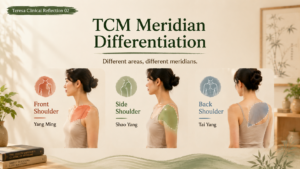
One of the unique features of Traditional Chinese Medicine is meridian differentiation.
The location of pain often provides important clues about which meridian pathway may be involved.
Pain at the front of the shoulder is commonly associated with the Yang Ming channel.
Pain along the side of the shoulder often relates to the Shao Yang channel.
Pain at the back of the shoulder may involve the Tai Yang channel.
This understanding helps guide treatment selection and point prescription.
Rather than treating every shoulder pain case in exactly the same way, treatment may vary according to the location and pattern of symptoms.
Why We Do Not Always Needle the Shoulder
Many patients are surprised when acupuncture points are selected away from the painful area.
In Traditional Chinese Medicine, points along the meridian pathway may be used to influence the entire channel.
For example, points on the hand, forearm, or lower leg may be selected depending on the meridian involved.
After needling, patients are often encouraged to gently move the shoulder.
Combining acupuncture with movement can sometimes help restore function more effectively and encourage a smoother recovery process.
Qi Stagnation and Blood Stasis
A classical Traditional Chinese Medicine principle states:
“Where there is blockage, there is pain.”
One of the most common explanations for chronic shoulder pain is Qi stagnation and Blood stasis.
When circulation becomes impaired, stiffness, discomfort, reduced movement, and persistent pain may develop.
Treatment aims to promote the smooth flow of Qi and Blood, reduce stagnation, and restore normal function.
Bloodletting and Cupping Therapy
In some situations, I may combine acupuncture with bloodletting and cupping therapy.
From a Traditional Chinese Medicine perspective, this approach is often used to invigorate Blood and remove Blood stasis.
The goal is to improve local circulation, reduce stagnation, and support the body’s natural healing process.
Many patients are familiar with cupping, but fewer have experienced bloodletting therapy. When used appropriately, this traditional technique can be a useful part of treatment for certain patterns of pain and stagnation.
A Clinical Example
Recently, I treated a forty-six-year-old woman who had suffered from shoulder pain for more than a year.
She had previously been told that her shoulder would gradually improve over time. However, instead of improving, the pain became progressively worse.
Putting on clothes became difficult.
Driving became uncomfortable.
Her sleep was frequently disturbed by shoulder pain.
After treatment using acupuncture, local bloodletting, and cupping therapy, her shoulder pain reduced significantly and shoulder movement became noticeably easier.
Cases like this remind me that recovery is not always about waiting. Sometimes a different treatment approach may be needed.
Why Is It Called Frozen Shoulder?
Frozen shoulder is sometimes referred to as “Fifty Shoulder” in Chinese-speaking communities.
This reflects a long-standing observation that shoulder problems often become more common around middle age.
Women, particularly during and after menopause, may notice greater stiffness, slower recovery, and increased susceptibility to shoulder problems.
Traditional Chinese Medicine recognises that age-related changes may influence circulation, tissue recovery, and overall resilience.
Modern Lifestyle Factors
Modern lifestyles place significant demands on the shoulders.
Long hours at a computer.
Frequent use of mobile phones.
Poor posture.
Stress.
Insufficient exercise.
These factors may all contribute to recurring shoulder pain.
For this reason, treatment alone is often not enough. Long-term recovery also requires healthy daily habits, regular movement, and appropriate self-care.
Clinical Reflection
One lesson I continue to learn through clinical practice is that shoulder pain is rarely caused by a single factor.
From a Traditional Chinese Medicine perspective, recurring shoulder pain may involve Qi stagnation, Blood stasis, cold and dampness, ageing, lifestyle factors, or a combination of several influences.
This is why treatment may include acupuncture, distal point selection, movement therapy, cupping, or bloodletting.
The goal is not simply to reduce pain.
The goal is to restore circulation, improve function, and support the body’s natural ability to heal.
Thank you for joining me in this Clinical Reflection.
I look forward to sharing more clinical observations and reflections in future articles.
— Teresa Shen
PhD Win Acupuncture Clinic
Watch the Video
Related Issues
Teresa Clinical Reflection 01 | Why Does Neck Pain Keep Coming Back? | acupuncture clinic auckland
Book an Appointment
Book Online:
About Teresa Clinical Reflection
Teresa Clinical Reflection is a series of short articles exploring common health conditions from a Traditional Chinese Medicine perspective.
Rather than focusing solely on diagnosis and treatment, these reflections examine the broader factors that influence recovery, including meridian balance, lifestyle habits, emotional wellbeing, and the body’s natural healing processes.
The goal is to help patients better understand their condition, support long-term recovery, and develop a deeper appreciation of Traditional Chinese Medicine in modern clinical practice.



 中文微信:nzacupunctureclinic

Leave a reply