
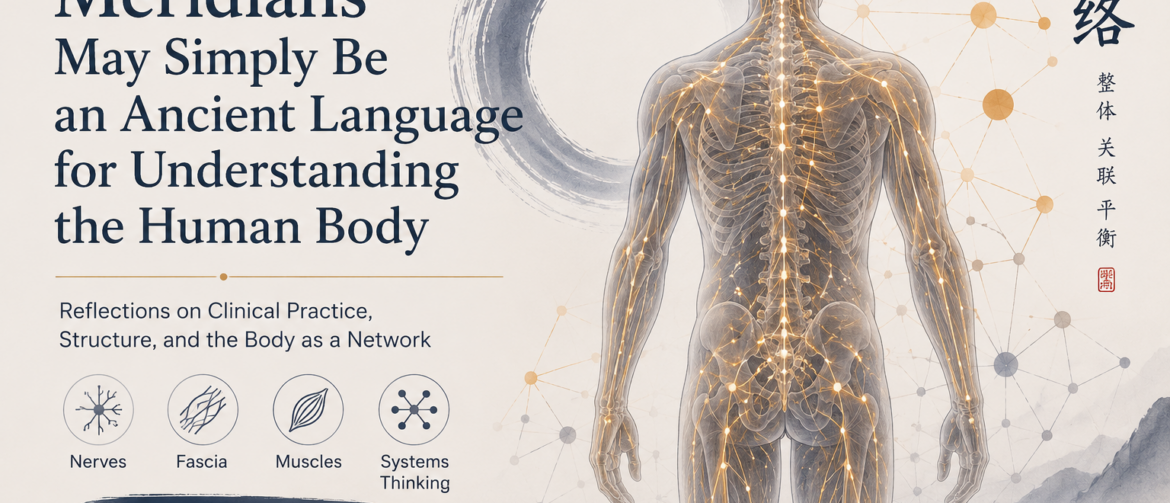
Meridians May Simply Be an Ancient Language for Understanding the Human Body
— Reflections on Clinical Practice, Structure, and the Human Body as a Network
Over the years in clinical practice, I have gradually developed a strong feeling:
The human body is not a collection of isolated parts.
Treating a person is very different from repairing a machine.
Many patients experience pain in one area, but the real problem may originate somewhere else.
One patient came to me with numbness and pain along the outer lower leg and the top of the foot. After examination, I realized it was not simply a local foot problem, but irritation of the superficial peroneal nerve.
However, looking deeper, I found that the muscles in the anterolateral lower leg had been chronically tight, creating compression around the nerve. And this tension itself was related to pelvic imbalance and long-term compensation from leg length asymmetry.
Eventually, you begin to realize:
A local symptom is often only the “expression point” of a larger imbalance within the body.
I have also seen many patients with deep buttock pain. Most people immediately assume it is a lumbar disc problem.
But clinically, I often find the real issue is not always in the lumbar spine itself, but within the deep gluteal space. In some patients, the tension is around the piriformis muscle; in others, it involves the quadratus femoris space, restricted neural mobility, or chronic pelvic tension patterns placing the sciatic nerve under prolonged mechanical stress.
If we only focus on the painful area itself, these conditions can be difficult to truly understand.
The longer I practice, the more I understand why ancient physicians developed ideas such as “meridians” and “Qi and Blood.”
Traditional Chinese medicine recognized that different regions of the body are interconnected. Concepts such as Qi, Blood, meridians, and systemic imbalance were early attempts to describe these relationships.
However, from a structural perspective, we can also see the limitations of traditional holistic thinking.
Ancient physicians did not have MRI, modern anatomy, neurophysiology, or advanced imaging technologies. Without detailed structural knowledge, holistic theory sometimes became too abstract and difficult to apply precisely at the local level.
Modern medicine developed in the opposite direction.
Today, modern medicine has become extremely advanced in studying local structures, imaging, pathology, nerves, muscles, and tissues. Yet at times, it can also fragment the body into too many isolated parts, losing sight of the body as an interconnected system.
For example, I once treated a patient with chronic knee pain. Ultrasound suggested bursitis, so treatment had focused mainly on the knee itself.
But during examination, I noticed an area of reduced sensation along the upper outer calf. Tapping near the lateral popliteal groove reproduced radiating pain down the lateral lower leg.
Eventually, it became clear that the problem was not simply within the knee joint, but irritation of the lateral sural cutaneous nerve near the lateral popliteal groove.
Yet even stopping at “nerve entrapment” was still incomplete.
Further assessment revealed long-term gait imbalance, lower limb tension patterns, and abnormal pelvic loading mechanics.
In other words:
Even a local nerve irritation may reflect a much larger tension and movement system problem.
This has gradually led me to think:
Without structure, holistic medicine becomes vague.
Without holistic thinking, structural medicine becomes fragmented.
How to combine these two perspectives properly may become one of the most important directions for future medicine.
Traditional Chinese medicine and modern medicine are not simply “right” or “wrong.” They are two different languages used to describe the human body.
Ancient physicians had no MRI, neuroscience, or modern anatomy. Through long-term observation of pain, sensation, breathing, emotion, sleep, digestion, and physical responses, they slowly recognized that the human body contains extensive cross-regional connections.
As a result, they created concepts such as Qi, Blood, and meridians to describe these phenomena.
Today, I increasingly feel that meridians may not necessarily be a single physical structure.
Instead, they may represent an ancient symbolic language created to describe the functional relationships within the human body.
Within this language may be elements of:
nerves, blood vessels, fascia, muscles, body fluids, autonomic nervous system regulation, tension transmission, and even interactions between the mind and the body.
Ancient physicians may not have fully understood the biological mechanisms behind these observations, but they clearly recognized that the body functions as an interconnected network.
That, perhaps, is one of the greatest insights of traditional Chinese medicine.
Of course, this does not mean we should remain limited to ancient language systems.
Modern structural medicine, neuroscience, fascia research, and pain science remain extremely important.
Perhaps truly mature medicine is neither purely “local” nor purely “holistic.”
It is an integrated medicine that understands local structures within the context of the body’s larger network.
Booking CTA
If you are experiencing ongoing unexplained nerve-related symptoms, you can book an appointment here:



 中文微信:nzacupunctureclinic

Leave a reply