
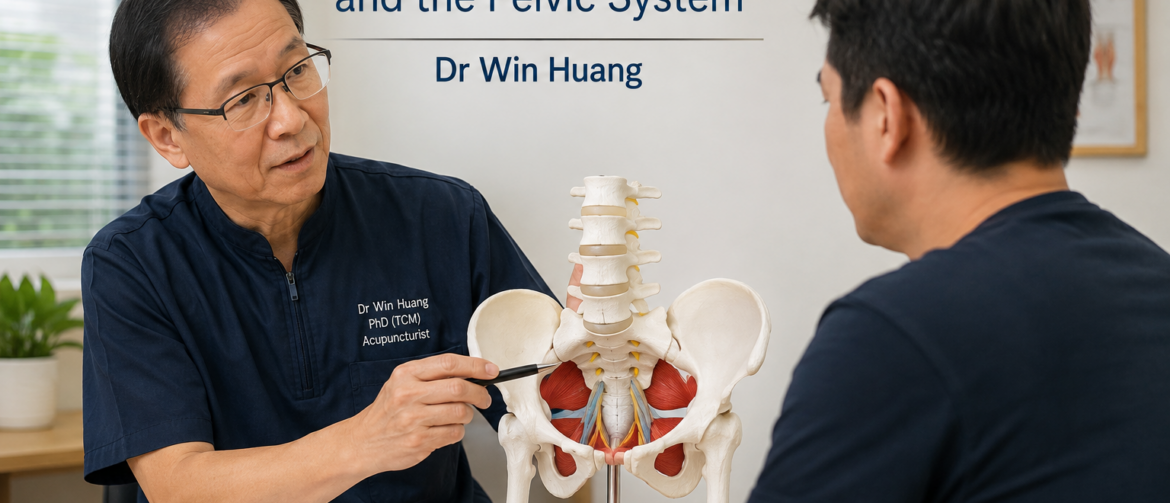
Dr Huang’s Clinical Reflections (10)
The Same Urinary Frequency, Different Treatments: Why Can They All Help?
By Dr Win Huang, PhD (Chinese Medicine & Acupuncture)
Recently, I attended a lecture on pelvic biomechanics and sacroiliac joint dysfunction.
The lecturer discussed how dysfunction around the sacroiliac joint may sometimes be associated not only with low back or buttock pain, but also with changes in deep pelvic muscles, pelvic floor function and, in some patients, urinary frequency or pelvic discomfort.
His approach was to assess local sacroiliac tenderness, pelvic asymmetry, apparent leg-length differences and other clinical findings. If sacroiliac dysfunction appeared relevant, manual correction of the pelvis and sacroiliac region could sometimes improve both musculoskeletal symptoms and urinary complaints.
This made me think about a question I often encounter in clinical practice:
Why can osteopathic or manual therapy, acupuncture, Chinese herbal medicine and pelvic floor rehabilitation all sometimes help the same symptom—urinary frequency?
The theories are different. The treatment targets are different. The methods are completely different.
Yet the patient may improve.
How should we understand this?
Urinary Frequency Is Not Always Only a Bladder Problem
When a patient presents with urinary frequency, the first step is to consider recognised medical causes.
Urinary tract infection, cystitis, prostate disease, urinary stones, diabetes and other systemic or urological conditions may all produce frequency and should be investigated where appropriate.
But some patients have repeated urinary symptoms without a clear structural or infective explanation.
They may report frequent urgency, lower abdominal discomfort, perineal pressure, a persistent sensation of needing to urinate after voiding, or worsening symptoms after prolonged sitting.
In these situations, focusing only on the bladder may not fully explain the problem.
The bladder does not function in isolation.
It sits within the pelvis and is surrounded by muscles, fascia, ligaments, blood vessels and nerves. Bladder storage and emptying are also influenced by the autonomic nervous system, pelvic floor coordination and central nervous system control.
This means that even if the bladder itself is structurally normal, persistent tension, mechanical strain or neural sensitivity in surrounding tissues may potentially alter how bladder sensations are experienced.
Direct Irritation and Indirect Irritation
I find it useful to think of bladder-related symptoms in two broad categories.
The first is direct irritation.
This includes infection, inflammation, stones or other local pathology directly affecting the bladder, urethra or nearby tissues.
In these cases, the primary disease should be treated first.
The second is indirect irritation.
Here, the bladder itself may not be the main site of disease, but abnormal function in surrounding structures may influence the patient’s symptoms.
Possible contributors may include:
- sacroiliac joint dysfunction;
- persistent pelvic asymmetry;
- pelvic floor overactivity;
- increased tension in deep hip muscles;
- lumbosacral muscular and fascial tension;
- local nerve sensitivity;
- autonomic changes associated with chronic pain.
These factors may not damage the bladder directly. Instead, they may influence the system through altered muscle tension, mechanical loading, neural reflexes or sensitisation.
If the Sacroiliac Joint Is Upstream, What May Happen Next?
If a patient genuinely has significant sacroiliac dysfunction, the problem may not remain confined to the joint.
The surrounding muscles, fascia and ligaments may compensate.
A change in pelvic loading on one side may alter the way the gluteal muscles, deep hip muscles, lumbosacral muscles and pelvic floor share tension.
A possible clinical sequence might be:
sacroiliac dysfunction → altered pelvic mechanics → muscular and fascial compensation → pelvic floor overactivity or poor coordination → increased neural or visceral sensitivity → urinary frequency or pelvic discomfort
This pathway certainly does not explain every case of urinary frequency, and urinary frequency alone should never be used to diagnose sacroiliac dysfunction.
However, when urinary symptoms coexist with lumbosacral pain, sacroiliac tenderness, pelvic asymmetry, buttock tension or pelvic floor discomfort, this relationship may be worth considering.
Why Might Acupuncture Help?
From an acupuncture perspective, I may not directly reposition a sacroiliac joint, but reducing tension in deep pelvic muscles, the lumbosacral region and related soft tissues may still reduce indirect irritation within the pelvic system.
One possible chain is:
deep pelvic muscle tension → local neural sensitivity → increased bladder sensation → urinary frequency
If acupuncture reduces muscular tension and neural sensitivity, the patient’s perception of urgency may decrease.
But the next question is important:
Why were those muscles tight in the first place?
If muscle tension is only compensating for an underlying mechanical problem, relaxing the muscle may improve symptoms without fully correcting the upstream cause.
This may explain why some patients improve quickly but relapse.
Why Might Chinese Medicine Also Help?
In Chinese medicine, urinary frequency may be understood through different pattern diagnoses.
Some patients may show signs traditionally associated with Kidney qi deficiency and poor containment. Others may present with damp-heat patterns, or disturbances involving qi regulation in the lower burner.
Herbal treatment may therefore focus on strengthening, clearing, regulating or restoring overall functional balance.
This approach may not directly alter sacroiliac mechanics, but it may still influence other parts of the patient’s condition—such as inflammatory tendency, sleep, energy, internal organ function or autonomic regulation.
For some patients, those factors may be clinically important.
Why Might Pelvic Floor Rehabilitation Help?
A physiotherapist may focus on pelvic floor strength, coordination and relaxation.
Importantly, pelvic floor dysfunction does not always mean weakness.
Some patients have excessive tension and cannot relax the muscles appropriately. Others have poor timing between contraction and relaxation.
Breathing work, relaxation, neuromuscular retraining and graded rehabilitation may therefore improve the coordination between the pelvic floor and bladder.
Again, this may address another part of the same clinical network.
Different Treatments May Act at Different Points in the Same Chain
This is the key lesson for me.
If several different treatments can improve the same symptom, it does not mean the theories are identical.
It may simply mean that each treatment is changing a different part of the pathological process.
Manual therapy may address joint mechanics.
Acupuncture may reduce muscular and neural sensitivity.
Chinese medicine may influence the patient’s broader functional state.
Pelvic floor rehabilitation may improve muscular control and coordination.
All of these may help.
But treatment effectiveness is not the same as proving the original cause.
Primary and Secondary Problems Must Be Distinguished
This is where clinical reasoning becomes important.
We should not only ask:
“Did this treatment work?”
We should also ask:
“What did it actually change?”
Was it treating the primary cause, or a secondary adaptation?
If the sacroiliac joint and pelvic mechanics are the upstream problem, relaxing muscles may be useful but incomplete.
If the true problem is urinary infection, prostate disease, diabetes or another medical condition, explaining everything through pelvic mechanics would also be incorrect.
The task is to work out the sequence.
What started the problem?
What is maintaining it?
What has become secondary?
My Clinical Reflection
This lecture reinforced something I have increasingly recognised over many years of clinical work:
Many symptoms are not created by one isolated structure.
Urinary frequency may appear to be a bladder symptom, but the wider clinical picture may involve the pelvic floor, fascia, nerves, pelvic biomechanics, the autonomic nervous system and the patient’s general functional state.
Different treatments may help because they enter the same disease process at different points.
But symptom relief should not stop the clinician from asking a deeper question:
Have we treated the most important link in the chain?
For me, a useful way to think about many chronic conditions is this:
a primary factor starts the problem, secondary factors maintain it, and different treatments may act on different parts of the chain.
Comprehensive treatment is therefore not about using more methods.
It is about understanding what each method is changing, and whether a more important upstream problem still remains.
Book a Clinical Assessment
If urinary frequency occurs together with pelvic, lower back or buttock symptoms, a clinical assessment may help determine whether musculoskeletal or pelvic factors are relevant.
Book online:
https://booking.mananotes.co.nz/PHD-WIN/v2
Disclaimer
Disclaimer:
Urinary frequency may have many causes, including urinary tract infection, prostate disease, diabetes, neurological conditions and other medical problems. This article is for general educational purposes only and does not replace medical assessment or diagnosis. Persistent, worsening or unexplained urinary symptoms should be appropriately investigated.
Related Reading
Dr Win’s Clinical Thinking (11) A Doctor Sees More Than a Diagnosis — They See Clues



 中文微信:nzacupunctureclinic

Leave a reply