
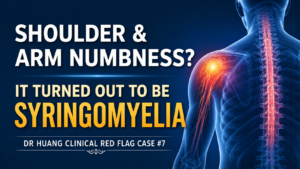
A few days ago, a middle-aged Indian gentleman came to my clinic specifically to see me.
As soon as he walked in, he shook my hand and said:
“Dr Huang, I came here especially to thank you.”
After that, he insisted on having acupuncture and cupping treatment. What surprised me even more was that he insisted on paying extra for the visit.
In all my years practising in New Zealand, this is not something I see very often. When a patient comes back years later simply to say thank you, it usually means the experience left a deep impression on them.
During our conversation, he brought up an event that had happened several years earlier.
He said:
“If you hadn’t told me to get an MRI, I still might not know what disease I actually had.”
That immediately reminded me of this case.
The interesting thing is that this was not a case that was successfully treated by acupuncture.
In fact, it taught me something much more important.
Sometimes the greatest help we can give a patient is not treatment itself. Sometimes it is recognising that the problem may be something more serious, making a reasonable preliminary diagnosis, and directing the patient toward the right investigation and the right specialist.
He Did Not Come Because of a Spinal Cord Disease
Several years ago, this patient came to see me because of numbness, heaviness and cold sensations affecting his left upper limb.
Before arriving at my clinic, he had already undergone numerous treatments. He had tried physiotherapy, acupuncture, massage therapy and chiropractic treatment. Most practitioners had treated the condition as shoulder impingement, frozen shoulder, muscular strain or nerve entrapment.
To be fair, that was not an unreasonable assumption.
Shoulder pain and arm numbness are among the most common complaints seen in clinical practice. Most practitioners naturally think of cervical radiculopathy, frozen shoulder or peripheral nerve compression.
But this case eventually proved something important.
Sometimes the most dangerous diseases look surprisingly ordinary.
A Burn Mark Changed My Thinking
During the first consultation, I noticed a significant burn mark on his back.
I casually asked:
“What happened here?”
He explained that he had been burned during heat therapy treatment.
Then he said something that immediately caught my attention.
“I didn’t feel the heat.”
That sentence may sound ordinary, but from a neurological perspective it is anything but ordinary.
A normal person does not usually sustain a significant burn without noticing excessive heat.
If somebody can be burned and remain unaware of it, the problem may no longer be muscular. It may involve the sensory system.
At that moment I started asking myself a different question.
If the sensory system is involved, is this really just another shoulder pain case?
What I Found During Examination
I proceeded with a more detailed neurological examination.
During sensory testing, I found clear abnormalities across the thoracic region.
Further assessment revealed reduced pinprick sensation and reduced temperature sensation. However, light touch sensation was relatively preserved.
In simple terms, the patient did not feel needles normally. He did not recognise hot and cold normally. Yet he could still feel a cotton swab lightly touching the skin.
As soon as I saw this pattern, one neurological concept immediately came to mind:
Dissociated Sensory Loss.
For many practitioners, this may simply appear as “abnormal sensation.”
For neurological localisation, however, it is a very important clue.
Why Dissociated Sensory Loss Made Me Think of Syringomyelia
Over the years I have learned that neurological diagnosis is not about memorising diseases.
It is about understanding pathways.
Pain and temperature fibres cross near the centre of the spinal cord, while light touch pathways travel differently through the posterior columns.
When a lesion develops within the central spinal cord, pain and temperature sensation are often affected first, while light touch sensation may remain relatively intact.
As a result, patients may experience unusual situations.
They may not notice burns.
They may feel reduced pain from needle stimulation.
They may have difficulty recognising temperature changes.
Yet they can still feel someone lightly touching their skin.
This classic pattern is known as dissociated sensory loss.
One of the most well-known causes is Syringomyelia.
When I put all the pieces together—chronic shoulder pain, upper limb numbness, abnormal temperature sensation, reduced pain sensation, inability to detect heat injury and failure to respond to prolonged treatment—my thinking moved beyond shoulder pathology or nerve entrapment.
I began to consider a central spinal cord lesion.
Why I Did Not Rush Into Treatment
Many patients come to an acupuncture clinic expecting immediate treatment.
In this case, however, I felt that diagnostic direction was more important than treatment.
I told him directly:
“This does not look like a typical shoulder condition.”
“I think you should arrange an MRI.”
“If the MRI is normal, you can always come back and we can continue treatment.”
To be honest, I did not know whether the MRI would confirm my suspicion.
I simply knew that the presentation no longer followed the usual musculoskeletal pattern.
When a case stops behaving like a common condition, further investigation often becomes more important than treatment.
MRI Confirmed the Suspicion
The patient later saw a neurological specialist and underwent MRI scanning.
Soon afterwards, he contacted me.
The MRI confirmed:
Syringomyelia.
The lesion was located in the cervicothoracic spinal cord, which corresponded closely with the sensory findings observed during examination.
He later asked me:
“Dr Huang, how did you know there was a problem inside my spinal cord without MRI?”
There was nothing magical about it.
It was simply neurological localisation.
Many neurological diagnoses are not guessed.
They are built step by step from symptoms, physical findings and an understanding of neural pathways.
Messages Years Later Confirmed the Original Suspicion
Several years later, the patient contacted me again.
This time he was not seeking treatment.
He wanted to tell me what had happened afterwards.
He sent me copies of our previous messages and reminded me of our earlier discussion.
One message read:
“One and half year before I came for treatment you told me my problem due to Syringomyelia.”
In other words, long before surgery, I had already suggested that syringomyelia was a possibility.
Reading that message years later was quite moving.
Most patients forget the details of consultations after several years.
Yet this patient still remembered the original discussion.
At that time I had no MRI and no imaging evidence.
The only tools available were history taking, neurological examination and clinical reasoning.
Those clues pointed toward a central spinal cord disorder.
The MRI later confirmed the diagnosis.
This is why I often say:
Imaging validates clinical thinking. It should not replace it.
A Question That Left a Deep Impression
The patient later sent another message.
He wrote:
“Without surgery, acupuncture can cure this? I would like to try before surgery.”
This is actually a common question.
Many patients hesitate when surgery is recommended.
When they trust acupuncture, they naturally hope conservative treatment may solve the problem.
My answer was straightforward.
Acupuncture may help symptoms.
It may reduce pain.
It may improve muscular tension.
But acupuncture cannot remove a cavity inside the spinal cord.
If a structural lesion already exists, surgical assessment may still be necessary.
For me, honesty is always more important than telling patients what they want to hear.
The value of a doctor is not giving comforting answers.
It is giving truthful answers.
What Happened Next
The patient eventually underwent neurosurgical treatment.
A drainage procedure was performed to reduce pressure within the spinal cord.
Fortunately, he recovered well.
Meeting Again Years Later
Years later, I thought the story had ended.
Then he walked back into my clinic.
“Dr Huang, I came back just to thank you.”
Later he also wrote a Google review:
“Dr. Win’s diagnosis is astonishing. Without MRI scanning he identified and told my problem. He is such an honest person and master over his craft.”
To be honest, what pleased me most was not the compliment.
What pleased me was knowing that the patient had reached the right diagnosis at the right time.
Patients rarely remember how many needles you used.
They remember whether you helped them find the real problem.
The Real Clinical Lesson
The most important lesson from this case is not that syringomyelia was identified.
The real lesson is that not every patient with shoulder pain and numbness has a shoulder problem.
Shoulder pain is common.
Arm numbness is common.
But when these symptoms occur together with dissociated sensory loss, abnormal temperature sensation and failure to improve despite prolonged treatment, the clinical logic changes completely.
Being burned without noticing.
Abnormal hot and cold sensation.
Long-standing treatment failure.
These are no longer typical musculoskeletal findings.
A mature clinician is not defined by how many patients they treat.
A mature clinician is defined by recognising when a case no longer behaves like a common condition.
Dr Huang’s Clinical Reflection
Over the years I have come to believe that a mature practitioner is not someone who treats everything.
A mature practitioner knows when not to continue treatment.
Acupuncturists do not need to become neurologists.
But they should be able to recognise when a patient no longer fits the pattern of an ordinary condition.
Sometimes the most valuable advice is not another treatment.
Sometimes it is simply:
“Please get an MRI.”
In this case, that advice may have been more valuable than ten acupuncture sessions.
Another Reflection: Doctor and Business Owner
After many years of running a private clinic overseas, I have realised that being a doctor and being a business owner are two very different ways of thinking.
A business owner focuses on sustainability, staff, growth and operations. A doctor focuses on what the patient truly needs—treatment, investigation or referral.
When I was younger, I often struggled to balance these two roles. Over time, I learned that maturity is not choosing one over the other. It is knowing when each role should take priority.
When I am sitting in front of a patient, I am a doctor first.
When I manage the clinic, I become a business owner.
I believe learning that balance has been one of the most important lessons of my professional life.
Why Choose PhD Win Acupuncture Clinic
At PhD Win Acupuncture Clinic, we do not simply focus on where the pain is located.
We focus on symptom patterns, neurological findings, disease progression and clinical red flags.
For persistent, worsening or unusual cases, recognising what does not fit may be more important than treatment itself.
Sometimes a correct diagnosis is worth more than many treatments.
Dr Huang’s Clinical Red Flag Cases
- “Shoulder Strain” Later Found to Have Spinal Cord Hemorrhage
- “Frozen Shoulder” for Months — But It Was ALS
- chronic shoulder pain, it is a benign tumor
- Calf Pain? It Turned Out to Be Deep Vein Thrombosis (DVT)
- A Long-Term “Upper Back Pain” Patient Later Found to Have Significant Coronary Artery Disease
- Seeking Treatment for Hearing Loss,I think it is a brain tumour
- Shoulder and Arm Numbness? It Turned Out to Be Syringomyelia
- Leg Cramps for Years? It Turned Out to Be a Brain Meningioma
- She Thought It Was Just Bloating, but it be diagnosed an ectopic pregnancy.
- A “Trigeminal Neuralgia” Patient Whose Real Problem Turned Out to Be a Dental Abscess | Auckland
- A “Chronic Sciatica” Patient Who Was Eventually Diagnosed with Lung Cancer and Brain Metastasis
Book an Appointment
If you are experiencing chronic shoulder pain, arm numbness, altered sensation, temperature abnormalities or persistent neurological symptoms, professional assessment may help identify the real cause.
Book Online:



 中文微信:nzacupunctureclinic

Leave a reply