
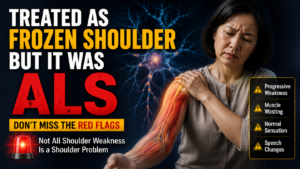
Treated as “Frozen Shoulder” for Months — But It Was ALS
Shoulder Weakness Case Study | PhD Win Acupuncture Clinic Auckland
This case happened more than ten years ago when I was practising in Newmarket, Auckland.
Even now, I still remember it very clearly.
Because this patient taught me something extremely important:
👉 Not every patient who “cannot lift the arm” has frozen shoulder.
Sometimes the dangerous sign is not pain.
Sometimes the dangerous sign is:
👉 weakness.
The Patient’s Initial Presentation
The patient was a woman working in a restaurant.
When she came to see me, her main complaints were:
- weakness lifting both shoulders
- difficulty washing dishes
- difficulty carrying plates
- weakness pulling objects
- progressive loss of upper limb strength
Before seeing me, she had already undergone:
- acupuncture
- massage therapy
- “frozen shoulder” treatment
for approximately six months.
Eventually, she came to my clinic after recommendation from a friend.
Why She Did Not Look Like Frozen Shoulder
The moment I first saw her, I immediately felt:
👉 “This does not behave like frozen shoulder.”
Why?
Because true frozen shoulder patients usually present with:
- significant pain
- obvious night pain
- passive range restriction
- stiffness or “locking” sensation
- inability to lift due to pain
But this patient was different.
She had:
- mild shoulder stiffness
- difficulty raising the arms
But the main problem was not:
👉 “too painful to lift.”
The main problem was:
👉 “not enough strength to lift.”
That distinction is extremely important clinically.
Because:
- pain-limited movement
and - weakness-limited movement
follow completely different clinical logic.
Important Findings During Examination
Further examination increased my suspicion that this was not a simple musculoskeletal shoulder disorder.
1. Clear Proximal Muscle Weakness
Weakness was especially obvious during:
- shoulder elevation
- abduction
- extension movements
The weakness involved both sides and appeared progressive.
This already looked very different from typical frozen shoulder.
2. Hand Function Was Relatively Preserved
At that stage:
- fine hand movements were still relatively functional
- distal weakness was less obvious
The pattern suggested:
👉 proximal weakness greater than distal weakness.
That became an important neurological clue.
3. Early Muscle Wasting Was Already Present
I also noticed early muscle wasting around:
- the shoulder girdle
- proximal upper limb muscles
There was visible reduction in muscle bulk.
This was not typical for ordinary shoulder inflammation.
4. Sensory Examination Was Relatively Normal
This was one of the most important findings.
The patient did not have:
- obvious numbness
- significant sensory loss
- classic nerve root pain
In other words:
👉 motor function was deteriorating,
while sensation remained relatively preserved.
That combination immediately raised concern for a motor neuron system disorder.
The Detail That Made Me Highly Concerned
Later during conversation, the patient casually mentioned:
👉 “Recently my voice has also started changing a little.”
That single sentence became extremely important.
Because:
- frozen shoulder does not affect speech
- ordinary neck and shoulder disorders do not change the voice
But ALS, especially when bulbar involvement begins, may affect:
- speech
- swallowing
- voice quality
At that point, my concern became much stronger.
My Clinical Impression at That Time
I eventually told the patient directly:
👉 “This is not a simple shoulder problem.”
I did not immediately tell her:
👉 “I suspect ALS.”
Because emotionally, that diagnosis carries enormous impact.
But I clearly told her:
- this was not ordinary frozen shoulder
- not simple muscle strain
- not a routine neck-shoulder condition
- further neurological investigation was urgently needed
The Phone Call From Her Husband
After returning home, the patient discussed the situation with her husband.
Later, her husband phoned me directly.
That was when I finally explained my concern more openly:
👉 I suspected motor neuron disease.
Possibly:
👉 ALS (Amyotrophic Lateral Sclerosis).
What Happened Afterwards
The patient was originally from Shanghai.
The next day, the couple immediately bought plane tickets back to China.
They did not even go home first.
After landing in Shanghai, she was admitted directly into a major hospital for neurological investigation.
Following:
- neurological consultation
- hospital admission
- systematic testing
she was formally diagnosed with:
👉 Motor Neuron Disease (ALS).
Later, her husband told me something I still remember clearly.
The neurologists in China reportedly asked:
👉 “How did you suspect this disease so early?”
Her husband answered:
👉 “A Chinese medicine doctor in New Zealand told us it might be ALS.”
The Final Outcome
Approximately six months to one year later, the patient’s child came to see me again.
By then, the disease had already progressed significantly.
She had developed:
- bulbar symptoms
- swallowing difficulty
- rapidly progressive weakness
At that stage, the prognosis was already very poor.
Later, I no longer received further updates.
But medically, we all understand how devastating ALS usually becomes.
The Real Clinical Value of This Case
The most important part of this case is not:
👉 “correctly guessing ALS.”
The real lesson is:
👉 Not every shoulder weakness case is frozen shoulder.
This is a very common clinical trap.
Especially when patients present with:
- bilateral symptoms
- progressive weakness
- minimal pain
- muscle wasting
- relatively normal sensation
These patterns do not fit ordinary frozen shoulder logic.
Clinical Reflection
1. Weakness and Pain Are Completely Different Clinical Pathways
Many patients say:
👉 “I cannot lift my arm.”
But clinically, the reasons can be very different:
- pain inhibition
- joint stiffness
- nerve injury
- muscle disease
- motor neuron disease
Therefore:
👉 “cannot lift” is not a diagnosis.
The key question is:
👉 “Why can’t they lift?”
2. Basic Neurological Examination Is Essential
Even if we are not neurologists, we still must assess:
- muscle strength
- sensation
- reflexes
- muscle wasting
- movement patterns
Because many serious diseases hide inside these basic findings.
3. Weakness With Relatively Normal Sensation Is a Major Red Flag
This clinical combination is extremely important.
Many common neck or nerve compression disorders usually produce:
- pain
- numbness
- sensory disturbance
But this patient mainly showed:
👉 progressive motor weakness with relatively preserved sensation.
That is not typical musculoskeletal logic.
4. A Doctor Should Not Continue Treating When the Pattern No Longer Fits
This case deeply affected me personally.
Because I could easily have continued:
- acupuncture
- shoulder treatment
- repeated sessions
and continued earning money.
But that is not the role of a doctor.
A mature clinician is not someone who “treats everything.”
A mature clinician is someone who knows:
👉 when the original diagnosis no longer makes sense.
Why Choose PhD Win Acupuncture Clinic
At PhD Win Acupuncture Clinic, we do not only look at where symptoms appear.
We also assess:
- movement patterns
- weakness versus pain
- neurological warning signs
- muscle wasting
- symptom progression patterns
Many dangerous diseases initially look very ordinary.
Clinical suspicion is often more important than treatment itself.
Dr Huang’s Clinical Red Flag Cases
- “Shoulder Strain” Later Found to Have Spinal Cord Hemorrhage
- “Frozen Shoulder” for Months — But It Was ALS
- chronic shoulder pain, it is a benign tumor
- Calf Pain? It Turned Out to Be Deep Vein Thrombosis (DVT)
- A Long-Term “Upper Back Pain” Patient Later Found to Have Significant Coronary Artery Disease
- Seeking Treatment for Hearing Loss,I think it is a brain tumour
- Shoulder and Arm Numbness? It Turned Out to Be Syringomyelia
- Leg Cramps for Years? It Turned Out to Be a Brain Meningioma
- She Thought It Was Just Bloating, but it be diagnosed an ectopic pregnancy.
- A “Trigeminal Neuralgia” Patient Whose Real Problem Turned Out to Be a Dental Abscess | Auckland
- A “Chronic Sciatica” Patient Who Was Eventually Diagnosed with Lung Cancer and Brain Metastasis
CTA
👉 Progressive shoulder weakness? Difficulty lifting the arms without significant pain?
👉 The problem may not simply be “frozen shoulder.”
Book Online:
PhD Win Clinic Online Booking



 中文微信:nzacupunctureclinic

Leave a reply