
Teresa’s TCM Clinical Reflections (26)
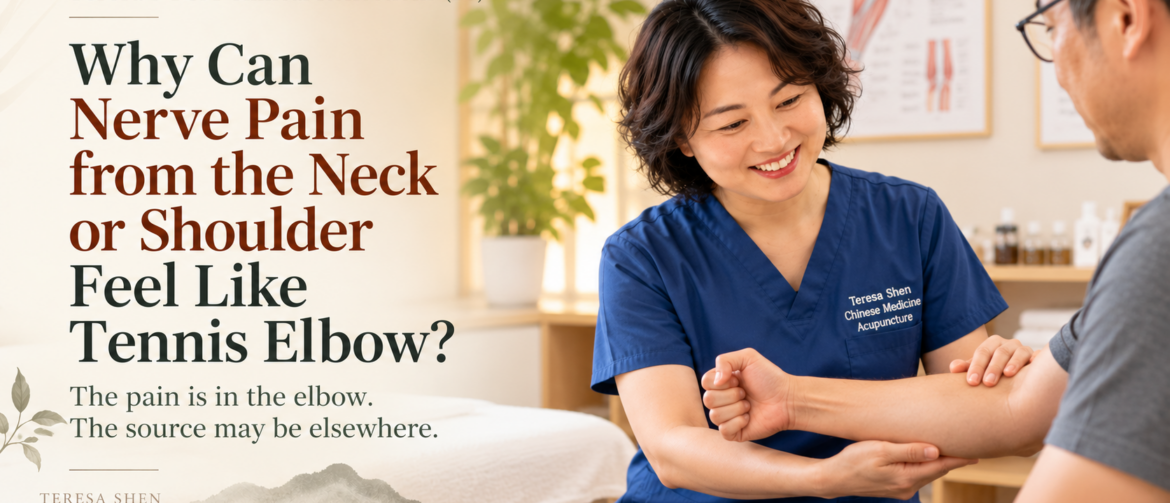
Why Can Nerve Pain from the Neck or Shoulder Feel Like Tennis Elbow?
By Teresa Shen, BHSc (Acupuncture), ACC Registered Treatment Provider, Registered Chinese Medicine Practitioner (NZ)
“Teresa, I’ve had tennis elbow for several months. I’ve tried medication, massage, physiotherapy and acupuncture, but it still hurts. Is tennis elbow really that difficult to treat?”
I often hear this question in my clinic.
These patients usually have pain around the elbow or forearm, tenderness when the area is pressed, and increased pain when gripping or lifting. Both the patient and previous healthcare providers may have considered it tennis elbow or a simple muscle strain.
But when treatment has not helped, I begin to ask a different question.
The pain is in the elbow, but could its main source be somewhere further up the nerve pathway?
Which Nerve Problems Can Be Mistaken for Tennis Elbow?
One possibility is cervical radiculopathy, where a nerve root in the neck becomes irritated or compressed. Some patients have very little neck pain. Their main symptoms are in the upper arm, elbow or forearm, so they may never suspect that the problem could come from their neck.
Another possibility is thoracic outlet syndrome. Nerves passing through the neck and shoulder region may be irritated or compressed around the scalene muscles, collarbone or pectoralis minor area. This can cause pain, numbness or weakness in the upper limb.
Radial nerve entrapment is another condition worth considering. Irritation of the radial nerve around the upper arm or elbow can produce pain along the outer elbow and forearm. Radial tunnel syndrome, in particular, can cause pain very close to the area affected by tennis elbow.
Each condition has its own clinical features, but not every patient presents in a typical way. Pain location alone is often not enough to identify the source.
Why Can Nerve Pain Feel So Similar to Tennis Elbow?
In my clinical experience, some patients with nerve-related pain have symptoms that look remarkably similar to tennis elbow. They may have local tenderness and pain with gripping or resisted wrist movements.
There are several possible reasons.
1. Nerve Pain Can Travel Down the Arm
When a nerve root or nerve pathway around the neck or shoulder is irritated, pain may travel into the elbow and forearm.
The patient feels pain at the elbow and naturally assumes something is wrong there.
But where pain is felt is not always where the main problem begins.
2. Nerve Irritation May Increase Local Pain Sensitivity
Persistent nerve irritation may make the elbow and forearm more sensitive to pressure.
An area that previously felt normal may become tender. Pain may be reproduced around the lateral epicondyle, forearm muscles or nearby tendons.
If we rely only on local tenderness, it can be easy to conclude that the patient has tennis elbow.
However, tenderness by itself does not always identify the primary source of pain.
3. Long-Term Pain May Lead to Secondary Soft Tissue Pain
When pain continues, the body may respond with protective muscle tension. Patients may avoid normal movements, hold their muscles tightly or change the way they use their arm.
Over time, these changes may contribute to muscle fatigue, altered loading and secondary soft tissue pain. Some patients may also develop local inflammatory changes.
This means a patient may have two contributing problems at the same time: nerve-related pain from further up the arm and secondary pain in the local muscles or tendons.
The elbow pain is real. The local tenderness is real. But the elbow may not be the only source of the problem.
When Should We Suspect an Upstream Nerve Problem?
In my practice, I pay particular attention to three situations.
1. Tennis Elbow Treatment Has Not Helped for Months
Tennis elbow can take time to recover. Many patients gradually improve with appropriate load management, rest from aggravating activities and rehabilitation.
But if someone has tried different treatments for several months and the pain remains severe or continues to worsen, I reconsider the original diagnosis.
Could another problem have been missed?
2. The Pain Does Not Behave Like Typical Tennis Elbow
Typical tennis elbow is often related to mechanical loading. Gripping, lifting and resisted wrist extension may reproduce the pain, while reducing these activities can provide some relief.
Nerve-related pain may behave differently.
Some patients experience pain even at rest. Others have significant night pain that wakes them from sleep. The pain may feel sharp, burning or electric, sometimes accompanied by numbness or altered sensation.
These features do not prove nerve compression, but they give me a reason to examine beyond the elbow.
3. There Is No Clear History of Repetitive Strain
Tennis elbow is commonly associated with repeated gripping or forearm loading, including work involving tools or frequent forceful hand movements.
However, some patients develop persistent elbow pain without any obvious increase in physical activity or repetitive strain.
When there is no clear mechanical explanation, and treatment has not helped, I consider whether another source of pain may be involved.
Re-examination May Be More Important Than Repeating Elbow Treatment
When I assess these patients, I do not examine only the tender area around the elbow.
Depending on their symptoms, I also assess neck movement, nerve pathways around the neck and shoulder, upper-limb sensation, muscle strength, reflexes and relevant nerve provocation tests.
One finding I pay particular attention to is whether examining an area further up the nerve pathway reproduces the patient’s familiar elbow or forearm pain.
A positive response does not establish the diagnosis on its own. I also compare findings on both sides and consider whether they fit the patient’s symptoms and other examination results.
If the local elbow examination does not fully explain the symptoms, but the neurological examination provides meaningful clues, I need to reconsider the original diagnosis.
Where Can Patients Seek Help in New Zealand?
If your tennis elbow has not improved after several months of treatment, your GP is a good place to start. Further investigations or specialist referral may be appropriate depending on the symptoms and examination findings.
I also understand that arranging specialist appointments or investigations in New Zealand can sometimes involve long waiting times.
Patients may consider an assessment with a registered Chinese medicine practitioner or acupuncturist who has experience in musculoskeletal and neurological examination.
In my practice, when symptoms appear to involve muscle tension or peripheral nerve irritation, I consider appropriate acupuncture and soft tissue treatment based on the clinical findings.
I have seen patients who received repeated treatment around the elbow with little improvement. After reassessment, when the findings suggested that the neck, shoulder or another nerve pathway was contributing to the pain, changing the treatment approach sometimes led to meaningful improvement.
For persistent elbow pain, the next step is not always more treatment at the painful spot. Sometimes, it is a better understanding of where the pain is coming from.
Book an Appointment
If your tennis elbow has continued for several months despite treatment, or if your elbow pain is accompanied by forearm pain, numbness or unusual night pain, a broader clinical assessment may help identify possible contributing factors.
Teresa assesses local tendon and muscle problems as well as relevant nerve pathways around the neck, shoulder and upper limb. Depending on the findings, she can consider whether acupuncture or other conservative treatments may be appropriate, or whether further medical assessment is needed.
Disclaimer
This article is for general health education and reflects Teresa Shen’s clinical observations. It is not a substitute for individual medical diagnosis or treatment advice.
Persistent elbow pain may involve local tendons, muscles, peripheral nerves or cervical nerve roots. Local tenderness, pain with resisted movement or a positive nerve provocation test cannot independently confirm the source of symptoms.



 中文微信:nzacupunctureclinic


Leave a reply