
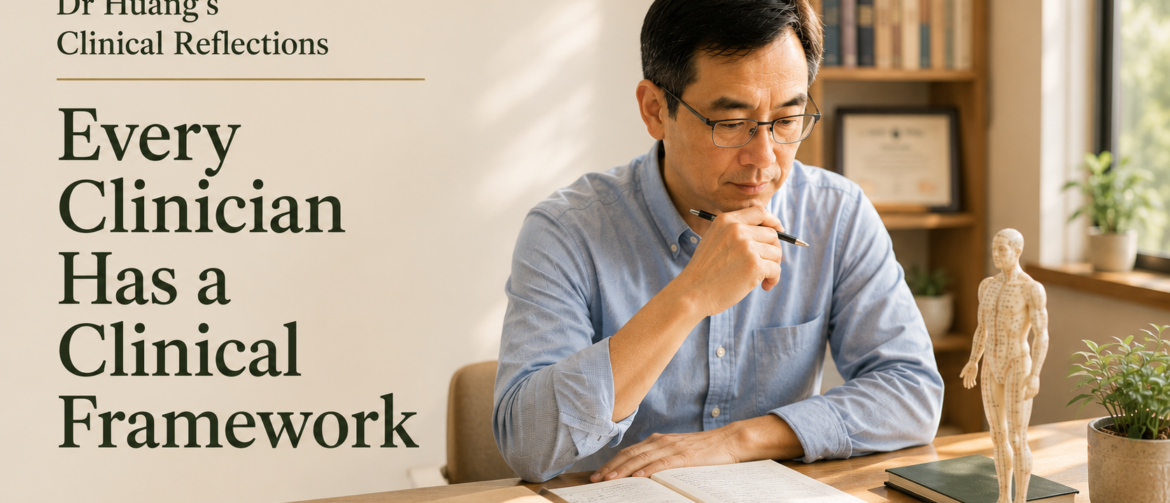
Every Clinician Works Within Their Own Clinical Framework
By Dr Win Huang, PhD (Chinese Medicine & Acupuncture)
The longer I work in clinical practice, the more I feel that every clinician eventually develops a clinical framework of their own.
This framework does not necessarily belong to a particular school of medicine, and it may never appear in a textbook. It develops from what we learned at university, the influence of our teachers, the theories we trust, and decades of clinical successes, failures and corrections.
Over time, these elements gradually become integrated into the way a clinician assesses, interprets and treats patients.
So I no longer think that some experienced clinicians “have a system” while others do not.
Anyone who practises independently for long enough will probably develop one.
The difference is in how deep, broad and flexible that framework becomes—and whether it remains open to challenge.
The Same Patient, Different Ways of Thinking
One clinician may see shoulder pain and immediately think of several familiar acupuncture points. Low back pain may lead to another familiar treatment.
After decades, this can become a stable and efficient clinical routine.
Another clinician may approach the same symptom differently.
Where is the pain actually coming from? Is it local tissue, nerve-related, structural or functional? Is there another condition that needs to be excluded? Why did the symptom appear now? If treatment produces no response, does that mean the original clinical judgement needs to be reconsidered?
The patient may be the same, but the thinking behind the consultation can be very different.
Earlier in my career, I worked closely with several doctors in the same department. After enough time, I could see that each had developed a distinct way of practising. Some focused first on symptoms, some on physical signs. Some relied heavily on experience, while others placed greater emphasis on particular diagnostic theories.
Each clinician was working within a framework built over years.
Experienced Clinicians Cannot Simply Replace Their Framework
A young clinician is still developing a stable way of thinking. It is therefore easier to learn another person’s method or adopt a new system.
After thirty or forty years of practice, things are different.
A clinician has spent decades using a particular way to take histories, interpret findings, make diagnoses and choose treatments. The framework is no longer simply knowledge. It has become a habit of thinking and, eventually, a way of understanding disease.
Completely abandoning it and replacing it with somebody else’s framework is probably unrealistic.
This has changed the way I approach continuing education.
As an experienced clinician, I am often less interested in learning another person’s complete system than in understanding how that person thinks.
Why did they ask that question? Which clue did they notice that I might have missed? Why did they consider one symptom particularly important? When treatment fails, how do they reconsider the case?
Those are the things worth taking home.
For a mature clinician, learning is often not about demolishing the house and building another one. It is about finding better materials that can strengthen or repair the house already standing.
Experience Can Also Become a Ceiling
There is, however, a problem.
The stronger a clinical framework becomes, the easier it is for that framework to become its own ceiling.
Decades of successful cases repeatedly tell us: my approach works.
When patients improve, our judgement is reinforced. When they do not improve, there may be valid explanations: the condition was severe, longstanding, complicated, or affected by other factors.
But if every failure can always be explained within our existing theory, the theory is never genuinely challenged.
A framework can therefore become increasingly stable—and increasingly closed.
Eventually, what limits a clinician may no longer be lack of knowledge. It may be the inability to see anything outside the framework itself.
Knowing What You Do Not Know
Having a personal clinical framework is not the problem.
The difficult part is recognising that it has limitations.
Which conditions do I not manage well? Which problems do I still not understand? Could another clinician be seeing something that I cannot see?
A clinician who understands these boundaries may actually be more clinically mature.
One of the greatest risks in medicine is not simply not knowing.
It is not knowing that you do not know.
A clinician who believes every condition can be treated and every finding explained through one theory may appear very confident. But that confidence can itself narrow clinical judgement.
A mature clinician should be able to say: this is outside my expertise; this needs further investigation; I need another professional opinion.
That is not weakness. It can be evidence of clinical maturity.
Seeing Your Own Framework
Perhaps clinical development has several stages.
Early in our careers, we build a framework.
With experience, we make it more stable.
Later, if we still want to improve, we need to learn to see the framework itself—its strengths, but also its blind spots and limitations.
We can then continue to modify it through new knowledge, other clinicians’ experience, different disciplines and, importantly, the cases in which our own approach did not work.
A clinician’s greatest ceiling may not be age or academic qualification.
It may be the clinical framework they have built themselves.
Perhaps real maturity begins when we can see that ceiling clearly enough to make an opening in it.
Our clinical framework may help us understand disease, but it should never be mistaken for disease itself.
Related Reading
Dr Win Huang’s Clinical Thinking (11) A Doctor Sees More Than a Diagnosis — They See Clues
Book Appointment
Persistent or complex symptoms sometimes require a fresh clinical assessment to determine which findings are most relevant to the patient’s current problem.
Book Online:https://booking.mananotes.co.nz/PHD-WIN/v2



 中文微信:nzacupunctureclinic

Leave a reply