
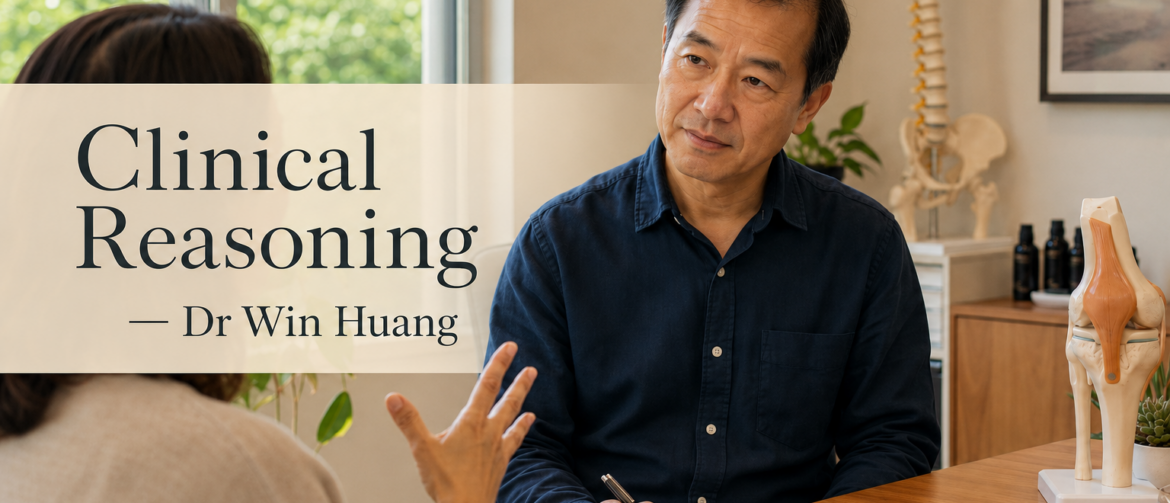
Dr Win’s Clinical Thinking (11)
A Doctor Sees More Than a Diagnosis — They See Clues
By Dr Win Huang, PhD (Chinese Medicine & Acupuncture)
Many people imagine that a medical consultation is straightforward: the patient describes the problem, the clinician performs an examination, and then gives a diagnosis.
But that is not really what happens in the consultation room.
When a patient walks in, what they usually bring is not a diagnosis. They bring fragments of information.
“My knee hurts.”
“It wakes me at night.”
“It hurts when I turn over in bed.”
“It is especially painful when I first get up in the morning.”
“Once I walk around for a while, it feels better.”
These are not answers.
They are clues.
The important part is how the clinician puts those clues together, piece by piece, until a coherent explanation begins to emerge.
Why Can the Same Patient Receive Different Diagnoses?
Patients often ask why three different clinicians can look at the same problem and give three different opinions.
In reality, this is not unusual.
Clinical diagnosis is not like answering a question from a textbook where there is one obvious answer waiting at the bottom of the page.
Every clinician interprets a case through the framework of their own knowledge, experience and clinical reasoning.
What a clinician considers possible determines the questions they ask.
The questions they ask determine the history they obtain.
That history then determines what they examine.
And the findings from that examination shape the final diagnosis.
This is why diagnosis is influenced not only by what the patient presents with, but also by how the clinician thinks about the information in front of them.
History Taking Is Not Simply Collecting Information
Many people think history taking is just the process of recording symptoms.
It is much more than that.
An experienced clinician usually has a working hypothesis behind each question.
If a meniscal problem is being considered, the clinician may ask about twisting injuries, locking, catching or pain during rotational movement.
If the patellar tendon is suspected, the questions may focus on whether the pain increases with loading or repeated activity.
If a nerve is involved, the clinician may ask about numbness, altered sensation, radiating pain or symptoms that occur at rest or during the night.
These questions are not random.
Each one helps support, weaken or rule out a particular hypothesis.
The History Determines the Examination
Patients sometimes expect a clinician to perform every possible examination test.
That is rarely how a focused clinical assessment works.
The history has already suggested which structures and mechanisms deserve closer attention.
The physical examination is then used to test those possibilities.
In other words, examination should not be a blind search for abnormalities.
It should be a way of testing the clinical reasoning that has already begun during the history.
Experienced Clinicians Often Work by Elimination
Many different conditions can produce very similar symptoms.
The key is not simply to think of one possible diagnosis.
It is to consider several plausible explanations at the same time.
The history helps eliminate some.
The physical examination eliminates others.
Further investigation may narrow the possibilities again.
Eventually, the aim is to arrive at the explanation that best accounts for the overall pattern of evidence.
Clinical reasoning, in this sense, is often a process of subtraction.
Finding an Abnormality Does Not Mean You Have Found the Cause
Long-standing pain frequently produces many secondary changes.
Muscles may become tight.
Movement may become restricted.
Certain areas may become tender.
The body may adopt compensatory movement patterns.
All of these findings can be real.
But not every abnormality is the primary cause of the patient’s problem.
The clinician still has to ask:
Which finding is central to the problem?
Which findings are consequences of the pain?
Which changes are compensations rather than causes?
Identifying an abnormality is relatively easy.
Determining which abnormality actually matters is much more important.
A Good Response to Treatment Does Not Automatically Prove the Diagnosis
It is tempting to think that if a patient improves after treatment, the diagnosis must have been correct.
But the relationship is not always that simple.
A patient may improve because the condition was naturally settling.
They may have rested more.
They may have changed their activity or lifestyle.
Or the treatment may genuinely have addressed the relevant mechanism.
This is why treatment response should not be treated as the only evidence.
A stronger diagnosis is supported by a chain of evidence.
Does the history fit?
Does the physical examination support it?
Have other reasonable explanations been considered and excluded?
And does the patient’s response to treatment make sense in light of the mechanism we originally suspected?
When these different pieces of evidence point in the same direction, confidence in the diagnosis becomes stronger.
What Does an Experienced Clinician Really Look For?
After more than forty years in clinical practice, I increasingly feel that good clinical work is not about memorising more diseases.
It is about learning how to think.
One sentence from a patient can change the direction of the diagnosis.
One examination finding can overturn an earlier assumption.
And every treatment response should give us another reason to reassess what we previously believed.
Clinical practice is not simply about finding a fixed answer.
It is a continuous process of forming hypotheses, testing them, rejecting some, refining others and reassessing as new information appears.
Clinical reasoning is, in many ways, the process of moving gradually closer to the truth.
I write Dr Win’s Clinical Thinking not because I want to give readers a collection of ready-made answers.
I want to record the thinking process that has developed through more than forty years of clinical work.
Because, in my view, the most valuable thing to learn is not simply the final diagnosis.
It is how the clinician arrived there, step by step.
If you have been living with persistent pain, or have seen several clinicians without receiving a clear explanation, a detailed clinical assessment may help clarify what is actually driving the problem.
Our aim is to identify the most likely source of the problem first, and then decide what treatment direction is most appropriate.
Book an Appointment
Book a Clinical Assessment
If you have persistent pain or have received different explanations for the same problem, a detailed clinical assessment may help clarify the next step.
Book online:
https://booking.mananotes.co.nz/PHD-WIN/v2
Disclaimer
Disclaimer:
This article is intended for general educational purposes only and does not constitute medical advice or replace an individual clinical assessment. Symptoms can have many different causes, and diagnosis and treatment should be based on each person’s medical history, physical examination and, where appropriate, further investigation.
Related Reading
Dr Win’s Clinical Thinking (11) A Doctor Sees More Than a Diagnosis — They See Clues



 中文微信:nzacupunctureclinic

Leave a reply