
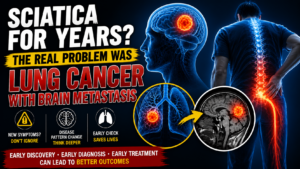
A Long-Term Patient with a Familiar Problem
This patient had been seeing me for many years and had become both a patient and a friend.
He had a history of low back pain, right leg numbness, and sciatica for more than ten years. Throughout that time, his symptoms would fluctuate. Acupuncture, rest, and other conservative treatments usually provided some degree of relief.
Because of this long history, everyone—including the patient, his family, and initially even myself—naturally assumed that his current symptoms were simply part of the same old problem.
Looking back, that assumption was the most dangerous part of the case.
One of the biggest traps in clinical practice is believing that an old patient must still have the same old disease.
What Caught My Attention Was Not Pain, But Slowness
During one consultation, he told me that his right leg did not feel as responsive as before.
He noticed that pressing the accelerator felt awkward. His reaction when moving between the accelerator and brake seemed slower. On one occasion, he nearly had a car accident because his foot did not respond quickly enough.
He also felt that walking required more effort than before. His movements seemed slower and less coordinated.
However, neither he nor his family considered this a new problem.
They simply believed that his long-standing lumbar disc disease and sciatica were getting worse. In fact, he and his wife had already been discussing whether surgery might finally be necessary. His wife felt that after so many years of suffering, surgery might be the solution.
When he came to see me, he was mainly seeking advice about his chronic back and leg condition.
Why Stroke Came to Mind
After listening to his story, my first thoughts were not about cancer.
Like everyone else, I initially thought about lumbar disc disease, sciatica, and nerve compression.
He had undergone multiple MRI scans over the years. He had seen several specialists. In fact, shortly before seeing me, another specialist had recommended surgery.
However, one detail stood out.
He was not telling me that the pain was worse.
He was not telling me that the numbness was worse.
Instead, he was telling me that the leg was no longer functioning normally.
That distinction is important.
Pain and numbness belong to the sensory system.
Slowness, poor coordination, and loss of control belong to the motor system.
That change prompted me to perform a more detailed neurological examination.
The Most Important Finding Was Not in the Leg
The examination was interesting.
His right leg showed the same abnormalities I had seen for years. The numbness was still there. The sciatica pattern was still there. There were no dramatic new findings.
Looking back, this makes sense.
The leg had already been abnormal for more than ten years. Chronic nerve irritation and sensory changes were part of his baseline condition. Any new findings in the leg could easily be explained away as progression of the old disease.
The more important finding came from somewhere else.
During the upper limb examination, I noticed that the reflexes on the right side were slightly more active than those on the left.
The difference was subtle.
There were no obvious pathological reflexes.
There was no paralysis.
There was no dramatic neurological deficit.
But something did not fit.
His arm had never been injured.
His arm had never been affected by his lumbar condition.
So why was the reflex changing?
At that moment, I began to wonder whether the problem was no longer in the lumbar spine.
Could this be an early central nervous system problem?
Could he be developing a stroke?
Why I Suggested a Brain Scan
The patient was approaching seventy years of age. He also had risk factors including hypertension, hyperlipidemia, and obesity.
I told him frankly:
“Are you sure you’re not heading toward a stroke?”
I explained that I could not make a definitive diagnosis, but the combination of a slower right leg and subtle changes in the right arm reflexes no longer looked like simple lumbar disease.
I recommended that if he had the opportunity, he should arrange a brain CT scan and discuss the issue with his doctor.
At that stage, I did not know the final diagnosis.
I simply felt that the clinical picture no longer matched the old explanation.
The Problem Was Not in the Leg
Later, the patient travelled back to China.
His original intention was to investigate his lumbar spine and determine whether surgery might be necessary.
Fortunately, he remembered our discussion.
While arranging spinal investigations, he also underwent brain imaging.
That decision changed everything.
The scan revealed hydrocephalus.
Further imaging raised concern about an intracranial mass.
An MRI was arranged, followed by additional investigations.
Not long afterwards, his wife sent me a message:
“The problem is not in the leg. There is fluid in the brain.”
At that moment, I knew we were dealing with something completely different.
The Final Diagnosis: Lung Cancer with Brain Metastasis
Subsequent investigations confirmed a brain tumor.
Further examination identified the primary source.
The diagnosis was lung cancer with brain metastasis.
The result surprised everyone.
The patient had never experienced the symptoms most people associate with lung cancer.
There was no persistent cough.
No coughing blood.
No chest pain.
No significant breathing difficulty.
If you looked only at the lungs, there was very little to suggest cancer.
The earliest clues came from the brain.
The slowing of the leg.
The changes in walking.
The delayed braking response while driving.
The subtle asymmetry in upper limb reflexes.
What appeared to be a worsening spinal problem ultimately led to the discovery of advanced lung cancer.
Fortunately, There Was Still Time
In the months that followed, the patient and his family kept me updated.
One message stayed with me:
“Thank you for reminding me. Otherwise, I probably would have delayed things again.”
Fortunately, genetic testing identified a targetable mutation.
The patient later told me:
“The gene matching worked. I can start the medication.”
For patients with advanced lung cancer, this can make a tremendous difference.
Another fortunate aspect of this story is New Zealand’s healthcare system.
In recent years, several targeted therapies for lung cancer have become publicly funded.
Without that support, some patients would face enormous financial burdens in order to access life-saving treatment.
The patient underwent radiotherapy, targeted therapy, and ongoing medical management.
Today, the brain lesions have significantly reduced in size.
The lung lesions are under control.
Although his walking has not completely returned to normal, his overall condition is far better than it could have been.
Dr Huang’s Clinical Reflection
The most important lesson from this case is not that lung cancer was discovered.
The most important lesson is that the disease pattern changed.
For more than ten years, the patient followed the same pattern:
Pain.
Numbness.
Sciatica.
Then something changed.
The symptoms shifted from sensory complaints to motor dysfunction.
The disease no longer behaved like the old disease.
Many dangerous conditions do not begin with dramatic symptoms.
They begin with subtle changes that no longer fit the original diagnosis.
Old patients do not always have old problems.
When a long-standing diagnosis can no longer explain new clinical findings, it may be time to start the diagnostic process again from the beginning.
The real danger is not failing to know the diagnosis immediately.
The real danger is continuing to treat a changing disease as though nothing has changed
Dr Huang’s Clinical Red Flag Cases
- “Shoulder Strain” Later Found to Have Spinal Cord Hemorrhage
- “Frozen Shoulder” for Months — But It Was ALS
- chronic shoulder pain, it is a benign tumor
- Calf Pain? It Turned Out to Be Deep Vein Thrombosis (DVT)
- A Long-Term “Upper Back Pain” Patient Later Found to Have Significant Coronary Artery Disease
- Seeking Treatment for Hearing Loss,I think it is a brain tumour
- Shoulder and Arm Numbness? It Turned Out to Be Syringomyelia
- Leg Cramps for Years? It Turned Out to Be a Brain Meningioma
- She Thought It Was Just Bloating, but it be diagnosed an ectopic pregnancy.
- A “Trigeminal Neuralgia” Patient Whose Real Problem Turned Out to Be a Dental Abscess | Auckland
- A “Chronic Sciatica” Patient Who Was Eventually Diagnosed with Lung Cancer and Brain Metastasis
Book an Appointment
Chinese Booking:
https://drwin.co.nz/zh/zh-online-booking/



 中文微信:nzacupunctureclinic

Leave a reply