
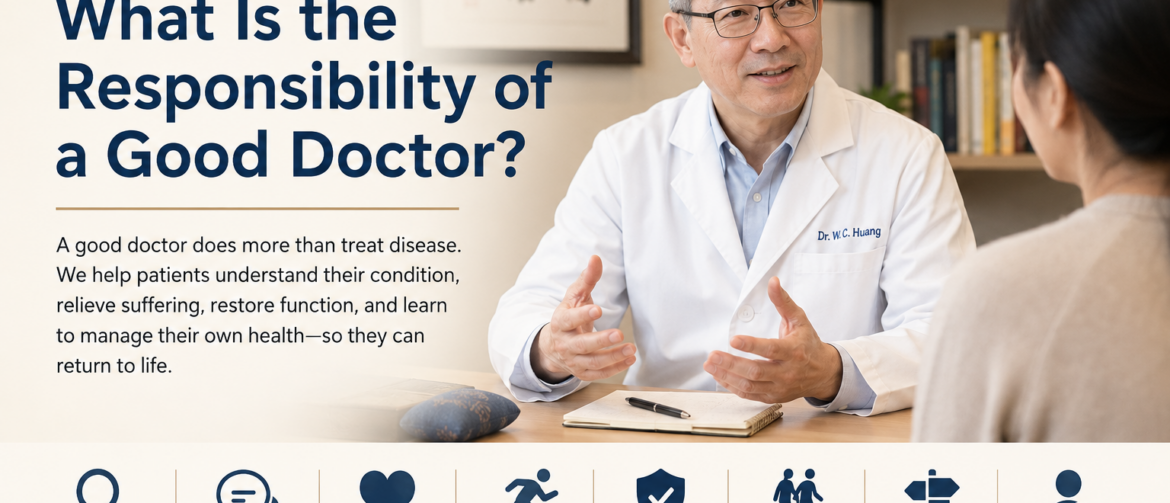
The responsibility of a good doctor is not limited to treating disease.
A doctor should help patients obtain an accurate diagnosis, understand their condition, relieve suffering, restore function, avoid unnecessary treatment, provide direction, and learn how to manage their own health.
Because doctors do not treat diseases.
They treat people who happen to have diseases.
Over the years, as I have seen more and more patients, I often find myself reflecting on a simple question:
What exactly is the responsibility of a good doctor?
When I was young, I believed that a doctor’s most important job was to cure illness. If a patient had pain, the goal was to remove the pain. If a patient had a problem, the goal was to fix it.
The longer I practised, however, the more I realised that treatment is only one part of a doctor’s responsibility.
A truly good doctor does more than provide treatment. They help patients understand disease, face illness, manage their health, and eventually return to normal life.
Over time, I have come to think of a doctor’s responsibility in eight different areas.
1. Making the Correct Diagnosis
I have always believed that diagnosis comes before treatment.
If we do not understand what the disease actually is, even the most enthusiastic treatment may be directed down the wrong path.
A doctor’s first responsibility is not to start treatment immediately. It is to understand what problem they are actually facing.
Some time ago, I saw a patient with recurrent episodes of dizziness. At first glance, it looked very much like benign positional vertigo. Many clinicians would naturally think about repositioning manoeuvres as the first step.
However, after a more detailed history, I noticed that the pattern of attacks, their duration, and the symptoms afterwards were not consistent with typical positional vertigo.
Further specialist assessment later suggested that the condition was more likely to be a neurological episodic disorder rather than ordinary positional vertigo.
This case reminded me that one of the most important skills a doctor can develop is the ability to remain sceptical.
Just because a patient believes they have a certain disease does not mean they do.
Just because another clinician suggested a diagnosis does not automatically make it correct.
Doctors must return to the disease itself, the symptoms themselves, and the natural behaviour of the condition.
Making the correct diagnosis does not mean knowing everything. Often it means recognising when further investigation is needed, when referral is appropriate, and when another specialist should become involved.
Helping a patient reach the correct diagnosis is itself an important form of medical care.
2. Explaining the Disease
Many patients are not frightened by disease itself.
They are frightened by what they believe the disease means.
I once treated a university student in her early twenties who had suffered from headaches, dizziness, and fatigue for several years. By the time I met her, she had already withdrawn from university and was extremely anxious about her future.
During our conversations, I learned that her father had suffered from severe migraine for many years. Throughout her childhood, she often saw him lying in a dark room during attacks, unable to work and unable to tolerate light.
Those memories left a powerful impression.
When she later developed headaches herself, she naturally assumed she had inherited the same condition.
As time went on, she became increasingly focused on her symptoms. Her fear grew, and her condition seemed to worsen. She avoided crowded places, struggled with study, and eventually stopped attending university altogether.
After examination, I felt her presentation was not typical of migraine. Years of prolonged study had created severe tension throughout her neck and shoulder muscles. Her symptoms were much more consistent with chronic tension-type headache.
Treatment helped her headaches and dizziness improve.
But looking back, I do not think the most important intervention was acupuncture.
I think it was the conversation.
I told her:
“Your father has migraine. You do not. You do not have to follow the same path he did.”
Gradually, she lost her fear of migraine, regained confidence, and returned to university.
This case taught me that doctors are not only treating disease.
Sometimes they are helping patients escape from fear.
3. Relieving Suffering
Modern medicine has achieved remarkable things.
Yet there are still many diseases that cannot be completely cured.
Many chronic pain conditions remain difficult to eliminate.
Many degenerative conditions cannot be reversed.
Many neurological disorders cannot be fully restored.
Even so, doctors continue to provide enormous value.
Because we can reduce suffering.
Less pain.
Better sleep.
Less dizziness.
Less anxiety.
For patients, these changes are meaningful.
Over the years I have increasingly felt that relieving suffering is one of the most important purposes of medicine.
Even when a disease is not completely cured, a significant improvement in quality of life can still represent success.
4. Restoring Function
Many patients tell us they are in pain.
But if we continue asking questions, we often discover that pain itself is not their biggest concern.
The real problem is what they can no longer do because of the pain.
Some can no longer bend because of low back pain.
Some struggle to climb stairs because of knee pain.
Some cannot put on a shirt because of shoulder pain.
Others can no longer work because of dizziness.
For this reason, I increasingly view symptom reduction as a process rather than the final goal.
The real goal is restoring function.
Helping people return to work, return to exercise, care for their families, and participate in life often matters far more than simply reducing a pain score.
5. Avoiding Overtreatment
Doctors need to know not only when to treat.
They also need to know when to stop.
This sounds simple, but it is often difficult.
Many clinicians naturally view problems through the lens of their own skills. Acupuncturists may want to use acupuncture. Surgeons may think about surgery. Medication-focused practitioners may think about prescriptions.
Yet what patients need is not always what we personally do best.
Some conditions are best managed surgically.
Some respond best to medication.
Some require rehabilitation.
Some benefit from acupuncture.
A mature clinician should first ask what is best for the patient, not what is most familiar to themselves.
Patient welfare must come before personal preference.
6. Walking Alongside Disease
This is one of the deepest lessons I have learned.
Many diseases do not disappear simply because patients wish them away.
Ageing does not disappear.
Degeneration does not disappear.
Some forms of tinnitus do not disappear.
Many neurological diseases do not fully recover.
I once treated a man in his thirties with a high-grade brain tumour. After surgery, radiotherapy, and chemotherapy, he was left with significant neurological deficits and increased muscle tone.
I knew acupuncture could not change the ultimate course of the disease.
At that stage, my responsibility was no longer to promise a cure.
It was to reduce suffering, improve comfort, and help him live with greater dignity.
Sometimes medicine is not about defeating disease.
Sometimes it is about helping patients live alongside it.
7. Providing Direction
Many patients today are not lacking treatment.
They are overwhelmed by treatment.
They have undergone numerous investigations.
They have received countless opinions.
They have spent hours researching online.
The result is often confusion rather than clarity.
One of the doctor’s responsibilities is to provide direction.
To explain what matters and what does not.
To identify which treatments are worthwhile and which are not.
To know when further investigation is necessary and when reassurance is enough.
A correct direction is often more valuable than greater effort.
8. Helping Patients Manage Their Own Health
Doctors cannot accompany patients forever.
For that reason, the best doctors do not create dependence.
They help patients understand their own bodies.
Patients should learn which symptoms deserve attention.
Which problems can be monitored.
How to exercise.
How to rest.
How to manage stress.
How to reduce recurrence.
For many chronic conditions, long-term outcomes depend as much on self-management as they do on treatment.
The more patients understand their own health, the more resilient they often become.
Conclusion
After more than forty years in practice, I have come to believe that doctors do not primarily deal with diseases.
They deal with people.
Diseases are names.
Test results are data.
The real person needing help is the individual who feels confused, frightened, frustrated, or overwhelmed because of illness.
For conditions that can be cured, we try to restore health.
For conditions that cannot be cured, we try to reduce suffering and improve quality of life.
For lifelong conditions, we help patients adapt and continue living meaningful lives.
The purpose of medicine is not simply to eliminate disease.
Whether through acupuncture, medication, surgery, or rehabilitation, the ultimate goal is to help people return to life.
To work.
To study.
To care for family.
To enjoy life.
To live as fully as possible.
If there is one lesson I have learned from more than forty years of clinical practice, it is this:
Doctors do not treat diseases.
They treat people who have diseases.
And helping a patient return to life is worth far more than any impressive test result.
Related Clinical Reflections
Clinical Reflections (1) Where Does All the Phlegm Come From? Why Did an Elderly Woman’s Morning Phlegm Drop from 80ml to 10ml After One Treatment?
Clinical Reflections (2) Why Are Rotator Cuff Tests So Accurate in Textbooks Yet Increasingly “Inaccurate” in Clinical Practice?
Clinical Reflections (3) The Dizziness Patient Already Had an Answer, But I Still Said No
Clinical Reflections (4) Why I Like My Low Back Pain Patients to Lie Face Down and Move Their Hips
Clinical Reflections (5) – What Is the Responsibility of a Good Doctor?
Clinical Reflections (06) – From Unhappy to Happy: How a Long-Collapsed System Restarted Itself
Book an Appointment
If you are struggling with chronic pain, dizziness, functional limitations, or persistent unexplained symptoms, you are welcome to book an assessment at Dr Huang TCM Clinic.
English Booking:
https://drwin.co.nz/online-booking/
Chinese Booking:



 中文微信:nzacupunctureclinic

Leave a reply