
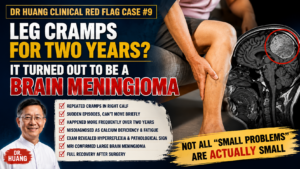
Dr Huang Clinical Red Flag Case #8
Leg Cramps for Years? It Turned Out to Be a Brain Meningioma
This case happened more than ten years ago when I was practising in Newmarket, Auckland.
The patient was a middle-aged woman who owned a nearby restaurant. Her restaurant was only a short distance from my clinic, so we knew each other quite well.
When she first came to see me, nobody was thinking about a brain tumour.
She did not complain of headaches.
She was not paralysed.
She had no obvious neurological diagnosis.
Her only complaint was recurrent cramping of her right calf.
At first glance, it sounded like one of the most common problems seen in clinical practice.
Most people hearing “leg cramps” would immediately think about calcium deficiency, muscle fatigue, dehydration, prolonged standing or poor circulation. Considering that she spent long hours working in her restaurant, these explanations sounded completely reasonable.
But this case later taught me that dangerous diseases often hide behind very ordinary symptoms.
It Started as a Simple Calf Cramp
Her symptoms had already been present for more than two years.
Each episode was remarkably similar.
The right calf would suddenly tighten and cramp. During an attack she found it difficult to walk and sometimes could barely move the leg for a short period of time.
Then, after resting for a few minutes, everything would return to normal.
Initially the episodes were occasional.
Over time they became more frequent.
From once in a while, to several times a week, and eventually sometimes twice a day.
The problem gradually began affecting her work and daily life.
She had already seen her GP and had been told that the symptoms were probably related to calcium deficiency, fatigue or prolonged standing. She tried supplements and vitamins, but nothing changed.
If the cramps had occurred occasionally in both legs, those explanations might have been reasonable.
But there was one thing that kept bothering me.
It was always the right leg.
Always.
The Detail That Made Me Stop and Think
Over the years I have learned that the most important clues are often the details that do not fit.
This patient was a good example.
If it was simply calcium deficiency, why was it always the right calf?
If it was fatigue, why did it never switch sides?
Why was it becoming progressively more frequent?
Why did it always follow exactly the same pattern?
The more I listened, the less it sounded like a muscle problem.
Instead, it sounded like a recurring neurological event affecting the same area over and over again.
That was the moment I started moving away from the idea of calcium deficiency and began thinking about the nervous system.
The Neurological Examination Changed Everything
I performed a neurological examination.
During the assessment I noticed mild hyperreflexia in the right lower limb.
That immediately raised concern.
Ordinary muscle cramps should not produce hyperreflexia.
Further examination revealed subtle upper motor neuron signs.
At that point I became much more concerned.
When hyperreflexia and pathological reflexes appear together, the problem is no longer simply muscular.
The central nervous system has to be considered.
Continuing to explain everything as fatigue or calcium deficiency no longer made sense.
Why I Started Thinking About the Brain
At that stage I began considering focal seizures.
Her attacks had several important characteristics.
They were localized.
They were recurrent.
They always affected the same area.
They caused brief motor dysfunction.
They resolved spontaneously.
And they were becoming progressively more frequent.
Taken together, these features resembled focal motor seizures rather than ordinary muscle cramps.
If this was a focal seizure, then the real problem might not be in the leg at all.
It might be in the brain.
At that point I did not know the exact cause.
It could have been a vascular lesion.
It could have been a space-occupying lesion.
It could have been a tumour.
But I felt strongly that brain imaging was necessary.
I advised her to undergo a brain MRI or CT scan to rule out an intracranial lesion.
The Reality of New Zealand Healthcare at the Time
One aspect of this case that remains vivid in my memory was the practical difficulty of obtaining advanced imaging.
At that time, access to neurological specialists and MRI scans in New Zealand was much more limited than today.
Waiting times were long.
Referral pathways were slow.
For a patient whose main complaint was simply “leg cramps,” obtaining a brain MRI was not easy.
The patient herself was not particularly worried.
From her perspective, she did not have headaches, paralysis or any major neurological disability.
She simply had leg cramps.
As a result, the investigation was delayed for more than a year.
The Diagnosis Was Finally Made in Hong Kong
Later she travelled to Hong Kong to visit family.
Fortunately, she still remembered my recommendation.
While she was there, she arranged a brain MRI.
The scan revealed a large meningioma.
The neurosurgeon immediately advised surgery.
She was admitted to hospital and underwent tumour removal.
Looking back, her recurrent right calf “cramps” were not muscle cramps at all.
They were focal motor seizures caused by irritation of the motor cortex from the growing meningioma.
Later her son contacted me and said:
“Dr Huang, you were right. My mother really did have a meningioma.”
What Happened After Surgery
Following surgery, the attacks disappeared completely.
The recurrent calf cramping stopped.
Her walking returned to normal.
The episodes never came back.
Over the following years we occasionally saw each other around the neighbourhood.
She recovered well and remained grateful for the recommendation to pursue further investigation.
What This Case Taught Me
The most important lesson from this case is not the meningioma itself.
The lesson is that not every recurrent cramp is simply a cramp.
Leg cramps are common.
Fatigue is common.
Calcium deficiency is common.
But when a symptom is always confined to one side, follows the same pattern repeatedly and becomes progressively more frequent, it deserves a second look.
Many brain diseases do not begin with dramatic symptoms.
Sometimes they begin with something as simple as a cramp, a brief abnormal movement or a minor neurological complaint.
A mature clinician does not stop thinking after hearing a familiar symptom.
The important question is whether the symptom behaves like an ordinary condition.
When it does not, we need to ask why.
This case reminds us that recurrent unilateral cramps, especially when confined to the same limb and becoming more frequent over time, should raise concern about focal seizures and possible intracranial pathology.
Dr Huang’s Clinical Reflection
Many dangerous diseases begin as small problems.
The challenge is not recognising severe disease when it becomes obvious.
The challenge is recognising it when it still looks ordinary.
In this case, the key was not the cramp itself.
The key was that the pattern did not make sense.
Why always the same leg?
Why increasingly frequent?
Why associated with abnormal neurological findings?
Sometimes the diagnosis is hidden inside those questions.
And this patient’s “leg cramp” remains one of the most memorable examples from my early years of practice.
Why Choose PhD Win Acupuncture Clinic
At PhD Win Acupuncture Clinic, we do not focus only on symptoms. We focus on patterns, neurological findings and whether the presentation follows a normal clinical course.
For persistent, progressive or unusual symptoms, identifying red flags can be more important than treatment itself.
Sometimes a correct diagnosis is worth more than many treatments.
Dr Huang’s Clinical Red Flag Cases
- “Shoulder Strain” Later Found to Have Spinal Cord Hemorrhage
- “Frozen Shoulder” for Months — But It Was ALS
- chronic shoulder pain, it is a benign tumor
- Calf Pain? It Turned Out to Be Deep Vein Thrombosis (DVT)
- A Long-Term “Upper Back Pain” Patient Later Found to Have Significant Coronary Artery Disease
- Seeking Treatment for Hearing Loss,I think it is a brain tumour
- Shoulder and Arm Numbness? It Turned Out to Be Syringomyelia
- Leg Cramps for Years? It Turned Out to Be a Brain Meningioma
- She Thought It Was Just Bloating, but it be diagnosed an ectopic pregnancy.
- A “Trigeminal Neuralgia” Patient Whose Real Problem Turned Out to Be a Dental Abscess | Auckland
- A “Chronic Sciatica” Patient Who Was Eventually Diagnosed with Lung Cancer and Brain Metastasis
Book an Appointment
If you are experiencing recurrent cramps, numbness, dizziness, balance problems, unexplained weakness or other persistent neurological symptoms, professional assessment may help identify the underlying cause.
Chinese Booking:



 中文微信:nzacupunctureclinic

Leave a reply