
2023 patient come to see me and thanks video
Over the years, I have come to realise that some of the most dangerous conditions are not dangerous because the symptoms are severe. They are dangerous because the symptoms appear ordinary.
The more ordinary the symptoms look, the easier it is for both patients and clinicians to overlook them.
This case left a deep impression on me.
The patient did not come because of a brain tumour. She did not come because of severe neurological symptoms. She came because her hearing was gradually getting worse.
If you only listened to her main complaint, you would probably think about hearing loss, ear problems, tinnitus, ageing, or middle ear disease. Most people would.
But the symptom that changed the entire direction of the case was not the hearing loss itself.
She Travelled to Auckland Seeking Treatment for Hearing Loss
The patient was a woman in her fifties from the Cook Islands.
Several people from her local community had previously received treatment at our clinic, so she travelled to Auckland hoping acupuncture and moxibustion might help her hearing.
She told me that hearing in her left ear had been gradually deteriorating for nearly two years.
Conversations were becoming more difficult. She often needed people to repeat themselves.
At first glance, it sounded like a straightforward hearing problem.
However, during the consultation she casually mentioned something else.
For several months she had been experiencing increasing difficulty with balance.
She said that when she walked, she often drifted to one side.
Sometimes she felt as though her body was being pulled toward the left.
That comment immediately caught my attention.
Hearing loss alone is common.
Hearing loss combined with balance disturbance is a completely different story.
One Finding Changed the Entire Direction
I decided to perform a more detailed neurological examination.
During the assessment I checked facial sensation.
I found that sensation on the left side of her face was mildly reduced compared with the right.
At that point, the patient was presenting with three separate findings:
Progressive left-sided hearing loss.
Balance disturbance with a tendency to drift to the left.
Reduced facial sensation on the left side.
Individually, none of these symptoms is particularly rare.
Hearing loss may suggest an ear disorder.
Balance problems may suggest vestibular dysfunction.
Facial numbness may suggest a neurological issue.
But when all three occur together on the same side, they start to tell a different story.
I was no longer thinking about the ear.
I was thinking about the brainstem.
Why I Suspected the Cerebellopontine Angle
One principle has guided much of my clinical thinking over the years:
The most important question is not what symptoms the patient has.
The most important question is whether all the symptoms can be explained by one anatomical location.
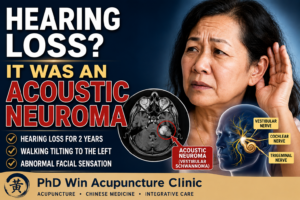
In this case, the location that immediately came to mind was the cerebellopontine angle (CPA).
This is the region where several cranial nerves run very close together, including:
The cochlear nerve (hearing).
The vestibular nerve (balance).
The trigeminal nerve (facial sensation).
A lesion in this area could potentially explain all three of her symptoms.
Compression of the cochlear nerve could produce hearing loss.
Compression of the vestibular nerve could produce balance problems.
Compression of the trigeminal nerve could produce facial sensory changes.
At that stage I did not know exactly what the pathology was.
Was it a tumour?
A cyst?
Another space-occupying lesion?
I did not know.
What I did know was that continuing acupuncture treatment was no longer the priority.
The priority was ruling out a brain lesion.
I advised her to arrange an MRI as soon as possible.
I told her that if the MRI was normal, she could return and we could continue treatment. But before doing anything else, we needed to know whether there was a structural problem inside her head.
MRI Confirmed the Suspicion
After returning to the Cook Islands, the patient took the recommendation seriously.
She arranged specialist assessment and underwent MRI scanning.
The MRI revealed a large lesion in the left cerebellopontine angle region.
She was referred to neurosurgery and surgery was arranged.
The final diagnosis was:
Acoustic Neuroma (Vestibular Schwannoma).
When I heard the result, I did not feel proud.
I felt relieved.
The patient finally had an explanation for her symptoms.
She Returned to Auckland to Thank Me
One of the most memorable parts of this story happened later.
In 2023, after her surgery and recovery, she returned to Auckland and came back to visit me.
She showed me the surgical scar behind her left ear.
She told me that the operation had gone very well.
The tendency to fall toward one side had disappeared.
Her balance had improved significantly.
Part of her hearing had returned, although it was not completely normal.
She still had some residual facial numbness, but overall she was very happy with the outcome.
We took photographs together and recorded a short video.
2023 patient come to see me and thanks video
She thanked me repeatedly for encouraging her to undergo MRI.
In truth, I know that what helped her most was not me.
It was the MRI.
Without the scan, the tumour would have continued growing.
The outcome could have been very different.
What This Case Taught Me
This case reinforced something I have learned many times throughout my career.
Common symptoms can sometimes hide uncommon diseases.
Hearing loss is common.
Dizziness is common.
Balance problems are common.
Even mild facial numbness can easily be overlooked.
But when these symptoms appear together, they stop being isolated complaints.
They become clues.
If you connect the clues correctly, they can point directly to the underlying pathology.
In this case, the clues pointed to one location:
The cerebellopontine angle.
Common Red Flags
Further investigation should be considered when patients present with:
- Progressive unilateral hearing loss
- Persistent or worsening balance problems
- Walking drift or falling toward one side
- Facial numbness or altered facial sensation
- Multiple cranial nerve symptoms occurring together
- Symptoms that do not fit a simple ear disorder
These findings do not automatically indicate an acoustic neuroma.
However, they deserve further evaluation.
Dr Huang’s Clinical Reflection
The longer I practise, the more I believe that a doctor’s most important skill is not treatment.
It is recognition.
Many patients do not need a miracle treatment.
They need someone to recognise when the pattern no longer fits the original diagnosis.
If I had focused only on hearing loss, I might have viewed this as an ordinary ear problem.
But hearing loss, balance disturbance, and facial sensory loss occurring together were telling a much deeper story.
Many serious diseases do not look serious in the beginning.
Clinical maturity is not about treating everything.
It is about recognising when something no longer behaves like an ordinary condition.
Why Choose PhD Win Acupuncture Clinic
At PhD Win Acupuncture Clinic, we do not only focus on where symptoms occur.
We also pay attention to symptom patterns, neurological findings, disease progression, and clinical red flags.
For patients with persistent, worsening, or unusual symptoms, recognising what does not fit can be just as important as providing treatment.
Sometimes a correct clinical direction is more valuable than a hundred treatments.
Dr Huang’s Clinical Red Flag Cases
- “Shoulder Strain” Later Found to Have Spinal Cord Hemorrhage
- “Frozen Shoulder” for Months — But It Was ALS
- chronic shoulder pain, it is a benign tumor
- Calf Pain? It Turned Out to Be Deep Vein Thrombosis (DVT)
- A Long-Term “Upper Back Pain” Patient Later Found to Have Significant Coronary Artery Disease
- Seeking Treatment for Hearing Loss,I think it is a brain tumour
- Shoulder and Arm Numbness? It Turned Out to Be Syringomyelia
- Leg Cramps for Years? It Turned Out to Be a Brain Meningioma
- She Thought It Was Just Bloating, but it be diagnosed an ectopic pregnancy.
- A “Trigeminal Neuralgia” Patient Whose Real Problem Turned Out to Be a Dental Abscess | Auckland
- A “Chronic Sciatica” Patient Who Was Eventually Diagnosed with Lung Cancer and Brain Metastasis
Book an Appointment
If you are experiencing:
- Hearing loss
- Balance problems
- Walking instability
- Facial numbness
- Unexplained dizziness
- Persistent neurological symptoms
Professional assessment may be worthwhile.
Book Online:



 中文微信:nzacupunctureclinic

Leave a reply