
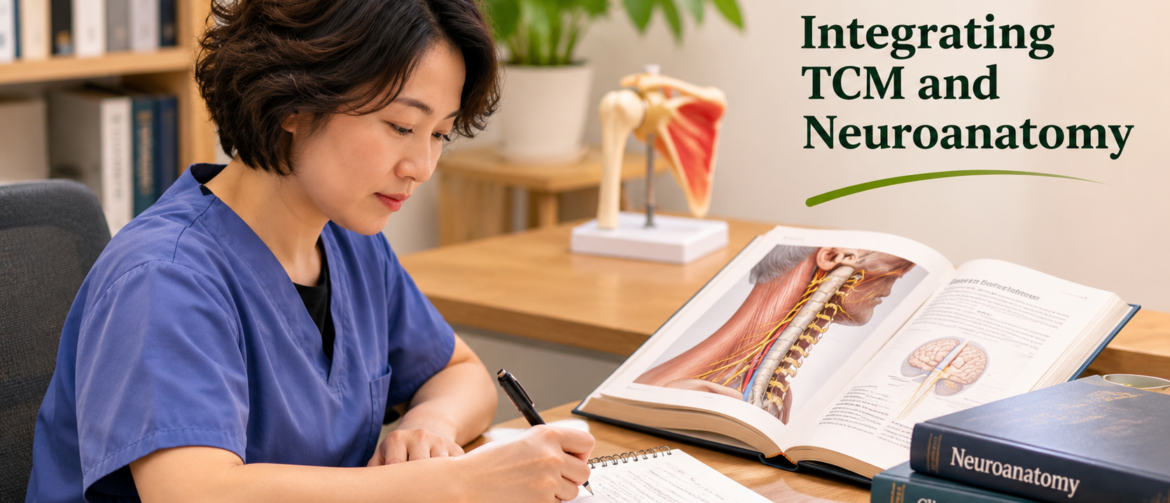
Teresa’s TCM Clinical Reflections | Diagnosing and Treating Occipital Neuralgia with Acupuncture
Subtitle: Combining Traditional Channel Differentiation with Modern Neuroanatomical Localisation
By Teresa Shen, BHSc (Acupuncture), ACC Registered Treatment Provider, Registered Chinese Medicine Practitioner (NZ)
1. Pain in the Back of the Head Is Not Automatically Occipital Neuralgia
Pain in the occipital region is a symptom. The location of pain alone is not enough to diagnose occipital neuralgia.
The neck and occipital region involve several nerves, including the greater occipital nerve, lesser occipital nerve, third occipital nerve, great auricular nerve and suboccipital nerve.
The great auricular nerve mainly supplies sensation around the auricle, mastoid region and angle of the jaw, while the suboccipital nerve is predominantly motor.
For this reason, I focus here mainly on the greater occipital, lesser occipital and third occipital nerves.
2. How I Assess and Differentiate Occipital Neuralgia
In clinical practice, I mainly look at three things.
The first is the quality of the pain.
Sharp, stabbing, cutting or electric-shock-like pain is an important clue suggesting a neuralgic component.
The second is the distribution of pain.
Pain close to the midline in the lower occipital region makes me consider the third occipital nerve.
Pain across a broader central posterior scalp region, sometimes extending towards the vertex, makes me consider the greater occipital nerve.
Pain over the lateral occipital region and behind the ear makes me consider the lesser occipital nerve.
In my own clinical practice, greater occipital neuralgia is encountered relatively often.
The third part is sensory examination, which I consider especially important.
When a nerve is irritated or injured, its sensory territory may become hypersensitive, but sensation may also become reduced or altered.
I do not examine only the symptomatic side. I compare it with the opposite side, and also compare anterior and posterior scalp regions and different nerve territories.
This helps me define the area of sensory change more clearly and consider which nerve may be involved.
3. Is the Patient Suitable for Acupuncture?
Diagnosis is only one part of the assessment.
I also need to decide whether the patient’s presentation is appropriate for acupuncture treatment.
In my clinical experience, many patients with occipital neuralgia also have potentially modifiable factors such as local irritation, muscle and fascial tension, nerve entrapment, or degenerative changes in the upper cervical region.
In these situations, acupuncture may have a useful clinical role.
However, pain associated with structural pathology, including some disc lesions, syringomyelia or lesions around the skull base, requires careful differentiation.
When necessary, I recommend further investigation or specialist assessment.
For me, understanding the indications and limitations of acupuncture is just as important as knowing how to perform the treatment.
4. Traditional Channel Differentiation Remains the Foundation
When treating occipital neuralgia, I commonly differentiate the pain through the Taiyang, Shaoyang and Jueyin channels.
I combine distal points along the relevant channel with local points.
For posterior occipital pain associated with the Taiyang pathway, I may use Kunlun (BL60) distally and Tianzhu (BL10) locally.
For lateral occipital and temporal pain associated with the Shaoyang pathway, I may use Zulinqi (GB41) distally and Fengchi (GB20) locally.
For pain extending towards the vertex and corresponding more closely with the Jueyin pathway, I may use Taichong (LR3) distally together with Baihui (GV20) locally.
The point combination is based on the patient’s actual pain distribution rather than a fixed formula.
5. Adding Modern Neuroanatomical Localisation
On top of traditional channel differentiation, I also use modern neuroanatomical knowledge to guide localisation.
One area I pay particular attention to is the region around the C2 and C3 transverse processes.
I use these anatomical landmarks during palpation, looking for unusually sensitive points and observing whether pressure can reproduce the patient’s familiar pain.
I then combine this localisation with a traditional acupuncture approach of carefully searching within a small area for the most clinically relevant point.
I also select local treatment regions according to the anatomical course of the three occipital nerves.
For symptoms suggesting the third occipital nerve, I focus more on the region around Tianzhu.
For the greater occipital nerve, I focus more on the region around Fengchi.
For the lesser occipital nerve, I focus more on the region around Wangu (GB12).
Palpation findings, pain reproduction and the individual presentation then guide the final needle placement and stimulation.
These point selections and techniques come from my developing clinical experience. They are not applied in exactly the same way to every patient.
6. My Clinical Reflection
Treating occipital neuralgia requires more than knowing where the patient feels pain.
I need to understand the character of the pain, which nerve may be involved, where the problem may be located, and whether acupuncture is appropriate for that presentation.
My approach is to use modern neuroanatomy to guide assessment and localisation, traditional Chinese medicine channel differentiation to guide point selection, and traditional palpation and point-searching techniques to make treatment more targeted.
Diagnosis should not stop at the location of pain, and treatment should not be limited to the location of pain.



 中文微信:nzacupunctureclinic


Leave a reply