
Not Every Knee Pain Should Be Treated the Same Way
Every Patient Has a Different Story
A woman in her fifties came to see me with pain on the inside of her right knee.
The discomfort had gradually become part of her daily life. Walking for longer distances made it worse, stairs were uncomfortable, and kneeling had become something she tried to avoid. She had already reduced many of her activities, hoping the pain would eventually settle on its own.
Like many people with knee pain, she had started to wonder whether it was simply arthritis.
When she sat down in my consultation room, she smiled and said,
“Maybe this is just what happens when you get older.”
I smiled back, but I wasn’t ready to accept that explanation.
Years of clinical practice have taught me that many patients arrive with similar symptoms, but very different stories. Before thinking about acupuncture, I wanted to understand why this particular knee was painful.
Something Didn’t Quite Fit
As I examined her knee, a few small details immediately caught my attention.
Her knee moved surprisingly well.
There was very little swelling.
The joint itself felt relatively calm.
The ligaments appeared stable, and the movements that often reproduce pain from the joint did not fully explain her symptoms.
Then I gently pressed one small area along the inside of the knee.
She immediately looked at me.
“That’s exactly the pain.”
It was such a small spot, yet it reproduced the discomfort she had been living with for months.
That moment made me pause.
At first, I had considered the common causes of medial knee pain, but these findings did not quite fit the picture I had expected.
Rather than assuming the joint itself was responsible, I felt I needed to keep looking.
Sometimes the smallest clinical findings become the most important ones.
Looking Beyond the Joint
As the assessment continued, I began thinking about structures outside the knee joint itself.
Could a small sensory nerve be contributing to her symptoms?
The more carefully I examined the area, the more that possibility seemed to make sense.
From a Traditional Chinese Medicine perspective, I also considered the meridians travelling through the medial aspect of the knee and how local stagnation might be contributing to her pain.
For me, these two ways of thinking do not compete with each other.
Modern assessment helps me understand which structures may be involved.
Traditional Chinese Medicine helps me understand how to approach treatment from a broader perspective.
Together, they often provide a clearer picture than either approach alone.
Treatment Is Never Just About Needles
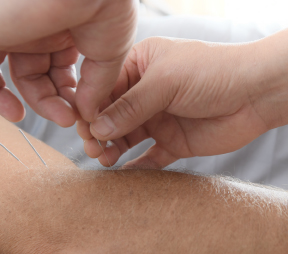
Once I felt confident that acupuncture was appropriate, I planned the treatment according to her individual presentation rather than following a routine protocol for knee pain.
The treatment focused on reducing irritation around the sensitive area while improving local circulation.
I also selected distal acupuncture points along the corresponding meridians to support the movement of Qi and Blood.
During treatment, I asked her to gently move the knee several times.
I enjoy doing this because it allows both the patient and me to observe how the symptoms are changing in real time.
Sometimes those small changes give us more useful information than words alone.
Recovery Happened Step by Step
After the first treatment, she told me that walking already felt a little easier.
Over the following visits, the sharp pain gradually became less frequent.
Climbing stairs became more comfortable.
She found herself thinking less about protecting the knee with every movement.
One comment stayed with me.
“Yesterday I walked around the supermarket and only realised afterwards that I hadn’t been thinking about my knee.”
Patients often measure recovery differently from clinicians.
We may focus on pain scores or physical findings.
Patients remember the moments when they quietly return to normal life.
Those moments are often the best signs that recovery is progressing.
Every Knee Deserves Its Own Assessment
People often ask me,
“Can acupuncture help knee pain?”
My answer is always the same.
“It depends on why your knee hurts.”
Some knee pain comes from osteoarthritis.
Some from tendons.
Some from muscles.
Some from bursae.
Occasionally, the source is much smaller than patients expect.
If every painful knee received exactly the same treatment, many of these differences would be missed.
That is why I believe assessment should always come before treatment.
The diagnosis guides the treatment—not the other way around.
My Reflection
Looking back, I realised this patient reminded me of something that is easy to forget.
Pain does not always come from where we expect.
Sometimes the answer is hidden in a small detail that could easily be overlooked.
This experience also reminded me that acupuncture is not simply about choosing the right points.
It begins much earlier.
It begins with listening carefully.
Observing patiently.
Remaining curious.
And resisting the temptation to reach a conclusion too quickly.
Every patient who walks into the clinic teaches me something new.
Although many people begin with the same sentence—
“My knee hurts.”
—the story behind those words is rarely the same.
Perhaps that is why I still enjoy treating knee pain.
Every consultation encourages me to slow down, observe a little more carefully, and remember that good treatment always begins with good assessment.
Book an Appointment
If you are experiencing knee pain and would like an individual assessment, we welcome you to book a consultation.
Our approach begins with understanding your symptoms and identifying the possible cause of your pain before discussing whether acupuncture is the most appropriate treatment. If further medical assessment or imaging is needed, we will explain why and help guide you towards the next appropriate step.
English Online Booking
https://drwin.co.nz/online-booking/
Disclaimer
This reflection is shared for educational purposes and is based on a real clinical experience. Some patient details have been modified to protect patient privacy.
Every patient is unique, and the information in this article should not be considered personal medical advice, a diagnosis, or a recommendation for treatment. If you are experiencing knee pain or any other health concern, please seek an assessment from a qualified healthcare professional.



 中文微信:nzacupunctureclinic

Leave a reply