
Follow Dr. Win Huang to Learn Clinical Diagnosis (Case 8)
Sometimes Severe Pain Is Actually Shingles Knocking at the Door
The patient was a 55-year-old woman and one of my long-term patients. She had previously suffered from lower back and leg pain and had received treatment at my clinic before.
Last week she suddenly called me, saying that she had severe pain in her right buttock, with the pain radiating toward the groin and thigh. She said the pain was so intense that she almost cried, and even painkillers were not helping. She asked if she could come in for acupuncture treatment.
However, my schedule was already full that day, so I could only book her for the following Monday.
On Monday, she arrived at the clinic supported by her family. During the examination, the pain in her right buttock was obvious. The pain radiated to the outer thigh and groin area and could also travel down along the inner thigh. My first impression was that this was nerve-related pain.
But at that moment it was not clear which nerve was involved. It could have been the superior cluneal nerve, the femoral nerve, or one of the cutaneous nerves around the inguinal region. All of these possibilities were considered.
At that time, my working diagnosis was irritation of the lumbosacral nerves causing neuralgia.
I performed acupuncture treatment based on this assumption. She reported a slight improvement, but the relief was not very significant.
On Wednesday she had another appointment scheduled, but she did not show up. Later I learned that the pain had become unbearable, so she went to the emergency department.
She told me that the pain had become so severe that she could hardly walk. Even small movements in bed would trigger intense pain, and painkillers were not controlling it. At the hospital they took lumbar spine X-rays, which showed no obvious abnormality. Eventually she received a local injection in the lower back, which reduced the pain by about half.
On Friday she called again and asked whether she could return for another acupuncture session.
My thought at that time was that if it was nerve pain, at least we might be able to reduce the symptoms. So I asked her to come in.
When she returned, I examined her again and suddenly noticed an important detail: there was a patch of red rash on her right buttock.
I asked her, “What happened here? Why are there so many red spots?”
She said she thought it might have been caused by a hot water bottle that had accidentally burned her skin.
At first I almost accepted that explanation. But when I continued the examination, I noticed similar rashes on the inner thigh as well.
At that moment it immediately came to my mind.
I told her, “This might not be a burn. You may actually have shingles.”
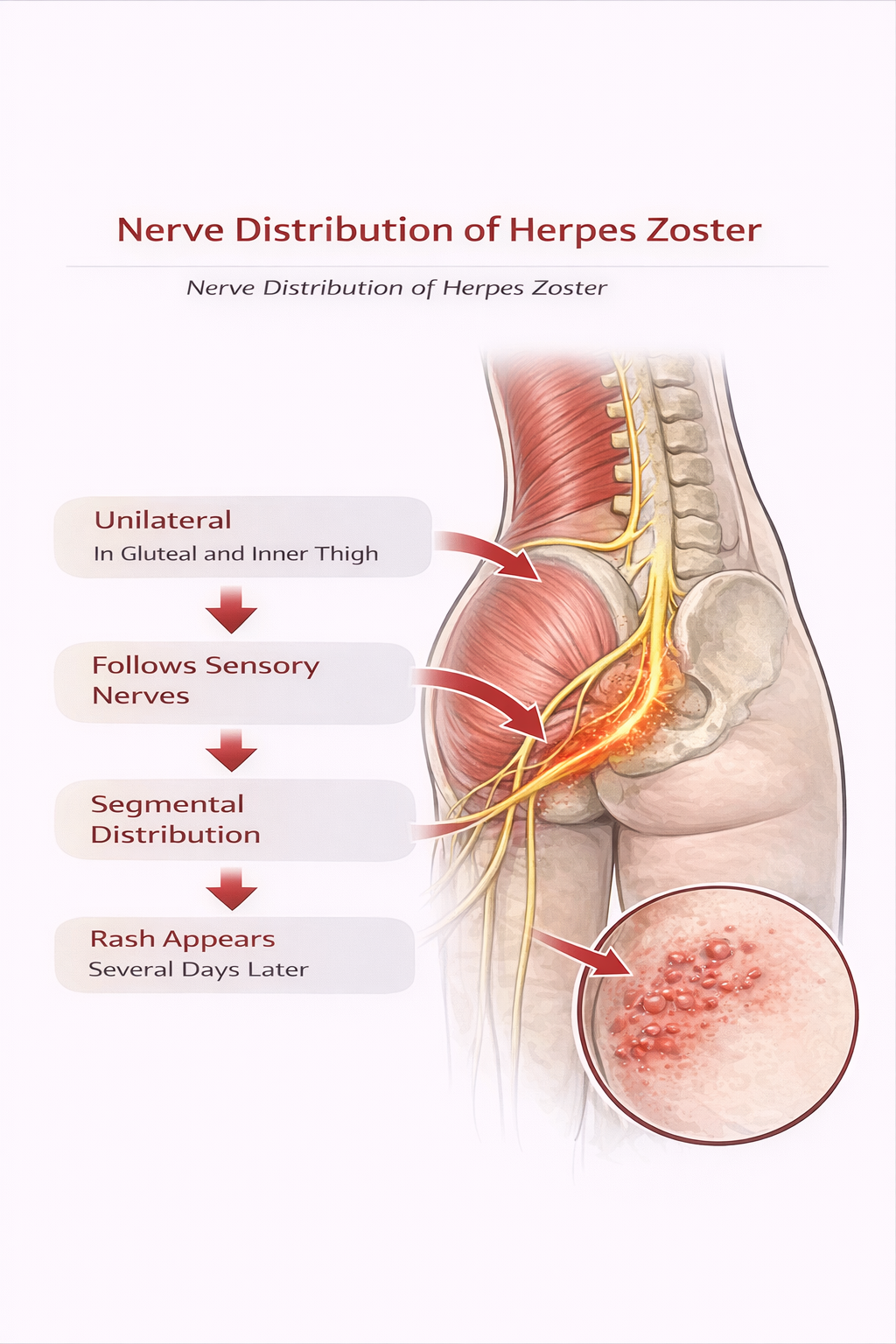
When we looked again at her original symptoms—severe unilateral nerve pain radiating from the buttock to the groin and down the inner thigh—combined with the newly appeared rash, the picture became very clear. This was a typical case of shingles-related neuralgia.
Shingles is caused by the reactivation of the varicella-zoster virus. This virus usually remains dormant in the spinal nerve ganglia. When it reactivates, the first structure affected is actually the nerve itself.
For this reason, in many cases the pain appears first, while the skin rash develops several days later.
In medicine, this period is called the prodromal stage of shingles. During this stage, patients often experience significant nerve pain such as stabbing pain, burning pain, sharp knife-like pain, or extreme sensitivity to touch. The pain is usually unilateral and follows the distribution of a specific nerve.
In most cases this stage lasts one to three days before the rash appears. However, in some patients it may take longer—four or five days, or even up to a week.
What made this case unusual was the length of that interval.
From the onset of pain to the appearance of the rash, there was a gap of more than ten days. During that period there was only pain but no visible rash. Because of this, neither my first consultation nor the emergency department visit immediately suggested shingles.
Once the rash appeared, however, the diagnosis became clear.
After confirming the diagnosis, the treatment plan was also straightforward. I advised her to see her general practitioner for antiviral medication, while continuing acupuncture treatment to help relieve the nerve pain and support nerve recovery.
This case serves as a simple clinical reminder: if a patient presents with severe unilateral pain following a nerve distribution, and no clear structural cause can be identified, even if there is no rash at that moment, one possibility should always remain in mind—
it may be prodromal neuralgia of shingles.



 中文微信:nzacupunctureclinic

Leave a reply