
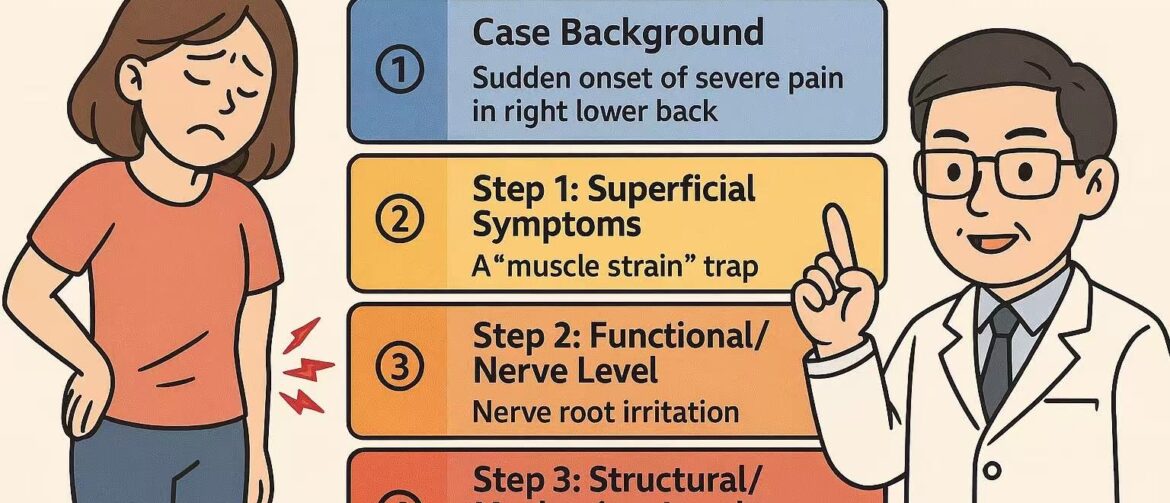
Case 1|Acute Right Thoracolumbar Pain: From Sharp Back Pain to Cough Pain — A Four-Tier Diagnostic Pathway
① Case Background
A 46-year-old female developed sudden, severe right thoracolumbar pain one week ago while bending forward to pick up an item in the kitchen.
The pain extended from the right costal margin down to the iliac crest. The patient described it as “right lower back and flank pain.”
Typical features:
-
Pain significantly worsened with coughing, sneezing, or deep breathing
-
Pain increased with thoracolumbar movement
② Four-Tier Clinical Reasoning
🔵 Tier 1: Symptom-Level Interpretation — The Trap of “Muscle Strain”
At first glance, this appears to be a typical “acute back strain” scenario:
-
Sudden onset after bending
-
Localized tenderness
-
Patient feels she “twisted her back”
Thus, many clinicians and patients naturally assume:
muscle strain / muscle spasm / soft-tissue injury
However, this explanation fails to answer key questions:
-
Why does coughing, sneezing, or deep breathing immediately worsen the pain?
A muscle strain alone does not produce sharp, cough-induced pain.
👉 Staying only at the muscular level easily leads to diagnostic misdirection.
🟡 Tier 2: Functional / Neurological Interpretation — This Is Nerve Root Irritation
Clinically, the question should shift from “Where does it hurt?” to
“When does it hurt the most?”
Three hallmark symptoms stand out:
-
Coughing pain
-
Sneezing pain
-
Deep-breathing pain
These strongly suggest nerve root irritation.
Physical examinations further confirmed this:
-
Hyperalgesia in the right T10–T12 dermatomes
-
Paraspinal tenderness at T10–T12, with referred pain to the patient’s symptomatic region
Together, these findings point to:
Intercostal neuralgia / thoracic nerve root irritation
This is no longer a muscular issue.
👉 The nervous system is signaling distress.
This tier marks the shift from “muscle thinking” to “neurogenic thinking.”
🟠 Tier 3: Structural / Mechanistic Interpretation — What Is Irritating the Nerve Root?
After confirming nerve root involvement, the next essential question is:
“Why is the nerve root irritated?”
Several examination clues provided the answer:
-
Distinct paraspinal tenderness at T10–T12
-
Restricted mobility in the same segments
-
Immediate reduction in cough pain after facet joint mobilization
These findings strongly support:
Thoracic facet joint dysfunction / capsular entrapment → irritation of the corresponding nerve root → intercostal neuralgia
The diagnosis thus progresses from “what hurts” to
👉 “what mechanism is creating the pain.”
🔴 Tier 4: Deep Structural Interpretation — Why Did Facet Dysfunction Occur?
The deeper question is not
“Which joint is misaligned?”
but rather:
“Why is this patient prone to facet joint locking?”
Common underlying contributors include:
-
Prolonged sitting and forward-bending postures → thoracolumbar stiffness / flat-back posture
-
Mild scoliosis or asymmetric spinal loading
-
Insufficient core stability
-
The thoracolumbar junction’s inherent nature: low stability + limited mobility
In such a structural environment,
even a simple forward-bending movement can trigger facet locking → nerve root irritation → acute sharp back pain, cough-induced pain, and abdominal radiation.
This tier reminds us:
The acute episode is the result; long-standing structural imbalance is the true cause.
③ Treatment Strategy
The management approach is straightforward:
1. Remove the source of nerve root irritation
-
Mobilize the thoracolumbar facet joints
-
Release tissues potentially impinging or tethering the nerve root
2. Reduce protective muscular guarding
-
Acupuncture or manual techniques to relax hypertonic muscles
-
Interrupt the protective spasm cycle
3. Restore normal joint mobility
-
Guide the patient through gentle flexion, extension, and side-bending
-
Reestablish proper joint biomechanics
After one treatment, the patient’s severe pain significantly reduced, and coughing no longer triggered sharp pain, confirming that the nerve root irritation was relieved.
④ Key Clinical Insight
Back pain should not be evaluated only by “where it hurts.”
Once coughing pain appears, nerve root irritation must be considered.
Following the pathway of neurogenic pain leads to identifying facet dysfunction, spinal imbalance, and deeper structural contributors.



 中文微信:nzacupunctureclinic

Leave a reply