
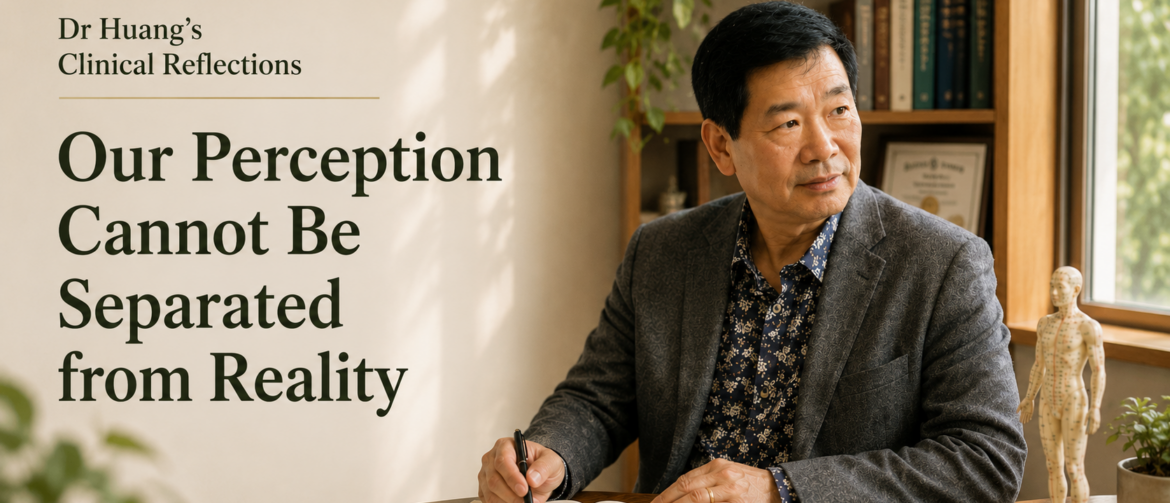
Our Perception Cannot Be Separated from Reality
By Dr Win Huang, PhD (Chinese Medicine & Acupuncture)
Some time ago, I watched a video about a man with oesophageal cancer.
He was around 50 years old. After being diagnosed, he believed strongly in his own mental strength. He felt that if his willpower was strong enough, he could fight the cancer. He did not undergo the recommended treatment or surgery.
Later, the disease progressed until he could no longer eat normally. By then, he was frightened and wanted treatment. But the disease and his physical condition had already changed considerably. Eventually, a gastrostomy was performed to maintain nutrition, and he died not long afterwards.
I do not know his complete staging or medical history, so I cannot say that earlier treatment would certainly have produced a different outcome.
But his story made me think about something very important:
Mental strength can be powerful, but it cannot change the biological behaviour of a disease.
You may refuse to be afraid of cancer, but cancer does not stop progressing simply because you are not afraid.
You may tell yourself, “I am fine,” but feeling fine and actually being medically well are not the same thing.
Feeling Young Does Not Stop the Body from Ageing
This reminds me of another situation I often see in clinical practice.
Some people in their seventies or eighties still think of themselves physically as they were twenty years earlier. They want to hike, climb mountains, lift heavy objects or perform strenuous exercise in the same way they did in their fifties or sixties.
They may say:
“I have always been very healthy. I could do this before.”
But age is more than a number.
With ageing, muscle strength, balance, reaction time, bone strength, joint tolerance and recovery capacity can all change.
Being able to walk a difficult mountain track ten years ago does not guarantee the same capacity today. A slip that was easily corrected when younger may, later in life, result in a fall and fracture.
This is not about whether someone is willing to “admit they are old”.
It is about recognising that the body has changed even when our perception of ourselves has not.
Being Young Does Not Mean the Body Is Fully Mature
There is also the opposite problem.
Some people do not accept that they are ageing. Others do not recognise that they are still growing.
I once saw an 11-year-old girl who developed a clavicular stress fracture after prolonged high-intensity swimming training.
An 11-year-old is young and generally has good healing capacity. But being young does not mean the body is fully mature.
Children and adolescents are still developing. Their bones, muscles and tendons are adapting as they grow. If repetitive training loads consistently exceed what the developing body can tolerate, injury can occur.
A young athlete may think:
“Other people can train this hard, so I can too.”
Parents or coaches may also think:
“She is strong. A little more training will be fine.”
But biological development follows its own timetable.
Believing that the body is mature cannot make the skeleton mature earlier.
We Can Misunderstand Our Own Bodies
These examples appear very different—a person with cancer, an older adult who still feels young, and a child training beyond her physical capacity.
But I think they share something important.
Human beings can develop an inaccurate understanding of their own physical reality.
We may have an illness but not want to accept that we are ill.
We may be ageing but not want to accept that our physical capacity has changed.
We may still be developing but believe that we can tolerate the same load as a fully mature adult.
The problem is not mental strength itself.
The question is whether that mental strength remains grounded in reality.
Disease has its biological course.
Ageing has its biological course.
Growth and development have their own biological course.
Our mindset can help us face these realities, but it cannot replace them.
Mature Thinking Begins with Seeing Reality Clearly
This does not mean that a person with illness should lose hope. It does not mean that older people should stop being active, or that children should avoid challenging themselves.
Quite the opposite.
The more accurately we understand our current physical state, the better we can make appropriate decisions.
When disease appears, we need to recognise it and respond appropriately.
As we age, our activities may need to adapt to changing capacity.
When a child is still developing, training load needs to respect that stage of growth.
This is not pessimism.
It is aligning what we want to do with what the body can realistically tolerate at that point in life.
One of the easiest mistakes for human beings to make is to confuse:
“What I want myself to be”
with:
“What I actually am.”
Mental strength matters.
But mature mental strength is not the denial of reality. It is the ability to see reality clearly—and then decide how best to face it.
Our perception cannot be separated from reality.
Book Appointment
When symptoms, imaging findings and our understanding of a condition do not fully match, a careful clinical assessment can help clarify the patient’s current physical state and the most appropriate next step.
Book Online: Book an Appointment



 中文微信:nzacupunctureclinic

Leave a reply