
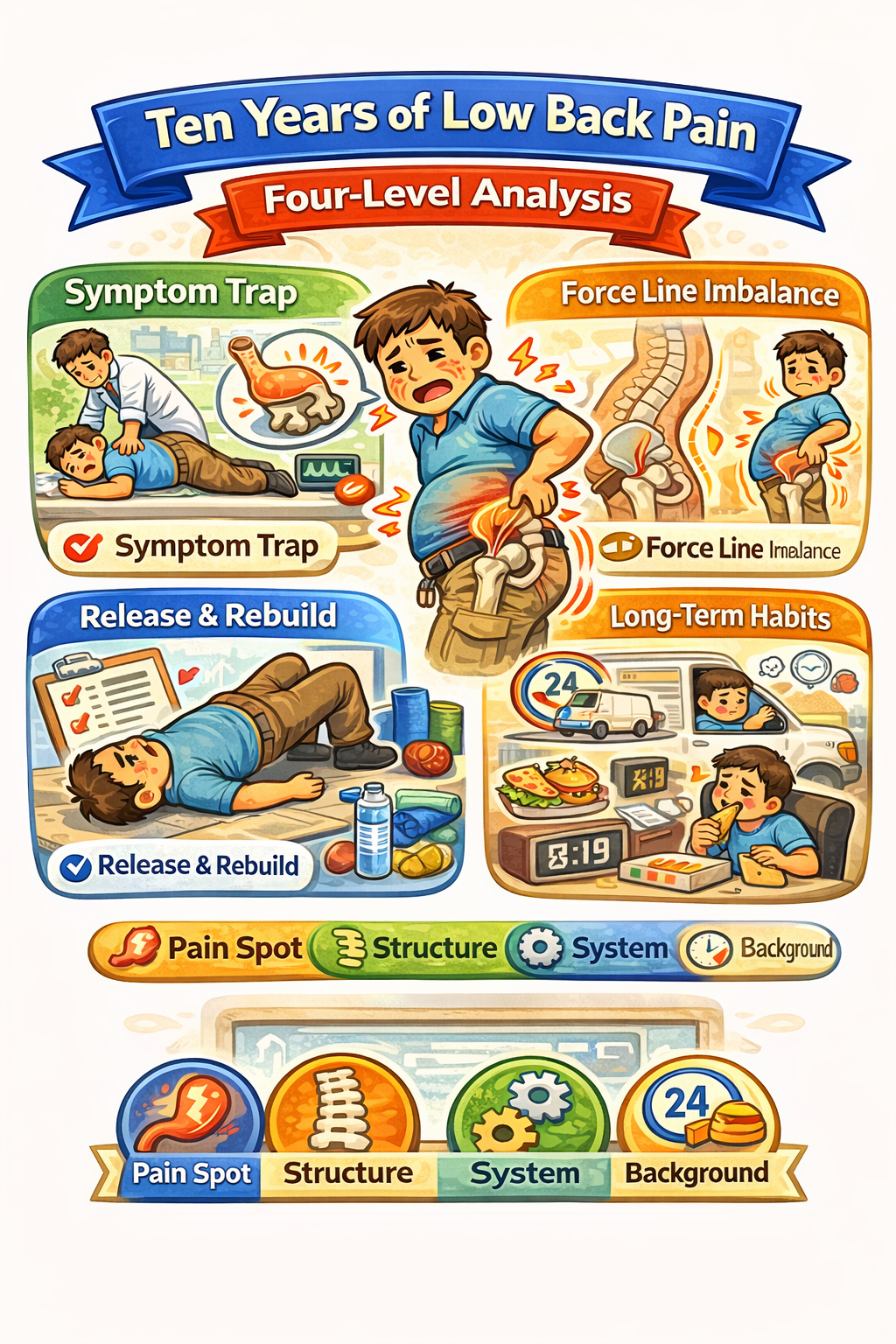
Case 5|Ten Years of Low Back Pain — A Turning Point from “Pain-Spot Thinking” to “Force-Line Thinking”
① Case Background
The patient is a middle-aged male who had suffered from chronic low back pain for nearly ten years.
Over the past decade, he had tried various treatments including physiotherapy, massage, chiropractic adjustments, and acupuncture. Each intervention provided only temporary relief, and the pain would inevitably return. No clear structural pathology had ever been identified, and imaging studies were largely unremarkable.
By the time he presented to the clinic, the most striking feature was not the severity of pain itself, but the long-standing, treatment-resistant nature of the condition.
At first glance, this seemed like a typical case of chronic low back pain with no obvious red flags. However, it eventually became a pivotal case that marked a shift in diagnostic perspective.
② Four-Level Thinking Analysis
Level 1 — Symptom Layer: The Trap of “Where It Hurts”
On the surface, the case appeared straightforward. The patient complained of persistent low back pain localized to the lumbar region. Most previous treatments had focused directly on the painful area — loosening tight muscles, reducing local tension, or adjusting nearby joints.
This represents the most common clinical reflex: treating the pain where it appears. However, despite repeated interventions targeting the painful site, the symptoms kept recurring. This alone suggests that the true driver of the condition might lie beyond the pain point itself.
Level 2 — Functional Layer: Why Does the Pain Keep Returning?
At the functional level, the key question becomes: why does the relief never last?
The patient consistently experienced temporary improvement after manual therapy, but the pain gradually returned once normal activity resumed. This pattern strongly suggests that the underlying problem is not an acute injury, but a persistent biomechanical imbalance.
In other words, something in the patient’s movement system was continuously recreating the same mechanical stress.
Level 3 — Structural Layer: Seeing the Force Line
The turning point came during postural observation. From a lateral view, a clear structural pattern emerged:
-
Pronounced anterior pelvic tilt
-
Excessive lumbar lordosis
-
Weak abdominal wall support
-
Poor gluteal activation
This combination revealed a disrupted force transmission line through the trunk and pelvis. Instead of a balanced load-sharing system, the lumbar spine had been bearing disproportionate mechanical stress for years.
At this stage, the diagnostic focus shifted from isolated structures to force-line mechanics — understanding how global alignment shapes local pain.
The pain was no longer seen as a localized issue, but as the predictable outcome of a distorted biomechanical axis.
Level 4 — Deep Structural Insight: Why the Body Stayed This Way
The deepest layer of understanding lies not only in identifying structural imbalance, but in explaining its persistence.
Over many years, the patient had unknowingly adapted to a compensatory pattern: inactive gluteal muscles, under-engaged core stabilizers, and a pelvis locked in anterior tilt. These adaptations gradually became the body’s default motor program.
Once such a pattern becomes ingrained, passive treatments alone cannot restore balance. The body will repeatedly revert to the same structural configuration, reloading the lumbar spine and perpetuating the cycle of pain.
At this level, chronic pain is no longer viewed as a localized pathology, but as a long-standing structural habit encoded in the neuromuscular system.
③ Treatment Strategy
Once the primary structural axis is recognized, the treatment direction must fundamentally change.
The key is no longer “how much to release,” but “what needs to be rebuilt.”
Pure soft-tissue release can temporarily alter muscle tone, but posture will quickly pull everything back into its original pattern. Therefore, the therapeutic strategy must evolve from isolated release to a parallel model of release + reconstruction.
The core objectives are clear: reawaken gluteal activation, restore abdominal stability, and gradually guide the pelvis back toward a neutral position.
Treatment focuses on three coordinated components:
First, targeted soft-tissue release to reduce chronic compensatory tension, particularly in the lumbar extensors and hip flexors. This helps lower the mechanical load on the lumbar spine.
Second, structural re-education through movement retraining. Patients are guided to activate dormant muscle groups — especially the gluteal complex and deep core stabilizers — allowing the body to redistribute load more efficiently.
Third, long-term postural remodeling. Rather than chasing short-term pain relief, the emphasis is placed on gradually reshaping movement patterns so the spine is no longer forced into chronic overload.
Without this reconstruction phase, even the most refined manual therapy risks being overridden by the patient’s habitual posture.
④ Clinical Insight
This case represents a critical transition in clinical thinking — from chasing pain points to understanding force lines.
Many chronic low back pain cases are not driven by local tissue damage, but by long-standing distortions in global load distribution. If clinicians remain focused only on the site of pain, they may repeatedly miss the true driver.
The value of four-level thinking lies in expanding perspective. It allows us to move beyond symptoms, beyond local structures, and toward a deeper recognition of how the body organizes force and stability over time.
In essence, this is not merely a case of chronic low back pain. It is a reminder that long-standing pain often reflects long-standing structure — and that true resolution begins when we stop asking “where does it hurt?” and start asking “how is force moving through this body?”



 中文微信:nzacupunctureclinic

Leave a reply