
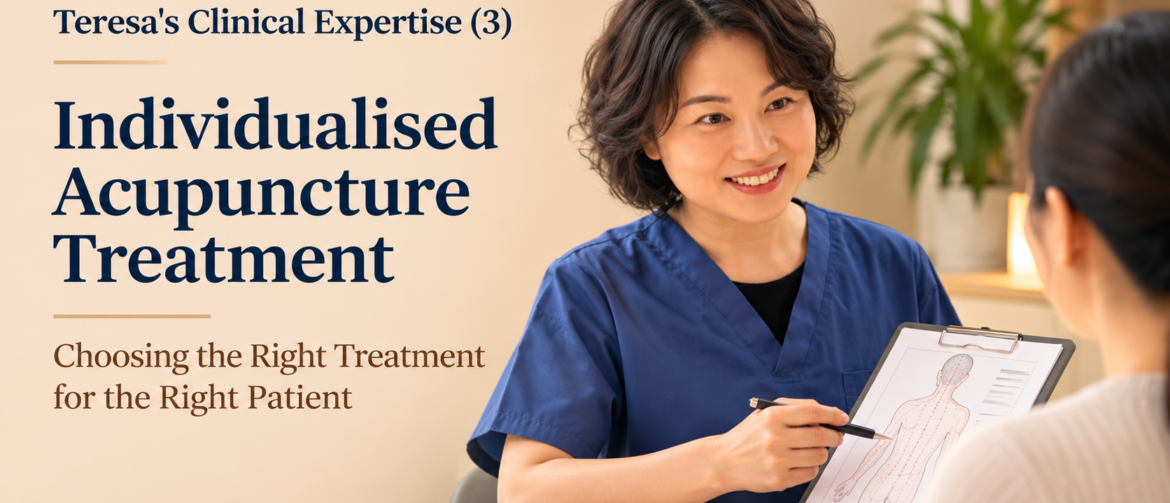
Teresa’s Clinical Expertise | Individualised Acupuncture Treatment
Choosing the Right Treatment for the Right Patient
1. Is Acupuncture Appropriate for This Patient?
Individualised acupuncture treatment begins before the first needle is inserted.
When a patient comes to see me, my first responsibility is to assess whether acupuncture is appropriate for their condition.
Not every health problem can or should be managed primarily with acupuncture. Some conditions may benefit from acupuncture as part of a wider treatment plan, while others require medication, further medical investigation, specialist care or surgery.
I consider the patient’s symptoms, medical history, examination findings and possible warning signs before recommending treatment.
If I suspect a serious underlying condition, or the patient’s symptoms fall outside the appropriate scope of acupuncture care, I recommend assessment by their GP or an appropriate specialist. Urgent symptoms require urgent medical attention.
Knowing when acupuncture is appropriate, and when another form of medical care is needed, is the first step in individualised treatment.
2. Establishing a Clear TCM and Medical Diagnosis
Once acupuncture is considered appropriate, the next step is to understand what is causing the patient’s symptoms.
My assessment combines Traditional Chinese Medicine (TCM) pattern differentiation with relevant modern medical knowledge.
TCM assessment considers meridian pathways, Zang-Fu patterns and the Eight Principles. Modern clinical assessment helps identify the possible anatomical structures, functional problems or medical conditions involved.
For example, two patients may both complain of shoulder pain. One may have a local shoulder tendon problem, while another has symptoms related to the cervical spine or a peripheral nerve.
Although the painful area appears similar, their assessment findings and treatment targets may be different.
A clear working diagnosis helps guide point selection, treatment techniques and realistic treatment goals. When the diagnosis remains uncertain, I consider further investigation or referral rather than assuming the cause.
3. Different Patients Need Different Treatment Plans
Even when patients have the same diagnosis, they do not necessarily need the same acupuncture treatment.
I consider their age, physical condition, duration of symptoms, severity, functional limitations and previous treatment response.
For example, a younger patient with a recent muscular injury may require a different treatment approach from an older patient with longstanding pain, reduced mobility and several other health concerns.
These differences influence the choice of acupuncture points, treatment intensity, session frequency and recovery goals.
I also review the patient’s response during treatment. Changes in pain, movement, sleep and daily activities help me decide whether to continue, modify or reconsider the treatment plan.
An individualised approach means adjusting treatment according to the patient’s progress rather than repeating the same procedure at every appointment.
4. Selecting Appropriate Acupuncture and Related Techniques
Individualised care also involves choosing suitable treatment techniques.
Alongside conventional acupuncture, I may consider other traditional methods when clinically appropriate.
Penetrating needling is a traditional acupuncture technique in which the needle is directed towards another point or along a selected tissue region. Its use depends on the anatomical location, treatment objective and safety considerations.
Bloodletting therapy may be considered in selected cases within traditional Chinese medicine practice, following appropriate assessment, informed consent and infection-control procedures.
Moving cupping involves moving a lubricated cup over a suitable body region. It may be used as part of treatment for selected muscular and soft-tissue complaints.
These methods are not suitable for every patient. I consider their indications, contraindications, potential risks and the patient’s preferences before using them.
Using more techniques does not necessarily produce better results. The purpose is to select an appropriate method for the individual patient’s condition.
My Clinical Approach
For me, individualised acupuncture is a clinical decision-making process.
First, I determine whether acupuncture is appropriate. Second, I establish a TCM assessment and a medical working diagnosis. Third, I consider the patient’s individual circumstances. Finally, I select and adjust the treatment methods according to their needs and response.
The aim is not to fit every patient into a standard acupuncture treatment, but to choose a treatment approach that fits the patient.
By Teresa Shen, BHSc (Acupuncture), ACC Registered Treatment Provider, Registered Chinese Medicine Practitioner (NZ)
Last updated: 24 November 2026
Disclaimer: This article describes an individual practitioner’s clinical approach for educational purposes. Acupuncture suitability and treatment decisions require individual assessment. Acupuncture does not replace necessary medical investigation or specialist care.
Book an Appointment at PhD Win Acupuncture Clinic



 中文微信:nzacupunctureclinic


Leave a reply