
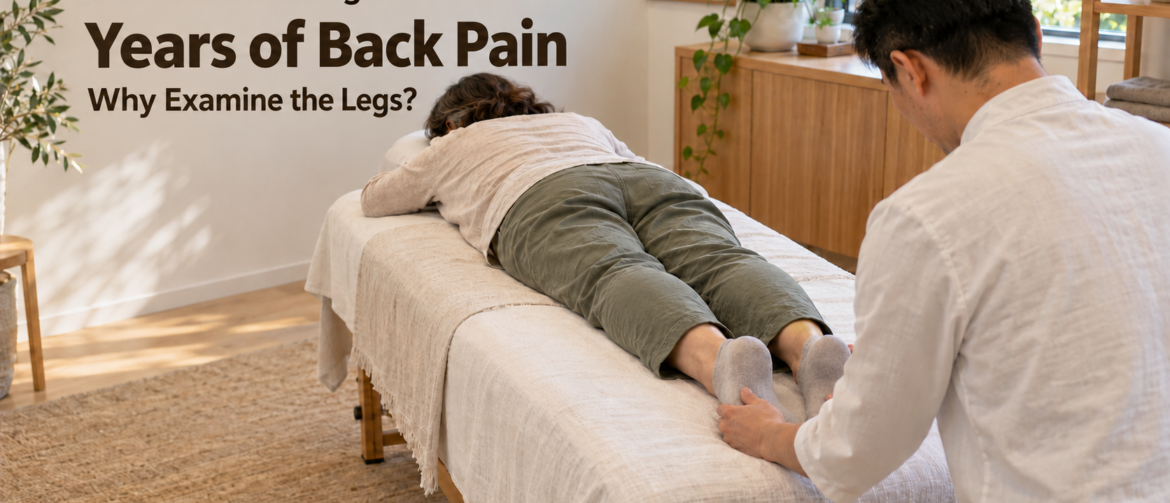
Years of Lower Back Pain: Why Did I Examine Her Legs First?
Follow Dr Win Huang’s Clinical Reasoning (27)
A long-term lower back pain case, from an apparent leg-length difference to lasting improvement in daily life
By Dr Win Huang, PhD (Chinese Medicine & Acupuncture)
After Years of Pain, She No Longer Expected Much Improvement
This patient was a woman in her fifties who had travelled from China to Auckland to visit her daughter.
Her daughter had been my patient for many years. Knowing that her mother had lived with lower back and shoulder pain for a long time, she brought her to my clinic to see whether anything more could be done.
The patient told me that her lower back pain had continued for many years. She had undergone several investigations and tried acupuncture, cupping and physiotherapy in China. Treatment sometimes gave temporary relief, but the pain always returned.
One doctor had told her, “It is an old problem. It cannot be cured, so you do not need to worry about it.” Over time, she gradually accepted that the pain might simply be something she had to live with.
Her pain was not severe all the time. It was closely related to posture and daily activity. Sitting for too long brought on discomfort, and prolonged standing also caused pain.
Everyday activities involving sustained bending were particularly difficult. Brushing her teeth, washing dishes and preparing food could all make her lower back uncomfortable if she remained bent forward for more than a short time. She often had to stop or change position.
After sitting through a long flight to New Zealand, her lower back pain became considerably worse. Her daughter then brought her to my clinic.
The Pain Was near the Right Sacroiliac Joint—but Was That the Whole Problem?
At the first assessment, I began by identifying the main location of pain. It was not spread across the whole lower back. It was concentrated on the right side of the lumbosacral region, close to the sacroiliac joint.
Palpation revealed clear tenderness around the right sacroiliac region, corresponding with the area she usually described as painful.
Local muscles, ligaments and tissues around the sacroiliac joint were therefore reasonable possibilities. However, one question made me continue the examination.
She had received local treatment for years. It sometimes reduced the pain, but the improvement had never remained stable.
We had located the painful area, but why did the same area continue to become painful?
I decided to examine the pelvis and compare both lower limbs.
Comparing Her Legs Revealed an Important Difference
I asked the patient to lie prone with both legs resting naturally and compared the positions of her heels. Her right lower limb appeared noticeably longer than the left, with the right heel sitting lower.
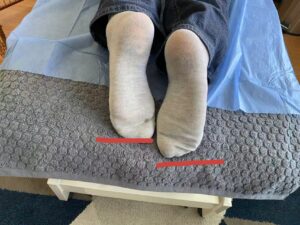
This did not automatically mean that the bones of one leg were longer. Clinically, we need to distinguish between a true structural leg-length difference and an apparent or functional leg-length discrepancy.
A structural discrepancy means that the actual bony lengths differ. A functional discrepancy may occur when the bony lengths are similar, but pelvic position, hip posture, muscle tension or lumbosacral function makes one leg appear longer during examination.
Comparing heel positions alone cannot prove a structural difference or identify one specific joint as the cause. It is a clinical clue that must be considered together with the pain location, pelvic findings, movement and reassessment after treatment.
In this patient, the right sacroiliac region was markedly tender and the right leg appeared longer. This led me to consider whether her recurring right lumbosacral pain might be associated with a functional imbalance involving the pelvis and sacroiliac region.
Shifting the Treatment Focus towards Pelvic Function
Based on the assessment, I used a gentle manual adjustment. In my clinical practice, I refer to this approach as a gentle bone-setting technique.
It does not depend on forceful manipulation or aim to produce a joint-cracking sound. The intention is to use relatively gentle techniques to address a possible functional imbalance around the pelvis and lumbosacral region.
Instead of repeatedly treating only the most painful point on the right side, I focused on the wider functional relationship that might have been affecting load and movement through the area.
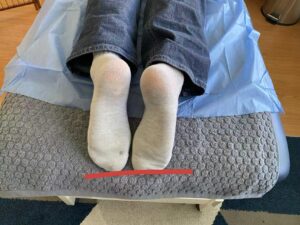
After the manual treatment, I asked her to lie prone again and compared the heel positions. The previous difference had clearly reduced, and the two heels were now much closer to the same level.
I then asked her to stand and repeat the forward-bending movement that had previously caused pain. Her pain was clearly reduced, and she could bend more fully.
The important finding was not simply that the heels looked more even. It was that the change in heel position occurred at the same time as reduced pain and improved bending.
This suggested that the treatment direction may have been clinically meaningful. However, an immediate response after one treatment could not prove the entire cause of her long-term pain. The next question was whether the improvement would last.
Would the Improvement Continue?
Her lower back pain improved considerably after one or two treatments. She also had long-term shoulder pain and continued attending the clinic for shoulder treatment, which gave me an opportunity to follow her lower back recovery.
More than two months later, she reported that the previous significant lower back pain had not returned.
In the past, sitting or standing for a relatively short period would provoke pain. She could now remain in these positions much longer without the previous problem. Brushing her teeth, washing dishes and cooking had also become easier because sustained bending no longer affected her in the same way.
She was very satisfied with the result and later left a Google review.

Her recovery was not limited to temporary relief on the treatment day. The improvement in daily function had remained for more than two months.
Considering the long history of recurring pain, the findings before treatment, the immediate change after manual adjustment and the subsequent follow-up, I believe that changing the treatment direction towards pelvic function provided a useful clinical lesson.
Long-Term Lower Back Pain: Look beyond the Painful Point
This case reminded me of a common clinical problem. Some patients have lived with lower back pain for years. They may have undergone investigations and received acupuncture, cupping, physiotherapy or other local treatments. Each treatment may help temporarily, but the same pain returns.
At that point, we should ask whether something beyond the painful area continues to affect loading and movement through the lower back.
Is there an apparent pelvic tilt? Do the lower limbs appear unequal during examination? Are there clear differences in hip movement or muscle tension? Do these findings correspond with the patient’s pain pattern and functional limitations?
When a patient has marked tenderness around the sacroiliac region together with an apparent leg-length difference, I believe the functional state of the lumbosacral–pelvic region deserves further assessment.
If the examination suggests a modifiable functional imbalance, gentle manual adjustment may sometimes be more relevant than repeatedly treating only the painful point.
This case does not mean that all chronic lower back pain comes from the pelvis. Nor can pelvic misalignment be diagnosed from heel position alone.
Its real lesson is more practical:
When a painful area has been treated repeatedly for years without stable improvement, it may be time to look away from the painful point and reassess the wider functional relationship.
Following Dr Win Huang’s clinical reasoning is not about seeing unequal heel positions and immediately applying an adjustment. It is about reassessing a long-standing problem, changing direction when appropriate, and using functional change and follow-up to test the reasoning.
Online Appointment
Has Your Lower Back Pain Continued to Return?
Long-term lower back pain may involve local soft tissues, the lumbar spine, sacroiliac joints, hips, pelvic function and daily loading patterns. The painful location may not fully explain why symptoms continue to recur.
At PhD Win Acupuncture Clinic, we consider the pain pattern, daily function, pelvic and lower-limb findings, and changes after treatment before deciding whether acupuncture, manual therapy or further medical assessment may be appropriate.
Button: Book an Appointment
Disclaimer
This article is based on an individual clinical case and shares general clinical reasoning and health information. Some non-essential details may have been adjusted to protect patient privacy. It does not replace personalised medical assessment, physical examination, imaging or diagnosis.
Comparing heel positions while lying prone is only one functional observation. It cannot by itself confirm a true difference in bony leg length or diagnose a structural pelvic or sacroiliac abnormality. The response described relates to this patient during the reported follow-up period and does not guarantee the same outcome for others.



 中文微信:nzacupunctureclinic


Leave a reply