
Dr Huang’s Clinical Reflections (8) Why Do Some Western Patients Say “I’m Much Better,” While Some Asian Patients Say “I’m Still Not Better”?
By Dr Win Huang, PhD (Chinese Medicine & Acupuncture)
Over many years in clinical practice, I have gradually noticed an interesting pattern.
After treatment, some Western patients often say:
“Dr Win, I’m much better.”
Many Asian patients, by contrast, are more likely to say:
“Dr Win, why do I still have pain?”
Over time, I began to realise that they are not always describing different treatment results.
Sometimes, they are describing exactly the same result from two different reference points.
The First Layer: Cultural Difference
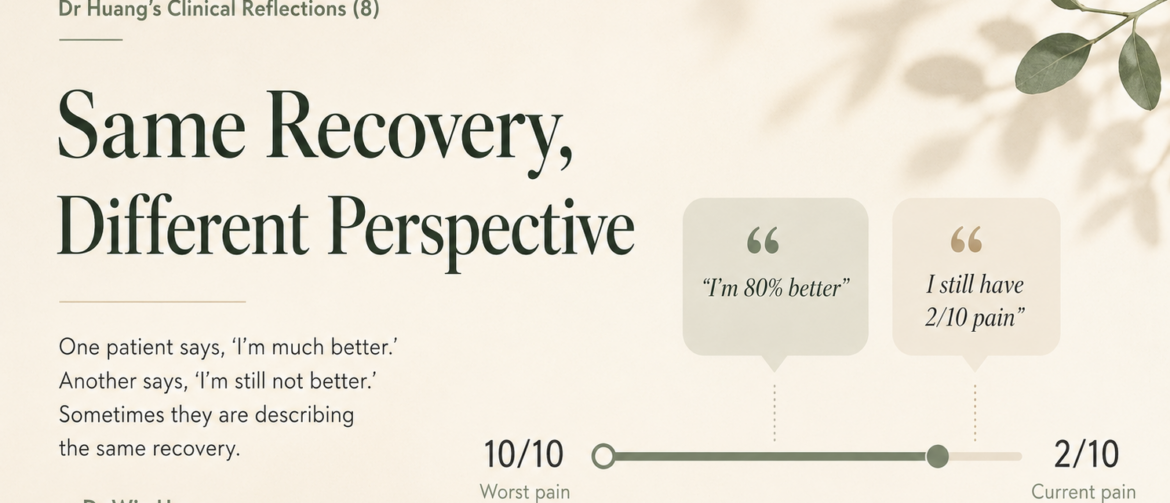
Imagine that a patient’s pain has improved from 10 out of 10 to 2 out of 10.
One person may say:
“I’m 80% better.”
Another may say:
“I still have 2 out of 10 pain.”
Both statements are correct.
The difference is what they are looking at.
One person focuses on how much has already improved.
The other focuses on what is still left.
In my experience, this difference is sometimes influenced by culture and education.
Many Western educational environments place strong emphasis on encouragement, confidence, positive reinforcement and recognising achievement.
Children frequently hear:
“Well done.”
“Great job.”
“You’ve improved a lot.”
The focus is often on progress.
In many Asian families and educational systems, the emphasis may be different.
Children are often encouraged to keep improving, correct weaknesses and aim for a higher standard.
A child who receives 95 out of 100 may hear:
“Where did the other five marks go?”
The intention may be positive. It is usually about improvement, discipline and not becoming complacent.
But over time, some people may develop a habit of noticing what is still missing before noticing what has already been achieved.
I do not think one way is simply right and the other wrong.
They are different reference systems.
The Second Layer: The Experience Between Clinician and Patient
Treatment is not only a technical process.
It is also a process that the clinician and patient go through together.
When many Western patients return for follow-up, they may begin by telling me what has improved:
“I’m sleeping much better.”
“I can stand straighter now.”
“My shoulder moves much more freely.”
If I then ask what is still not completely normal, they may say:
“I still wake once during the night.”
“It hurts slightly at the very end of bending.”
“There is still a little stiffness at the top of the movement.”
They report progress first, and remaining problems second.
Many Asian patients may begin in the opposite way:
“It still hurts.”
“It is still numb.”
“It is still not completely better.”
Then, when I ask:
“How does it compare with your first visit?”
they may say:
“Oh, of course it is much better.”
“Before, I could not straighten my back.”
“Before, I could not sleep at all.”
“Before, I could not climb stairs.”
This made me realise that sometimes the treatment result is not very different.
The communication style is.
And that difference can influence the atmosphere of treatment.
When a patient regularly recognises progress, both patient and clinician can clearly see that recovery is moving forward.
Trust becomes easier to build, and the treatment process often feels more cooperative.
If every conversation focuses only on what has not yet recovered, even 90% improvement can feel like failure because all attention is placed on the remaining 10%.
That can be frustrating for both sides.
The Third Layer: Can This Way of Thinking Affect Recovery?
Recovery is not only about tissue healing.
It also involves expectation, confidence, emotion and behaviour.
If a patient notices:
“I am better today than I was last week,”
the message they receive is:
“My body is recovering.”
They may become more willing to move, exercise, sleep normally, return to activity and participate in rehabilitation.
Fear may decrease.
Confidence may increase.
This can create a more constructive cycle.
On the other hand, if a person constantly thinks:
“There is still something wrong.”
“I am still not normal.”
“I am still a patient,”
they may naturally pay more attention to pain, numbness and every small abnormal sensation.
Does that actually slow recovery?
I do not think we should make such a simple conclusion.
Optimistic people do not necessarily recover faster, and people who worry are not automatically causing their own illness.
Recovery is affected by many biological, psychological and social factors.
But I increasingly feel that what a person repeatedly focuses on can influence what they notice, how they interpret symptoms and how they behave.
And behaviour can, in turn, influence recovery.
For me, this remains a clinical observation rather than a fixed rule.
The Fourth Layer: A Difference in How We Look at Life
Perhaps this is not only about illness.
Some people spend much of their life noticing what they already have.
Others spend much of their life noticing what they still lack.
The first group may find it easier to feel satisfied.
The second group may be driven to keep improving, but may also become more easily tired or dissatisfied.
In that sense, the different ways patients describe recovery may simply be two broader ways of looking at life.
One person is looking back and saying:
“I have already walked 90% of the distance.”
Another is looking forward and saying:
“I still have 10% to go.”
They are standing on the same road.
They are simply looking in different directions.
My Clinical Reflection
This is only an observation from many years of clinical practice.
It is not a rule that applies to every Western or Asian patient, and cultural background is only one of many factors that shape how people describe illness and recovery.
But the pattern has made me think more carefully about how patients understand progress.
When I assess recovery now, I try not to ask only:
“Do you still have pain?”
I also ask:
“What can you do now that you could not do before?”
“How much better are you compared with the beginning?”
“What is still limiting you?”
These questions give a more balanced picture.
Because recovery should include both sides:
what has improved, and what still needs work.
Perhaps the most useful perspective is not to ignore the remaining 10%, but also not to forget the 90% that has already been recovered.
Book an Appointment
Book a Clinical Assessment
Recovery is not measured only by whether symptoms are completely gone. Function, sleep, movement, pain intensity and daily activity all help show whether treatment is moving in the right direction.
Book online:
https://booking.mananotes.co.nz/PHD-WIN/v2
Disclaimer
Disclaimer:
This article reflects clinical observations and is intended for general educational purposes only. Individual attitudes toward illness and recovery vary widely and should not be assumed based on cultural background alone. Recovery is influenced by many physical, psychological and social factors.
Related Reading
Dr Win Huang’s Clinical Thinking (11) A Doctor Sees More Than a Diagnosis — They See Clues



 中文微信:nzacupunctureclinic

Leave a reply