

Dr Huang’s Clinical Reflections (4) Why I Like My Low Back Pain Patients to Lie Face Down and Move Their Hips
A few days ago, a patient who had been suffering from low back pain for more than six months came to see me.
His biggest problem was not actually pain.
It was the feeling that his back had become “stuck.”
Whenever he tried to bend forward, he could only get halfway down before feeling blocked, as if something was physically stopping him from moving any further. Picking objects up from the floor had become difficult. His hands could only reach the upper part of his lower legs. Any further movement felt impossible.
At the same time, raising his leg would pull on his lower back. The movement felt painful, weak, and restricted.
These symptoms had been present for a long time. He had already tried acupuncture and several other forms of treatment, but the improvement was limited.
After examination, I felt that the problem was mainly related to dysfunction involving the psoas muscle and associated lumbar muscle groups.
During treatment, I did not start by working directly on the lower back. Instead, I used a distal point at Tianzhu (BL10) in the neck region.
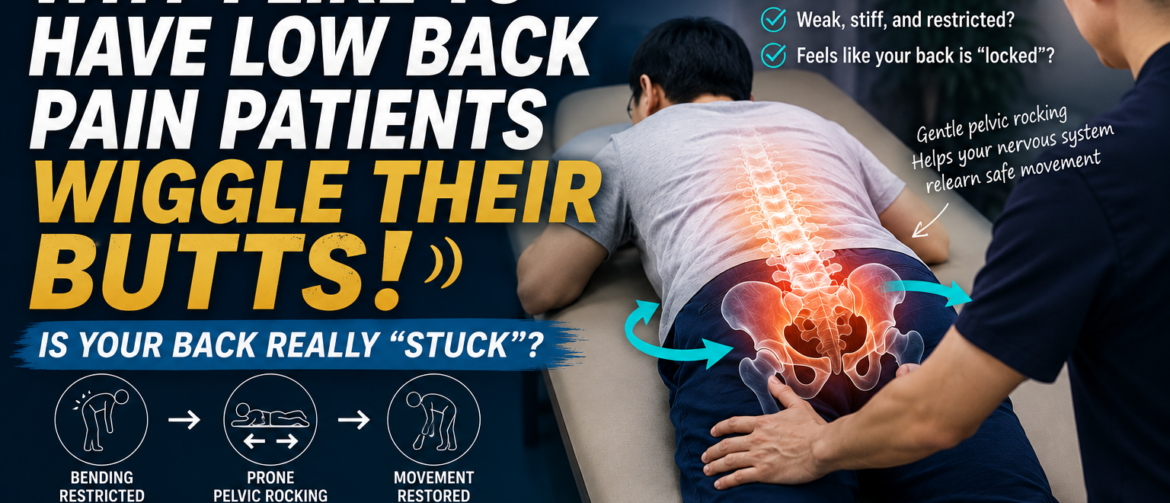
After needling, I asked him to lie face down on the treatment table and do something that many patients find a little unusual.
I asked him to start moving his hips.
More specifically, I asked him to gently rock his pelvis from side to side while allowing the lower back to move naturally.
He continued this for about ten minutes.
Afterward, I asked him to stand up and bend forward again.
The result was interesting.
The point where his movement previously stopped had disappeared. His hands could now reach the floor, and the pulling sensation during leg raising was significantly reduced.
The patient was surprised himself.
He said:
“That stuck feeling is gone.”
Over the years, I have treated many patients with similar presentations.
As I continued seeing these cases, I began asking myself a question:
Why does moving in a face-down position often work better than moving while standing?
Perhaps the Problem Is Not the Muscle Itself
Many people assume that low back pain and restricted bending occur because the muscles are tight.
Therefore, treatment should focus on loosening the muscles.
However, over the years I have become increasingly unconvinced that this explanation is complete.
If the problem were purely due to muscles, ligaments, or fascia, it would be difficult to explain why some patients regain such a large amount of movement within ten minutes.
Muscles do not suddenly lengthen in ten minutes.
Ligaments do not suddenly loosen in ten minutes.
Fascial tissues do not completely remodel in ten minutes.
Yet the patient’s movement clearly improved.
So what exactly changed?
I increasingly suspect that what is being removed is not simply a restriction in the local soft tissues.
It may be a restriction imposed by the nervous system.
Why Does the Back Feel “Stuck”?
Patients often tell me:
“My back feels locked.”
In reality, most of the time nothing is physically locked.
A bone is not stuck.
A joint is not jammed.
A disc is not suddenly blocking movement.
What may actually be happening is that the nervous system has activated a protective program.
When the brain perceives a movement as potentially threatening, it can automatically increase muscular protection.
Muscle activity rises.
Range of motion decreases.
Movement stops earlier than normal.
The patient experiences this as:
“I can’t bend any further.”
“My back is locked.”
“Something feels dangerous if I keep going.”
From a pain science perspective, this resembles an active braking system rather than a mechanical failure.
The patient experiences restriction.
The nervous system experiences protection.
Why Is Moving the Hips While Lying Face Down More Effective?
When a patient is standing, the muscles of the lower back are still responsible for supporting the body.
The body must maintain balance.
Prevent falling.
Control posture.
In other words, the muscles are still working.
When the patient lies face down on the treatment table, the situation changes completely.
The table supports the body’s weight.
The anti-gravity system has much less work to do.
The lumbar muscles no longer need to remain constantly active.
More importantly, the nervous system receives a different message:
“This is safe.”
Gentle movement in this position creates a low-threat environment in which movement can be relearned.
The nervous system gradually discovers that bending is not causing injury.
The pelvis can move safely.
The movement itself is not dangerous.
As this perception changes, protective muscle activity begins to decrease.
The braking system starts to release.
Movement returns naturally.
From this perspective, I am not simply asking the patient to move the lower back.
I am helping the nervous system rebuild trust in that movement.
Sometimes I Am Not Treating the Back
Many treatments that appear to be focused on “loosening muscles” may actually be influencing the nervous system that controls those muscles.
Patients often believe their back is tight.
In reality, the brain may be protecting the back too aggressively.
Patients think they cannot bend further.
In reality, the nervous system may simply be refusing to allow further movement.
Sometimes treatment is about creating an opportunity for the nervous system to reconsider the movement.
To recognise it again.
To feel safe again.
To release a protective brake that may have been present for months or even years.
That is one reason why I increasingly like having certain low back pain patients perform gentle movements while lying face down.
In many cases, what is being released may not simply be muscle tension.
My Reflection
Earlier in my career, I always searched for the tightest muscle.
I believed that if I could find it and release it, the problem would be solved.
Over time, however, I have come to appreciate that while muscles are important, there is a larger control system behind them.
Sometimes pain is not simply the result of tissue damage.
It is the nervous system’s response to that damage.
Sometimes movement restriction is not because the structure physically cannot move.
It is because the nervous system believes it should not move.
For that reason, treatment is not always about repairing tissues.
Sometimes it is about helping the body regain a sense of safety.
When safety returns, movement often returns as well.
Restrictions that seemed permanent can suddenly disappear.
Perhaps this is why some patients experience dramatic improvements in movement within only ten minutes.
What changes may not be the muscle itself.
It may be the nervous system’s judgement of the movement.
Related Clinical Reflections
Clinical Reflections (1) Where Does All the Phlegm Come From? Why Did an Elderly Woman’s Morning Phlegm Drop from 80ml to 10ml After One Treatment?
Clinical Reflections (2) Why Are Rotator Cuff Tests So Accurate in Textbooks Yet Increasingly “Inaccurate” in Clinical Practice?
Clinical Reflections (3) The Dizziness Patient Already Had an Answer, But I Still Said No
Clinical Reflections (4) Why I Like My Low Back Pain Patients to Lie Face Down and Move Their Hips
Clinical Reflections (5) – What Is the Responsibility of a Good Doctor?
Book an Appointment
If you suffer from chronic low back pain, difficulty bending forward, movement restriction, persistent back stiffness, or recurring lumbar discomfort, you are welcome to book an assessment at Dr Huang TCM Clinic.
Online Booking:



 中文微信:nzacupunctureclinic

2 comments