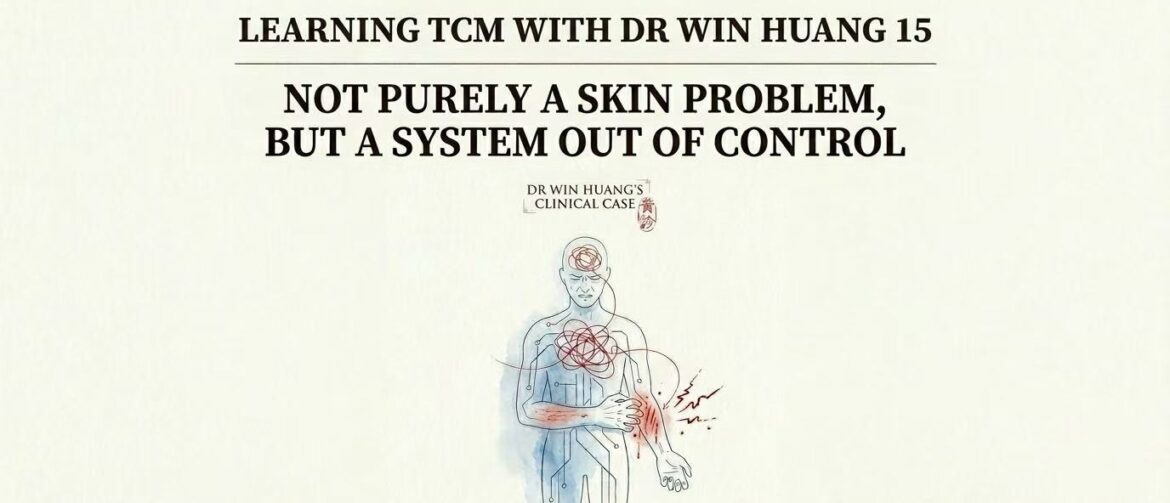
Not a Skin Problem, but a System Out of Control
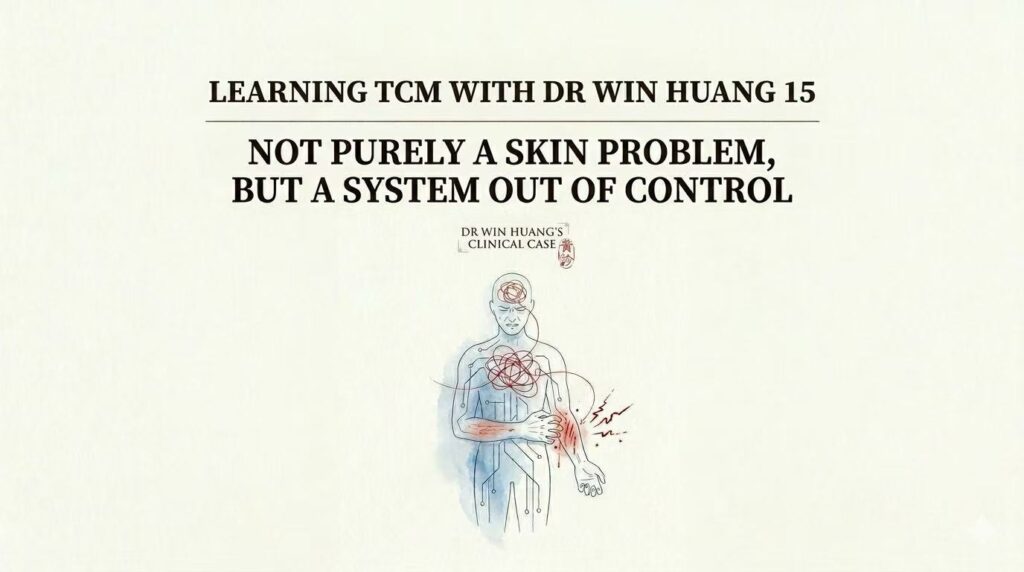
Follow Dr Huang to Learn Clinical Diagnosis (Case 15)
Not a Skin Problem, but a System Out of Control
This case is not complicated.
Its value is not in how difficult it is, but in whether you can clearly see what is really happening when everything looks chaotic.
This patient is one of my regulars, around fifty years old.
As soon as he walked in, he said:
“Dr Huang, please help me. I am itching all over. I can’t stand it.”
He told me the itching started suddenly at around 2 a.m. and had continued until now.
He had already taken anti-allergy medication three times and applied topical creams, but nothing worked.
He could not sit still.
He kept scratching, rubbing, and moving.
Some areas of the skin were already broken, with visible scratch marks and slight bleeding.
At this point, this is no longer just “itchy skin.”
The whole person is being pulled into it — irritated, anxious, exhausted, and losing control.
If a doctor focuses only on the skin at this moment, it is very easy to go in the wrong direction.
You start thinking: Is it allergy? Urticaria? Should we change medication? Add steroids?
Even wondering whether acupuncture can help.
But my judgment at that moment was very simple:
This is not about treating the skin.
This is about bringing the patient out of a state of loss of control.
I did not explain much.
I asked him to lie down and started acupuncture.
The point selection was also very clear — not targeting the skin, but aiming to calm the system and reduce the itch.
After needling, I did not interrupt him again.
I asked him to close his eyes.
If he could not sleep, that was fine — just imagine something relaxing, like the sky or clouds, and breathe slowly.
I told him I would come back in ten minutes.
When I returned, he was already different.
He said, “The itching is still there, but it’s not unbearable anymore.”
He was much calmer.
A little later, when I checked again, he had fallen asleep.
This whole process was very clear.
From being restless and overwhelmed, to gradually calming down, and finally falling asleep —
the system moved from chaos back to stability.
This itching may have started as a peripheral sensory stimulus.
But once it triggers emotion, it quickly enters an amplification loop:
More itch → more irritation
More irritation → more scratching
More scratching → stronger stimulation
Stronger stimulation → more itch
A classic vicious cycle.
So my job was not to “eliminate the itch,”
but to stop this loop at a certain point.
Once the loop is interrupted, the direction begins to change.
When the itch reduces slightly, the patient becomes less anxious.
When the emotional state settles, the overall level of nervous system excitation decreases.
When scratching stops, secondary skin irritation is reduced.
Then the symptoms continue to improve.
The vicious cycle turns into a positive one.
For me, the most important part of this case is not that “the itch was relieved.”
It is a reminder:
In clinical practice, many problems that appear local are actually systemic.
What a doctor needs to do is not only fight the symptom,
but at the right moment, bring a dysregulated system back to a state where it can regulate itself again.



 中文微信:nzacupunctureclinic