
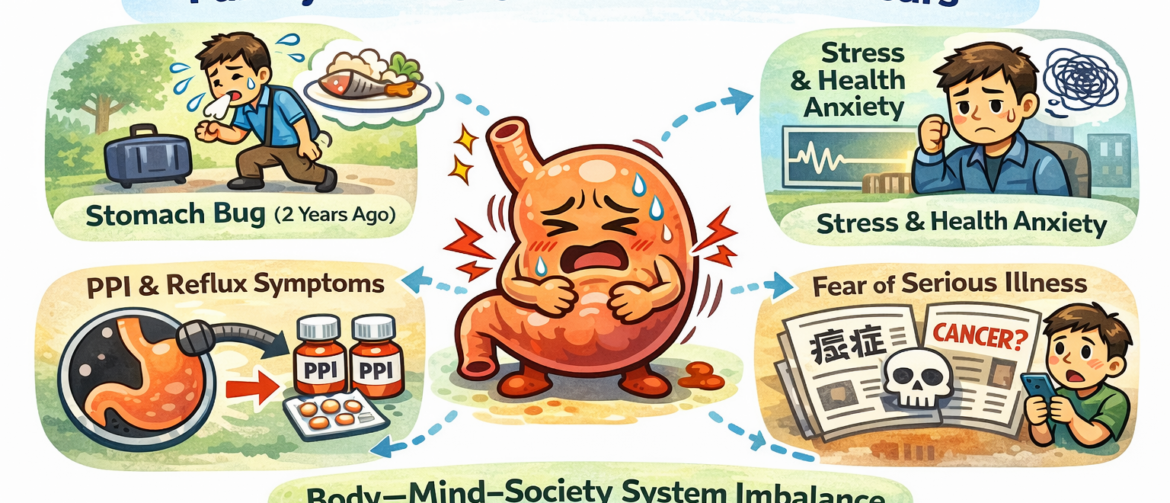
Case 4 | Paroxysmal Epigastric Pain for 2 Years
From an Acute Gastrointestinal Event to a Body–Mind–Society–Spirit System Imbalance
① Case Background
Patient:
Male, 30 years old, Kiwi, solid build, carpenter.
Timeline of the Condition
Approximately 2 years ago (initial event)
During overseas travel, the patient developed sudden nausea, vomiting, diarrhea, and abdominal pain, a presentation consistent with acute gastroenteritis / travel-related gastrointestinal disturbance.
After returning to New Zealand
The acute symptoms resolved, but residual issues persisted, including:
-
Ongoing gastric discomfort
-
Mild nausea
-
Heightened sensitivity to food
Subsequent GP management
The patient was prescribed proton pump inhibitors (PPIs) for approximately 3 months.
During PPI use, symptoms did not improve and gradually worsened.
After stopping PPI therapy
Over the following 6 months, gastrointestinal function gradually stabilized.
However, mild discomfort, occasional epigastric pain, and nausea remained.
The patient became extremely cautious with diet.
Past 2 months
Following a dietary trigger, symptoms recurred, including epigastric pain, nausea, and occasional diarrhea.
Although symptoms could settle spontaneously, psychological burden increased significantly.
Current acute episode (2 days prior to consultation)
The patient developed:
-
Severe abdominal pain
-
Marked nausea and vomiting
-
Diarrhea
Symptoms were intense and no longer tolerable.
Previous Investigations
Gastroscopy findings:
-
Gastric body, antrum, and duodenum essentially normal
-
No gastritis, no ulceration, no malignancy
-
Presence of fundic gland polyps
-
Lax lower esophageal sphincter
② Four-Level Thinking Analysis
Level 1 | Symptom Layer – What Is Observed
-
Paroxysmal epigastric pain
-
Nausea and vomiting
-
Diarrhea
-
High sensitivity to food stimuli
-
Recurrent, fluctuating symptom pattern
At this level, the case appears to be recurrent gastrointestinal discomfort, easily labeled as a “stomach problem.”
Level 2 | Functional / Organ Layer – Is the Stomach Itself Diseased?
The core question at this level is:
👉 Is there structural or organic damage to the stomach?
Key evidence:
-
Gastroscopy structurally normal
-
No inflammation, ulceration, or malignancy
-
Fundic gland polyps insufficient to explain symptom severity
-
Acid suppression with PPIs ineffective and even aggravating
Conclusion at this level:
This is not an organic gastric disease.
Continuing along a “gastritis / acid / GERD” pathway would lead only to repeated investigations and medication changes, without explaining symptom intensity or fluctuation.
Level 3 | Whole-System Layer – Gastrointestinal–Autonomic Dysregulation
When symptoms are viewed within the whole system, several features stand out:
-
Upper GI involvement (nausea, vomiting)
-
Lower GI involvement (diarrhea)
-
Triggered, episodic loss of control
-
Strong influence of attention, emotion, and worry on symptoms
This pattern is highly consistent with:
Dysregulation of the gastrointestinal–autonomic nervous system
In other words:
-
The stomach is not “damaged”
-
The intestines are not “infected”
-
The problem lies in system-level regulation
At this level, long-term PPI use did not correct regulation.
Instead, by suppressing gastric acid and altering the digestive environment and microbiota, it may have further weakened system resilience.
Level 4 | Spirit-Level (Psychological–Social–Information Environment)
This is the deepest and most critical layer of this case.
1️⃣ Psychological imprint of the initial acute event
A genuine, severe episode of acute gastroenteritis created a lasting fear of recurrence.
The patient became hypervigilant to any gastrointestinal sensation.
2️⃣ Modern disease information environment
In contemporary society:
-
Media, internet, and social platforms repeatedly emphasize
“stomach cancer,” “bowel cancer,” “serious illness in young people” -
Many individuals live in a state of cancer-related fear
This information environment is not neutral; it amplifies catastrophic interpretations of bodily sensations.
3️⃣ Behavioral adaptations becoming part of the problem
Over time, the patient developed:
-
Excessive dietary restriction
-
Avoidance of cold, spicy, or “stimulating” foods
-
Constant monitoring of gastrointestinal sensations
The result:
-
Chronic defensive autonomic state
-
Reduced adaptive capacity
-
Minor stimuli triggering disproportionate reactions
4️⃣ Key physical examination finding
-
No focal epigastric tenderness
-
Generalized abdominal tension and rigidity
This is a classic somatic manifestation of high autonomic tone associated with anxiety and vigilance.
③ Treatment Strategy
The therapeutic goal is not to “treat the stomach”, but to:
Restore global stability of the gastrointestinal–autonomic system
Core principles
-
Remove fear of organ damage
Clearly explain that the stomach “hardware” is intact and there is no serious disease. -
Avoid treatment at the wrong level
Discontinue unnecessary acid suppression and excessive interventions. -
Rebuild healthy life patterns
-
Regular daily rhythm
-
Post-work physical activity, exercise, stretching
-
Shift attention away from constant gut monitoring
-
-
Gradually restore dietary confidence
-
Avoid rigid dietary fear
-
Stop interpreting every discomfort as danger
-
The focus is system reset, not short-term symptom suppression.
④ Clinical Insight
This case illustrates that, in modern society, many conditions labeled as “gastric disease” are actually the result of:
Systemic dysregulation combined with disease-related fear
When clinicians remain confined to:
-
Organs
-
Investigations
-
Medications
Patients enter a cycle of:
-
More tests → more fear
-
More treatment → more chaos
-
Increasing system tension
The value of Four-Level Thinking lies in:
-
Identifying the correct level
-
Avoiding harm at the wrong level
-
Intervening where the system can truly recover
One-sentence summary
This is a body–mind–society–spirit integrated functional gastrointestinal disorder, initiated by an acute gastrointestinal event, maintained by systemic dysregulation, and amplified by modern information-driven disease fear.



 中文微信:nzacupunctureclinic

Leave a reply