
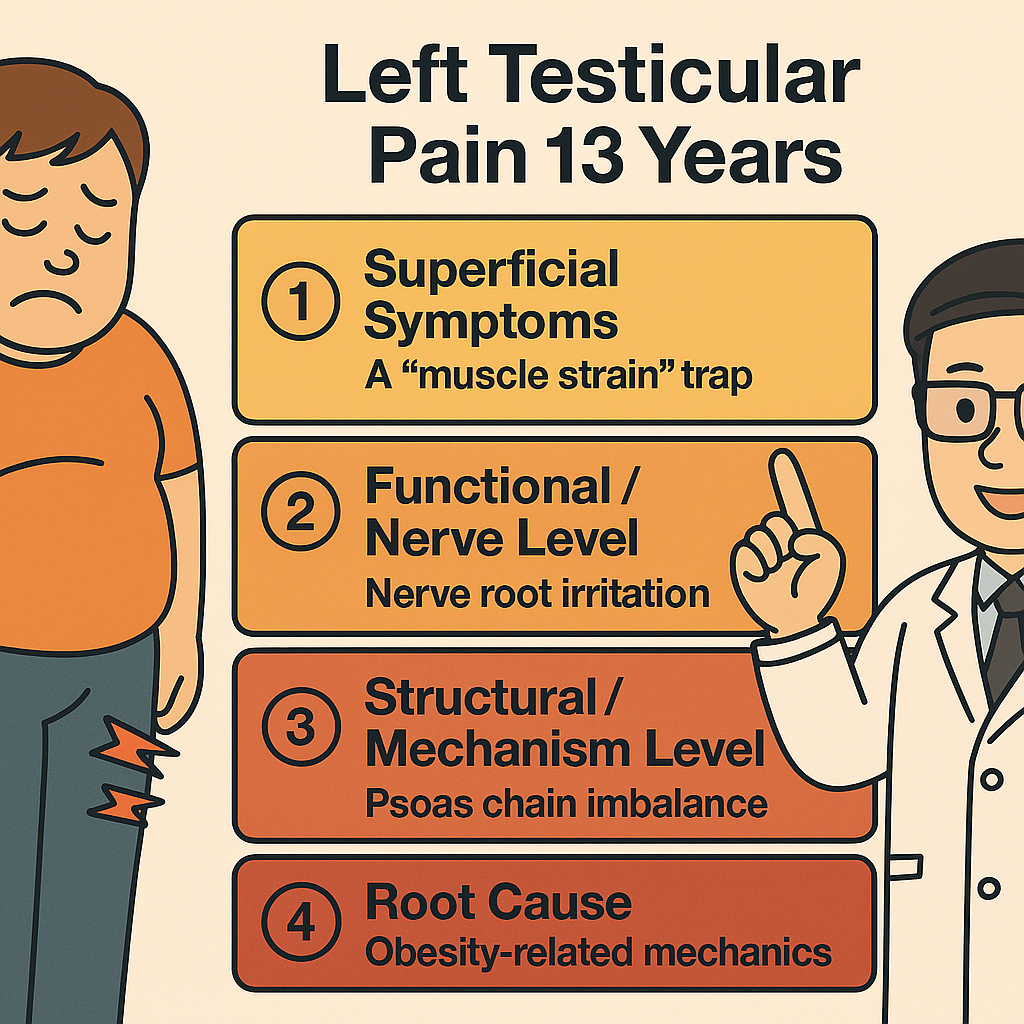
Case 2|Left Testicular Pain: A Psoas Chain–Induced Neural Traction Trap
① Case Background
The patient is a Kiwi male.
He has experienced left testicular discomfort for approximately 13 years, with significant worsening over the past two years.
Main symptoms:
-
Dull ache and aching sensation in the left testicle
-
A feeling of scrotal heaviness or “dragging”
-
Mild discomfort in the left inguinal region
-
Standing or prolonged walking aggravates symptoms
-
Lying down relieves symptoms
-
NSAIDs (ibuprofen, Voltaren) provide relief
-
Antibiotics have no effect
He was previously severely obese (around 130 kg) and later lost nearly 50 kg through surgery and fat-reduction procedures.
His current weight is around 90 kg.
The patient believed his symptoms might be related to a vasectomy he underwent when younger or possibly to varicocele.
One week ago, after receiving treatment at my clinic, he happily reported that he experienced several days without any pain, confirming that our diagnostic direction was correct.
② Four-Level Thinking Analysis
🔵 Level 1: Symptom Layer — Is “testicular pain” really coming from the testicle?
Typical testicular pain is often misattributed to:
-
Epididymitis
-
Varicocele
-
Post-vasectomy pain syndrome
However, this case presents several contradictions:
-
No tenderness of the testicle itself
-
No redness, swelling, or warmth
-
Antibiotics completely ineffective
-
NSAIDs effective
-
Significant improvement after a single structural treatment
All of these suggest:
👉 The problem is NOT within the testicle itself.
🟡 Level 2: Functional / Neural Layer — A classic pattern of neural traction pain
The clinical triad:
-
Dull ache
-
Dragging sensation
-
Mild inguinal discomfort
strongly suggests genitofemoral nerve traction pain.
Symptom behavior:
-
More activity → worse
-
Rest / lying down → relief
-
NSAIDs effective
-
Antibiotics ineffective
This pattern indicates:
👉 Pain arises from neural tension and traction, not infection.
🟠 Level 3: Structural / Mechanistic Layer — The psoas muscle is the true source
Three key clinical findings:
**① Deep abdominal palpation of the psoas showed:
Hypertrophy, hardness, and pain rated 6/10 on the affected side (vs 1–2/10 on the healthy side)**
→ Indicates long-term psoas tension and inflammatory thickening.
② Positive Thomas Test
→ Clear evidence of psoas shortening.
③ Audible snapping during hip flexion/extension (“snapping psoas”)
→ A classic sign of abnormal tendon glide.
These structural abnormalities create a clear chain:
Psoas hypertrophy and tightness
⬇
Traction on L1–L2 nerve roots
⬇
Irritation of the genitofemoral nerve
⬇
Manifestation as “pseudo testicular pain”
👉 The pain originates from the psoas chain, not the testicle.
🔴 Level 4: Deep Structural Layer — Obesity, rapid weight loss, and collapse of mechanical chains
This is the most critical layer in this case.
The patient had long-standing severe obesity (~130 kg).
During obesity:
-
Excess abdominal mass
-
Chronic anterior pelvic tilt
-
Psoas overactivation to stabilize the spine
-
Gradual development of chronic hypertrophy and shortening
Then he underwent rapid weight loss of nearly 50 kg.
Deep mechanical consequences of rapid weight loss:
1) The psoas, already chronically hypertrophied, does NOT regain normal elasticity simply because weight decreases
Muscle architecture remains shortened and tight.
2) Trunk stability decreases abruptly
With reduced abdominal mass,
the psoas must take on even more stabilizing work
→ continuous over-tightening
→ increased neural traction
3) Neural structures become more exposed and sensitive
Soft-tissue buffering decreases after weight loss
→ the genitofemoral nerve becomes more vulnerable to traction
→ symptoms worsen
This explains why symptoms have intensified over the past two years, forming a classic pattern of:
Obesity → chronic psoas overload
⬇
Hypertrophy + shortening
⬇
Rapid weight loss → instability
⬇
Increased neural traction
⬇
Pseudo testicular pain
③ Treatment Strategy
Goal: Release the psoas chain traction on the genitofemoral nerve.
Key steps:
1) Deep psoas release (the most critical step)
-
Abdominal deep-pressure technique
-
Needling into the psoas access points
-
Improve tendon glide and reduce muscle tone
2) L1–L2 facet mobilization
Reduce nerve-root tension.
3) Gentle release at the inguinal nerve-exit zone
Assist in reducing neural traction.
4) Establish psoas relaxation and hip-extension training
Shift the psoas from a “compensatory pattern” back to a functional pattern.
After a single treatment session, symptoms improved dramatically, repeatedly confirming the correctness of the diagnostic chain.
④ Clinical Insight
Many cases of “testicular pain” do NOT originate from the testicle itself,
but from neural traction caused by the psoas chain.
Understanding structural chains is the key to eliminating the pain.



 中文微信:nzacupunctureclinic

Leave a reply