
Dr. Huang’s Clinical Reflections | Learn Clinical Reasoning with Dr. Huang
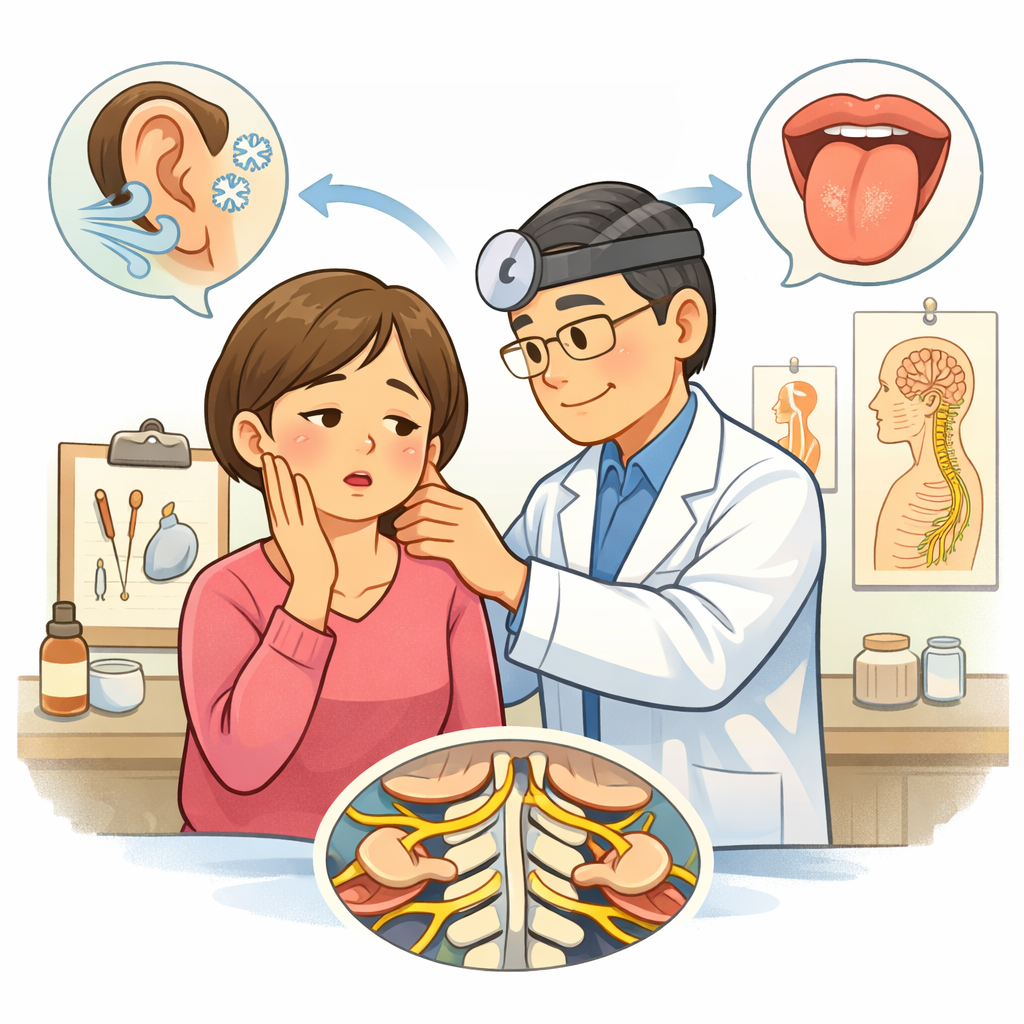
Facial Sensitivity to Wind, a “Swollen” Tongue: A Clinical Sign I Almost Overlooked
What makes this case truly interesting is not the final conclusion,
but the fact that for a long time, I treated two symptoms as two separate problems.
In reality, they originated from the same place.
1 | The Initial Complaint: Facial Sensitivity to Wind and Cold (and my treatment approach)
She first came to see me because the left side of her face was extremely sensitive to wind and cold.
In summer, when the air conditioner was on in the office, she had to wear a mask.
The pre-auricular region, the angle of the mandible, and the cheek area constantly felt cold and sensitive to airflow, sometimes radiating to the temple. This had been present for 3–4 years and had worsened significantly over the past 1–2 years, seriously affecting her work and social life.
On examination, I found:
-
Increased skin sensitivity around the left ear front, mandibular angle, and below the ear lobe
-
Pressure on the C2 transverse process reproduced pain radiating to the cheek
This was very typical in my view: great auricular nerve involvement from the cervical region.
My treatment approach at that time was clear:
Bloodletting at Tianyou (SJ16) + cupping around this cervical region to release neural pathway tension.
After several sessions, her facial sensitivity to wind and cold improved markedly. She no longer needed to wear a mask.
At this point, I thought the case was essentially resolved.
2 | The Symptom I Did Not Pay Attention To: “Tongue Numbness”
She had also mentioned:
“My tongue feels numb.”
But I did not consider this important.
In my mind, these were two different systems:
-
Facial sensation → great auricular nerve (cervical plexus)
-
Tongue issue → trigeminal nerve / glossopharyngeal nerve / hypoglossal nerve (cranial nerves)
I had mentally separated them.
I assumed that once the facial issue improved, the tongue issue would also resolve.
3 | Later, the Main Complaint Quietly Changed
As her facial symptoms improved, she began to repeatedly mention:
“Something is wrong with my tongue.”
She described:
-
A feeling that the tongue was swollen or enlarged
-
Difficulty articulating clearly
-
Speech feeling awkward
-
Occasionally getting “stuck” while speaking
To me, her speech sounded normal. But to her, it was very uncomfortable.
4 | The Key Examination: The Tongue Itself Was “Normal”
I carefully examined her tongue:
-
No muscle atrophy
-
No deviation
-
Normal movement
-
Normal sensation
-
Normal taste
But one crucial finding appeared:
Pressure on the C2 / C3 transverse process produced a radiating, distending sensation in the left side of the tongue.
At that moment, I realized:
The tongue issue might be related to the cervical region.
5 | Why I Initially Overlooked It
Because I was misled by nerve classification.
-
The mandibular angle and parotid region → great auricular nerve (cervical plexus)
-
Tongue movement → hypoglossal nerve (cranial nerve)
In my knowledge framework:
These two systems had nothing to do with each other.
6 | What Finally Made It Clear: They Share the Same Passage
The hypoglossal nerve originates from the skull base, but as it descends, it must pass through the region in front of the C2 / C3 nerve roots.
This region is exactly where:
-
The cervical plexus lies
-
The great auricular nerve originates
-
The deep layer of the sternocleidomastoid muscle exists
-
The carotid sheath passes
-
Deep fascial structures converge
This is a neural passage, not a bone problem.
When tension develops in this passage:
-
The great auricular nerve is affected → facial sensitivity to wind and cold
-
The hypoglossal nerve is mechanically irritated as it passes → tongue feels swollen and less flexible
Two symptoms, in fact, come from the same passage problem.
7 | What This Case Taught Me (In Depth)
(1) Two nerves that seem completely unrelated in textbooks may share the same pathway in the body
In theory, they are unrelated. In physical examination, the same point could reproduce both symptoms. The problem was not the nerves themselves, but the passage they shared.
(2) Much anatomical knowledge is not retained by memory, but reactivated through cases
This case forced me to revisit anatomy: how does the hypoglossal nerve descend? Where does the great auricular nerve arise? Where do they meet in the neck? The clinical sign pushed me back to the books.
(3) Clinical growth depends not on years of practice, but on the willingness to pursue abnormal signs relentlessly
If I had been satisfied when her facial symptoms improved, this case would have ended there. It was the patient’s repeated mention of the tongue problem that forced me to keep thinking.
8 | Final Reflection
This case made me realize:
Two seemingly unrelated complaints
were connected to the same cause through one clinical sign.
This was not accidental, but a deeper rediscovery of anatomical and physiological pathways.
Facial sensitivity to wind and a swollen, awkward tongue were not two separate problems, but two expressions of the same abnormal neural passage in the neck.
It reminded me once again:
Clinical signs can lead you deeper than textbook knowledge.



 中文微信:nzacupunctureclinic

Leave a reply