
Knee Weakness Treatment Case | PhD Win Acupuncture Clinic Auckland
This patient was a man in his sixties.
His main complaint was not severe knee pain — it was weakness.
For several months, he gradually lost the ability to rise from kneeling or squatting positions without support.
He often needed to push himself up using the floor or nearby furniture.
Multiple practitioners had focused on the knees themselves.
He underwent physiotherapy, exercises, electrotherapy, acupuncture, and X-ray examination.
The X-ray showed no major structural abnormality, and an MRI was being considered.
But despite months of treatment, the weakness continued.
The important clinical detail was this:
👉 Weakness was more prominent than pain.
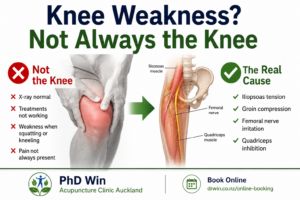
That pattern often suggests a functional nerve inhibition problem rather than a primary joint degeneration issue.
This immediately shifted the assessment direction.
If the quadriceps were failing to generate force properly, then the next question became:
What was happening along the femoral nerve pathway?
Further examination revealed marked iliopsoas tension, severe tenderness around the groin and anterior pelvic region, and obvious inhibition during hip flexion and knee extension testing.
The clinical pattern strongly suggested:
👉 Iliopsoas tension → groin compression → femoral nerve irritation → quadriceps inhibition.
Treatment therefore focused primarily on releasing the iliopsoas and reducing tension around the groin pathway, combined with fascial release around the proximal rectus femoris region.
The response was immediate.
After treatment, the patient could stand from a squat position without needing to hold onto the treatment bed.
This was not simply “more strength.”
It was a restoration of the inhibited movement pathway.
we do examination and acupuncture video
Clinical Insight
This case highlights an important distinction between functional and structural problems.
Many chronic knee cases continue being treated as “joint problems” simply because symptoms appear around the knee.
But clinically, weakness and pain do not always come from the same source.
When weakness becomes more dominant than pain, upstream nerve pathways and mechanical compression patterns must be considered.
The key is not chasing the symptom location.
The key is identifying which part of the movement chain is being inhibited.
In many difficult cases, treatment itself becomes part of the diagnostic process.
Patient Feedback
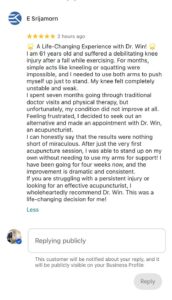
After four treatments, the patient later shared a positive Google review describing significant improvement in strength, function, and confidence during daily movement.
Why Choose Us
At PhD Win Acupuncture Clinic, we do not focus only on where symptoms appear.
We assess movement chains, nerve pathways, and mechanical restrictions behind persistent functional problems.
Many “knee problems” are not truly knee joint problems.
Related knee conditions
- Knee Pain and swellig ( reaction arthritis )
- Knee Pain and swelling ( juvenile-arthritis)
- Outer Knee Pain ( The lateral sural cutaneous nerve pain )



 中文微信:nzacupunctureclinic

Leave a reply