
Teresa’s TCM Clinical Reflections | Acupuncture for Headaches: Why Treating Where It Hurts Is Not Enough
Subtitle: From Traditional Chinese Medicine diagnosis to modern neurological assessment — my clinical approach to headache treatment
Headaches are among the common problems I see in acupuncture practice. Patients often ask me, “Teresa, can acupuncture help my headaches?”
For me, treating a headache involves more than selecting acupuncture points around the painful area. I first need to understand what type of headache the patient has, what may be causing it, whether acupuncture is appropriate, and where treatment should be directed.
There are several important parts of this clinical process.
1. Combining Meridian and Zang-Fu Pattern Differentiation
As a Chinese medicine practitioner, I begin with Traditional Chinese Medicine (TCM) diagnosis.
Meridian differentiation considers the location of the headache and its relationship to the meridian pathways.
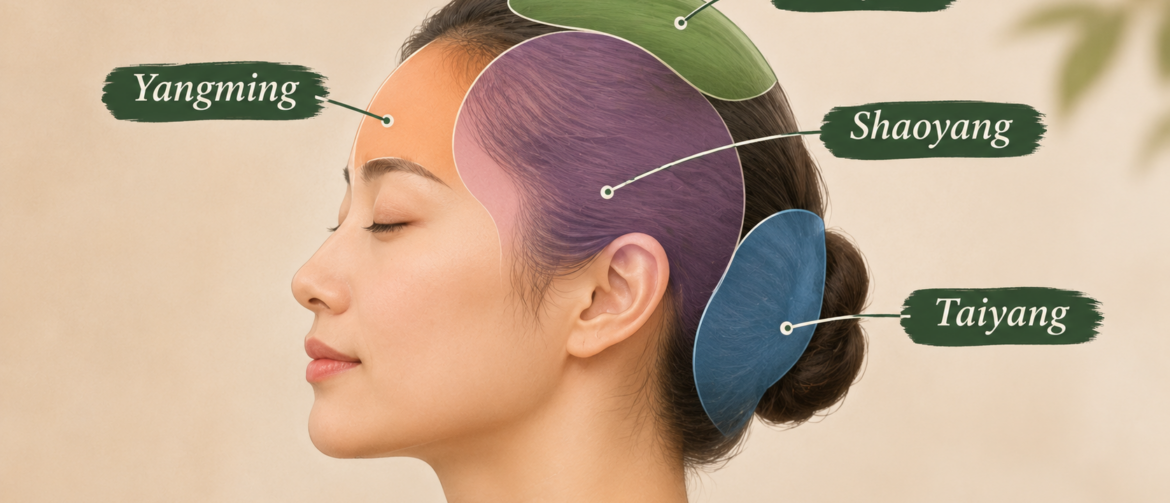
For example, forehead pain is commonly associated with the Yangming meridians, temporal and side-of-head pain with Shaoyang, and occipital pain with Taiyang. Pain at the top of the head may be considered in relation to the Jueyin pathway.
These patterns help guide acupuncture point selection.
However, location alone is not enough.
Zang-Fu pattern differentiation considers the patient’s overall symptoms, constitution and clinical signs.
In TCM, headaches may be associated with patterns such as Liver Yang Rising, Liver Qi Stagnation, Qi and Blood Stagnation, Qi and Blood Deficiency, or Kidney Essence Deficiency.
Two patients may experience headaches in similar locations but have very different associated symptoms. One may feel irritable and tense, while another experiences fatigue, poor sleep or persistent fixed pain.
Their acupuncture treatment may therefore require different points, techniques and broader treatment approaches.
2. Is This Headache Appropriate for Acupuncture?
I believe a Chinese medicine practitioner must also understand the relevant principles of modern medicine.
Not every headache should be treated as a routine acupuncture case.
Headaches can sometimes be associated with serious conditions, including intracranial tumours, raised intracranial pressure, brain swelling, intracranial infection, cerebrovascular disease or severe sinus-related conditions.
These problems require appropriate medical investigation and management.
I pay particular attention to warning signs such as a sudden, extremely severe headache, a significant change in headache pattern, double vision, new limb weakness, altered consciousness or severe vomiting.
When serious underlying disease is suspected, I do not proceed with routine headache acupuncture. I recommend prompt medical assessment, and sudden severe headaches or acute neurological symptoms require emergency evaluation.
Recognising when to treat and when to refer is an essential part of responsible clinical practice.
3. A Headache May Be a Symptom, Not the Whole Problem
Sometimes a headache is not an isolated condition. It may be related to problems elsewhere in the body.
For example, dysfunction involving cervical joints, muscles or related structures can contribute to cervicogenic headaches. Treating only the painful area of the head may overlook an important source of the symptoms.
Stress, anxiety, poor sleep and prolonged muscle tension may also contribute to headaches or make them more difficult to manage.
In these situations, I consider not only pain relief but also sleep, emotional wellbeing, work demands and daily habits.
This reflects an important principle of Chinese medicine: looking at the person as a whole.
I am treating a person experiencing headaches, not simply a painful head.
4. Different Headache Types Require Different Clinical Decisions
Modern medicine distinguishes between several headache disorders, including tension-type headache, migraine, cervicogenic headache and different forms of cranial or occipital neuralgia.
Their clinical features and mechanisms are not the same.
Migraine is a particularly important example. Some people call any one-sided headache a migraine, but unilateral pain alone does not establish the diagnosis.
Migraine is a recognised primary headache disorder with specific diagnostic criteria. Attacks may involve moderate to severe pain, worsening with routine physical activity, nausea, vomiting, and sensitivity to light or sound.
Some patients experience visual or sensory aura before or during an attack, while others do not. Fatigue may also occur after an episode.
Migraine is not always one-sided, and aura is not required for the diagnosis.
Even when a patient has previously been told they have migraine, I still consider the headache pattern, associated symptoms and relevant examination findings before deciding on a treatment approach.
5. Neuralgic Headaches Require Precise Nerve Localisation
Nerve localisation is particularly important in my acupuncture practice.
Different nerves supply different areas of the scalp and face. Pain distribution, tenderness, altered sensation and symptom triggers can help identify the possible source.
Greater occipital neuralgia often produces pain in the back of the head, sometimes radiating towards the crown. I examine the greater occipital nerve pathway and surrounding tissues. Acupuncture points around Fengchi (GB20), Tianzhu (BL10) and relevant tender areas may be considered according to the findings.
Lesser occipital neuralgia usually affects the outer occipital region and the area behind the ear. Assessment includes the posterior border of the sternocleidomastoid muscle and the nerve’s course. Wangu (GB12) is one nearby anatomical reference.
Third occipital nerve-related pain may involve the upper neck and lower occipital region. Its relationship with the C2–C3 facet joint and surrounding structures makes upper cervical assessment important.
Great auricular nerve pain may affect the ear, angle of the jaw and side of the neck. I consider the superficial cervical plexus and its course near the sternocleidomastoid muscle. Tianyou (SJ16) and adjacent cervical regions may provide useful surface references.
Auriculotemporal neuralgia usually involves pain around the front of the ear and temple. Symptoms may be associated with chewing or local stimulation, so the auriculotemporal nerve and nearby temporomandibular structures need consideration.
Trigeminal neuralgia requires a different assessment. Pain distribution across the forehead, cheek or jaw helps identify the potentially involved trigeminal branch, alongside the characteristic attack pattern.
Although these conditions may all be described as headaches or facial pain, they do not necessarily share the same nerve source or treatment targets.
In my assessment, I combine pain distribution with sensory findings, tenderness and symptom reproduction to guide treatment planning. Acupuncture points are anatomical references rather than exact one-to-one matches for individual nerves.
The clearer the anatomical localisation, the more targeted the treatment can be.
6. My Clinical Reflection
Acupuncture for headaches may appear straightforward, but effective clinical decision-making requires more than knowledge of acupuncture points.
I need to combine meridian and Zang-Fu differentiation with modern headache classification, neurological anatomy and appropriate differential diagnosis.
Before treatment, I consider whether there are warning signs, whether the pain may originate from the neck or a specific nerve, and whether sleep, stress or other factors are contributing.
For me, the most important question is not how many headache acupuncture points I know, but why I choose particular points for a particular patient.
First understand the nature and possible source of the headache. Then apply TCM pattern differentiation and select an appropriate acupuncture approach. This is the foundation of my clinical reasoning.
By Teresa Shen, BHSc (Acupuncture), ACC Registered Treatment Provider, Registered Chinese Medicine Practitioner (NZ)
Disclaimer: This article shares clinical perspectives for general education and does not replace individual medical assessment. A sudden severe headache or new neurological symptoms require urgent emergency medical attention.
Book an appointment at PhD Win Acupuncture Clinic: https://booking.mananotes.co.nz/PHD-WIN/v2
Last updated: 20 November 2026



 中文微信:nzacupunctureclinic


Leave a reply