
By Dr Win Huang, PhD (Chinese Medicine & Acupuncture)
Recently, a 12-year-old girl travelled from Australia to Auckland with her grandmother. They came to see me about a problem that had troubled her for five or six years: bedwetting.
It began when she was about seven. During a school camp, she wet the bed while staying away from home. Afterwards, occasional bedwetting continued, and the problem gradually became a major concern for the whole family.
Her parents took her to doctors and specialists. She underwent investigations and tried several treatments, including acupuncture, physical therapy and psychological treatment.
To prevent accidents, her grandmother had been waking her at around 1 am every night to use the toilet. Eventually, she was also wearing two layers of disposable nappies to bed.
When I first met her, I began thinking about something beyond the bedwetting itself.
Had the family unintentionally reinforced the same message for years: “You are a child who wets the bed”?
How Does a Bedwetting Label Become Part of a Child’s Identity?
Occasional bedwetting in childhood is not unusual. Persistent bedwetting, however, deserves appropriate medical assessment.
But I wondered what happens when a child repeatedly experiences investigations, treatments, reminders and precautions over several years.
Each appointment may remind her that something is wrong. Being woken every night may suggest that she cannot manage without help. Wearing nappies may reinforce the expectation that another accident is inevitable.
Over time, this can become more than a symptom. It can affect how a child sees herself.
This girl felt embarrassed and worried about other people finding out. School camps and sleepovers had become sources of anxiety.
I began to think that we needed to address not only the bedwetting, but also the identity and fear that had developed around it.
I Wanted to Help Her Move Beyond That Label
She had already undergone extensive medical investigations, with no serious underlying problem identified in the information available to me.
Simply telling her that everything was fine would not have been enough. After years of worry, she needed something she could experience and believe.
During my examination, I found considerable tenderness and tightness around her gluteal muscles. She practised gymnastics, which placed regular physical demands on this area.
I could show her the tenderness through palpation, treat the area, and then let her experience the change herself.
The important point was not that gluteal tenderness had been proven to cause her bedwetting. It had not.
Instead, it gave her a concrete, observable physical change. Rather than focusing only on a frightening problem that had persisted for years, she could recognise that something about her body was improving.
After her first treatment, she told me:
“Dr Win, you’re amazing. You know where to treat. Nobody else knew.”
What mattered to me was that she was beginning to believe change was possible.
Removing the Daily Reminders
I next discussed the family’s bedtime routine with her grandmother.
I suggested that she stop routinely waking the girl at 1 am and allow her to sleep through the night.
This was difficult for her grandmother. Waking the child had become a habit over several years, and she believed an accident would happen without it.
But during the next two nights, she did not wake her granddaughter, and there was no bedwetting.
At the second appointment, the girl was excited.
“Dr Win, Grandma didn’t wake me, and I didn’t wet the bed!”
For the first time, she had experienced sleeping through the night without someone intervening.
We then agreed to stop using nappies as well.
These changes were not intended to replace appropriate medical care. They were part of an individual plan following her previous assessments, with the aim of reducing unnecessary reminders and restoring confidence.
One Setback Did Not Mean Failure
Around the fourth or fifth day, she wet the bed again, quite heavily.
She was deeply upset. Her grandmother messaged me, saying the girl was discouraged and had slept poorly.
I reassured her that one accident did not erase the progress she had already made.
When we reassessed her gluteal tenderness, it had also reduced considerably. I used this improvement to help her recognise that change was continuing.
Importantly, the family did not return to the previous routine of nightly waking and nappies because of that one incident.
We continued supporting her confidence while observing what happened.
Two Weeks and Six Treatments
She stayed in New Zealand for approximately two weeks and received six treatments.
During that period, she had one bedwetting episode.
By the time she returned to Australia, she was no longer wearing nappies or being routinely woken by her grandmother.
She was delighted with the change.
But I was particularly interested in whether the improvement would continue once she was home.
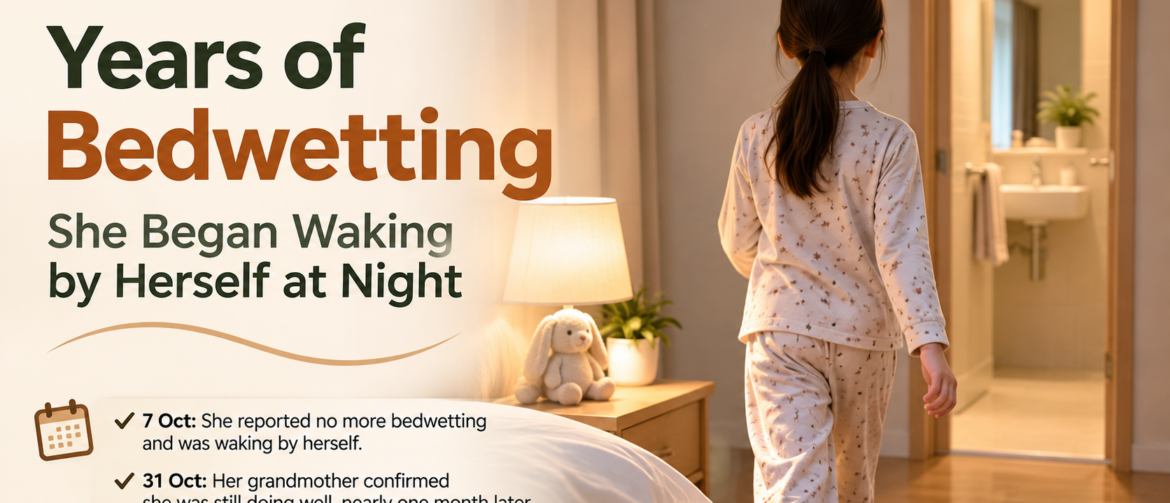
About a week after returning, she sent me a message with good news: no bedwetting, no nappies, and no need for her grandmother to wake her.
More than a month later, her grandmother contacted me again. She reported that the girl was continuing to do well, drinking normally, sleeping without nappies and no longer living with the same daily fear of an accident.
She was beginning to enjoy ordinary childhood activities again.
What Was I Really Treating?
Looking back, I do not think the most important part of this case was simply that her bedwetting improved after six acupuncture sessions.
The treatment, changes in family behaviour, reassurance, her own growing confidence and other possible factors may all have contributed. This individual case cannot establish which factor caused the improvement.
What I find most meaningful is how her understanding of herself changed.
First, I tried to stop reinforcing the idea that she was a “bedwetting child”. Then I gave her a physical change she could recognise. We gradually removed the daily reminders that had become part of her routine, while helping her manage a setback without losing confidence.
She discovered, through her own experience:
“I can sleep without Grandma waking me.”
“I can sleep without nappies.”
“And even after returning to Australia, I can still do it.”
For this girl, the change was not only about having dry nights.

It was about no longer defining herself by a problem that had followed her for years.
She could begin living like any other child, without constantly worrying about whether she would wet the bed that night.
That, to me, was the most meaningful outcome of this case.
English Booking
https://booking.mananotes.co.nz/PHD-WIN/v2
This article describes an individual clinical experience for educational purposes. It does not establish a causal relationship between gluteal muscle tenderness and bedwetting, or guarantee that acupuncture will resolve nocturnal enuresis. Persistent childhood bedwetting should be appropriately assessed.



 中文微信:nzacupunctureclinic


Leave a reply