
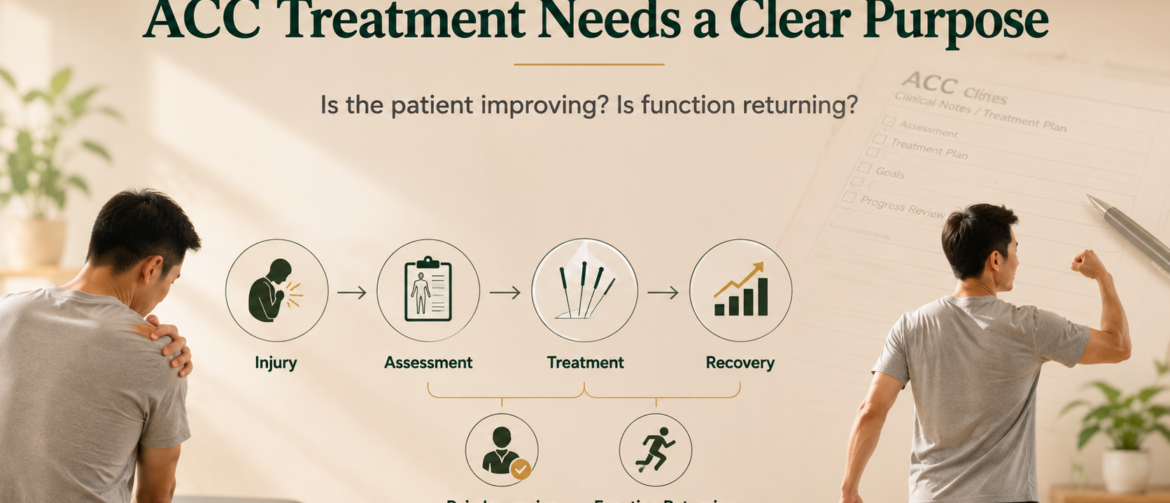
ACC Injuries: Why Acute and Chronic Injuries Need Different Treatment Approaches
By Teresa Shen, BHSc (Acupuncture), ACC Registered Treatment Provider, Registered Chinese Medicine Practitioner (NZ)
Working in clinical practice in New Zealand, ACC injury patients are an important part of my everyday work.
Some patients come in the day after twisting an ankle. Others develop sudden back or shoulder pain after lifting something heavy. Then there are patients who come to see me with an ACC injury that has already persisted for six months, a year, or even longer.
They often ask:
“Teresa, why hasn’t this injury healed?”
The longer I work with injury patients, the more I believe that although they may all have an ACC-covered injury, an acute injury and a long-standing injury require very different clinical thinking.
My approach is simple:
With an acute injury, timing matters. With a chronic injury, accuracy matters.
ACC Has Rules, but Treatment Still Needs a Clear Purpose
ACC can contribute towards acupuncture treatment for eligible injuries covered by an accepted ACC claim.
Under current ACC requirements, acupuncture is generally funded for up to 12 treatments within 12 weeks from the first acupuncture consultation. If further ACC-funded treatment is considered necessary after the relevant treatment or time limit, prior approval is required and supporting clinical information must be provided.
But in clinical practice, I do not think the most important question is simply:
“How many treatments are left?”
At every stage, I want to ask:
What are we trying to achieve now?
Is the patient improving?
Why has recovery stalled?
Are the current symptoms still related to the original injury?
These are not only ACC questions. They are fundamental clinical questions.
Acute Injuries: Timing Matters
Acute ankle sprains, knee injuries, shoulder strains, lower-back injuries, sporting injuries, and acute muscle, tendon and ligament injuries are common in ACC practice.
Early after an injury, patients may have pain, swelling, restricted movement and protective muscle tension.
At this stage, my first priority is not deciding how many treatments they will need.
I ask:
Can we settle the symptoms and begin restoring normal function as early as appropriate?
Pain often causes the body to protect an injured area. The patient moves less, surrounding muscles tighten, normal movement patterns change, and other parts of the body may begin to compensate.
If this continues for too long, a relatively straightforward injury can become more complicated.
My aim in the acute stage is therefore to help reduce pain and swelling, settle protective muscle tension, and gradually restore appropriate movement according to the severity of the injury.
From a Traditional Chinese Medicine perspective, acute injuries are commonly associated with Qi Stagnation, Blood Stasis and obstruction of the channels. Acupuncture and appropriate channel-based treatment may be used to support recovery.
But “treating quickly” does not mean treating aggressively.
It means:
Assess promptly, manage appropriately, and restore function as early as the injury safely allows.
Chronic Injuries: Accuracy Matters
When an ACC injury has persisted for three months, six months or longer, my thinking changes.
At this stage, asking only:
“Where does it hurt?”
is no longer enough.
I want to understand:
Why has this injury not recovered?
Is the original muscle, tendon or ligament injury still the main problem?
Has persistent tissue irritation developed?
Has joint movement become restricted?
Have compensatory movement patterns developed?
Is a nerve now being irritated or compressed?
Most importantly:
Is the problem maintaining the pain today still the same problem that existed immediately after the injury?
This is one of the most important lessons I have learned from treating long-standing injuries.
The original site of injury is not always the reason a patient is still in pain months later.
If treatment continues to focus only on the original painful spot, more treatment does not necessarily mean better recovery.
With chronic injuries, I prefer to reassess.
Treatment may be more gradual, but the direction needs to be accurate.
Chronic Injuries Also Change From a TCM Perspective
Traditional Chinese Medicine also recognises that an injury can change over time.
Early injury may predominantly involve Qi Stagnation and Blood Stasis.
As the condition becomes chronic, some patients may develop persistent Blood Stasis or Cold-Damp obstruction. Long-term pain, poor sleep and fatigue may also affect the person’s overall capacity to recover.
For this reason, I would not necessarily treat a two-day-old shoulder injury in the same way as a shoulder that has remained painful for a year.
Depending on the individual presentation, treatment may include acupuncture, channel-based distal points, moxibustion, cupping or other appropriate TCM techniques.
The method can change.
The principle remains the same:
Understand what stage the patient is in and identify what is preventing recovery now.
Sometimes Acupuncture Should Not Simply Continue
This is equally important.
Not every ACC injury should continue to be treated with acupuncture indefinitely.
If I suspect a significant ligament injury, major tendon tear, fracture, joint instability or another condition requiring further investigation, I may recommend imaging, GP review or specialist assessment.
Likewise, if a patient has received a reasonable course of treatment without the improvement I would expect, that is a reason to reassess—not simply add more treatments.
Knowing when to treat and knowing when to stop and investigate again are both part of good clinical care.
ACC policies, treatment limits and approval processes may change over time.
But one clinical principle does not change for me:
Acute injuries need timely management. Chronic injuries need accurate reassessment.
In the acute stage, the goal is to control symptoms, restore function and reduce the risk of a straightforward injury becoming unnecessarily complicated.
In the chronic stage, the challenge is to identify what is actually preventing recovery now.
More treatment is not always better treatment.
When the direction is right, every treatment has a clearer purpose.
Related Reading
Teresa’s TCM Clinical Reflections All
Why Does My Shoulder Hurt More at Night?
Why Is My Shoulder Pain Still Not Getting Better?
Why Can’t I Lift My Arm? Is It Frozen Shoulder or a Rotator Cuff Injury?
Where Could the Pain Be Coming From?
Internal Links
- ACC & Injury Recovery Hub
- Clinical Assessment
- Conditions We Treat
- Teresa’s TCM Clinical Reflections
- Meet Teresa Shen
- Book Appointment
- About Our Clinic
Book an Appointment
If you have an accepted ACC injury, whether it is a recent sprain or strain or an injury that has remained painful for several months, an individual clinical assessment can help determine the appropriate next step.
For acute injuries, we focus on timely symptom management and gradual restoration of function. For long-standing injuries, careful reassessment may be needed to understand what is currently preventing recovery.
ACC eligibility and treatment arrangements depend on your individual claim and current clinical circumstances.
Book Online:
https://booking.mananotes.co.nz/PHD-WIN/v2
Disclaimer
This Clinical Reflection is intended for general health education and is based on clinical experience and professional observation. It does not constitute individual medical advice or replace a face-to-face clinical assessment.
ACC cover, treatment funding, treatment limits and prior approval requirements are determined by ACC and may change over time.
If an injury involves significant loss of function, severe swelling or deformity, progressive neurological symptoms, suspected fracture or tendon/ligament rupture, or is not recovering as expected, further medical assessment may be required.



 中文微信:nzacupunctureclinic

Leave a reply