
🎥 Watch the Video
▶ Watch Teresa’s TCM Clinical Reflections 08
How I Approach Hand Pain and Numbness
Hand pain and numbness are problems I see quite often in my clinic.
Some people notice tingling in their fingers when they wake up in the morning. Others experience pain while using a computer, playing sports, lifting objects, or even holding a cup of tea. Some patients come because they have been diagnosed with carpal tunnel syndrome, while others have symptoms that seem much more difficult to explain.
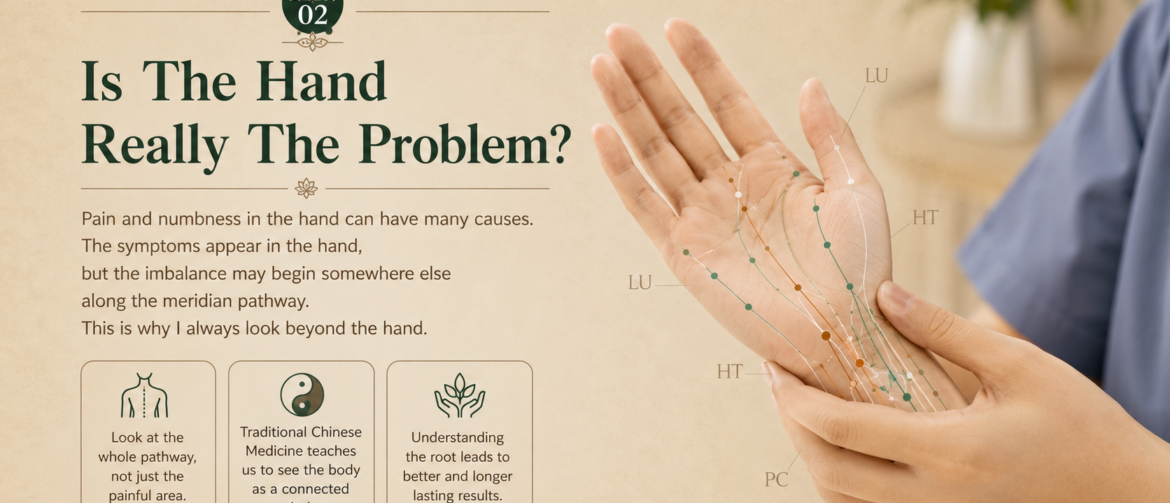
Although these patients all describe discomfort in the hand, I have learned that the source of the problem is not always there.
One of the first questions I ask myself is not “Where does it hurt?”
Instead, I ask,
“Where along the pathway is the problem beginning?”
That simple question often changes the way I assess the patient and the way I choose treatment.
Looking Beyond the Hand
Over the years, I have found that many conditions can produce very similar symptoms in the hand.
Some problems begin in the wrist.
Others involve tendons, ligaments or small joints.
Some are related to nerve entrapment.
Others may be associated with the neck, diabetes, gout, Raynaud’s phenomenon, or other medical conditions.
This is why I try not to focus only on the hand itself.
Instead, I follow the pathway from the shoulder, through the upper arm, elbow and forearm, before it finally reaches the hand.
Sometimes the hand is simply where the symptoms appear.
It is not always where the problem begins.
My Yin and Yang Approach
One clinical approach I use quite often is to consider whether the symptoms are mainly on the palm or the back of the hand.
If the symptoms are mainly on the palm, I think first about the Yin side of the arm.
If the symptoms are mainly on the back of the hand, I consider the Yang side.
This simple way of thinking helps organise my clinical assessment before treatment even begins.
For symptoms affecting the Yin side, I often pay particular attention to areas such as Jiquan (HT1) and Yunmen (LU2).
From a Traditional Chinese Medicine perspective, these regions are closely related to the Yin meridians of the upper limb.
From an anatomical perspective, they are also important areas where nerves and blood vessels travel together.
Rather than treating only where the pain is felt, I try to understand the entire pathway that leads to the hand.
Acupuncture Along the Pathway
Acupuncture is one of the main treatment methods I use, but I don’t always begin where the symptoms are.
If the symptoms mainly affect the palm, I often treat Jiquan (HT1) and Yunmen (LU2) before focusing on the hand itself.
If the symptoms are mainly on the back of the hand, I more often work around Jianzheng (SI9) and Tianchuang (SI16).
From a Traditional Chinese Medicine perspective, these points help regulate the meridian pathways.
From an anatomical perspective, they are also located near important regions where nerves and soft tissues may become restricted.
For me, acupuncture is not only about treating the painful area.
It is about improving the pathway that leads to the hand.
My Manual Therapy Approach
Acupuncture is only one part of my treatment.
I also use manual therapy to release unnecessary tension before the body begins to recover.
One of my clinical habits is again based on the Yin-Yang relationship.
If the symptoms are mainly on the palm, I usually release the anterior wall of the axilla using gentle manual techniques.
If the symptoms are mainly on the back of the hand, I more often work on the posterior wall of the axilla.
Rather than treating the hand alone, I try to improve the mobility of the soft tissues along the entire pathway.
Depending on the patient’s condition, I may also combine acupuncture with local treatment, moxibustion or cupping around the painful area.
Every treatment is individualised.
Every Patient Is Different
One of the reasons I enjoy treating hand pain and numbness is that no two patients are exactly the same.
Some improve after releasing tight soft tissues around the shoulder.
Others respond well when the nerve pathway is treated.
Some mainly need local treatment around the wrist or hand.
Others require us to address an underlying medical condition at the same time.
Traditional Chinese Medicine encourages us to treat the individual rather than simply treating the diagnosis.
That philosophy continues to guide my clinical practice every day.
Teresa’s Clinical Reflection
After treating many patients with hand pain and numbness, one lesson has stayed with me.
The hand is often where the symptoms appear.
It is not always where the problem begins.
When I understand the pathway, I understand the patient much better.
That is why I don’t only treat the hand.
I try to understand the whole pathway, the whole pattern, and the whole person.
For me, this is one of the most valuable lessons Traditional Chinese Medicine has taught me.
Frequently Asked Questions
Why do I have hand pain or numbness?
Hand pain and numbness can result from many different causes, including tendon injuries, nerve entrapment, joint problems, cervical spine disorders, diabetes, gout, or circulatory conditions. A careful assessment is important before deciding on treatment.
Can acupuncture help hand pain and numbness?
Many patients seek acupuncture for hand pain and numbness. Treatment depends on the underlying cause and may be combined with manual therapy, moxibustion, cupping, or local acupuncture depending on the individual’s presentation.
Why doesn’t Teresa only treat the hand?
Because symptoms felt in the hand do not always begin there. Teresa’s clinical approach is to assess the entire pathway from the shoulder to the hand before deciding where treatment should begin.
Why do you treat the axilla?
The axilla contains important muscles, nerves and blood vessels that continue into the arm and hand. Releasing tension around the anterior or posterior wall of the axilla may help improve the function of the entire pathway in appropriate patients.
About Teresa’s TCM Clinical Reflections
Teresa’s TCM Clinical Reflections is a series of educational articles and videos in which Teresa Shen shares her clinical observations and treatment philosophy developed through everyday practice.
Rather than presenting textbook knowledge, each reflection focuses on practical clinical thinking, personalised treatment, and the principles of Traditional Chinese Medicine that guide Teresa’s approach to patient care.
Book an Appointment
If you are experiencing persistent hand pain, numbness, tingling, or reduced hand function, Teresa Shen welcomes you to PhD Win Acupuncture Clinic for an individual Traditional Chinese Medicine assessment.
Book Online
https://drwin.co.nz/online-booking/
Medical Disclaimer
This article is provided for general health education only and should not be considered personal medical advice, diagnosis, or treatment. Hand pain and numbness may have many different causes. If your symptoms are severe, progressive, associated with significant weakness, recent trauma, or other concerning features, please seek assessment from an appropriately qualified healthcare professional.



 中文微信:nzacupunctureclinic

Leave a reply