
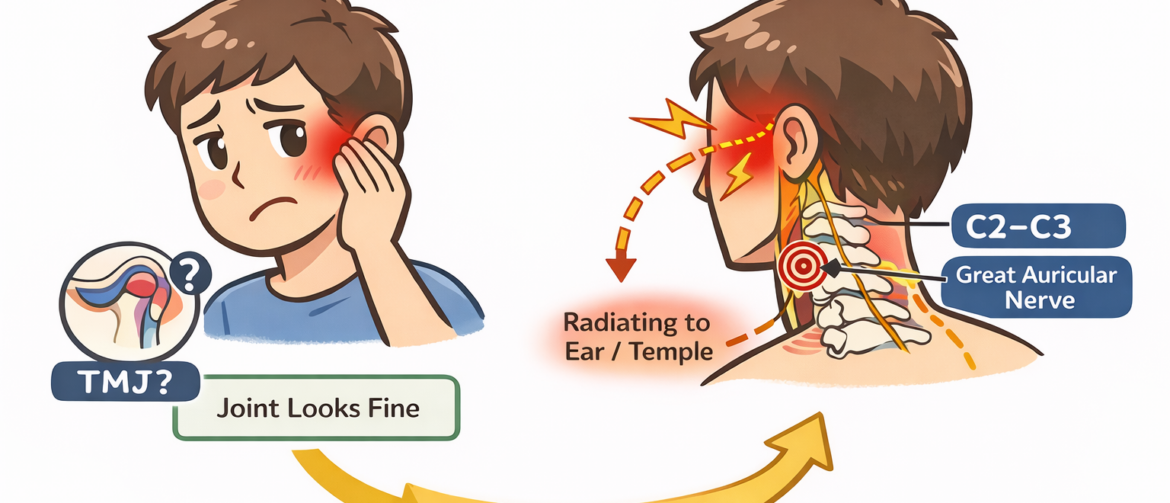
“TMJ Discomfort” with a Cervical Origin: A Reverse Diagnosis Involving the Great Auricular Nerve
This type of patient can easily lead a clinician off track.
He arrives with a “diagnosis” already formed — temporomandibular joint disorder (TMJ).
But in clinical reality, the diagnosis brought by the patient is often unreliable.
The clinician’s job is not to follow the patient’s conclusion, but to return to objective findings and logic.
The core misunderstanding in this case can be summarized in one sentence:
The location of discomfort is not equal to the location of the lesion.
1 | Case Background: Long-standing “ear-front discomfort” that recently became constant
The patient reported many years of discomfort — not sharp pain, but a vague aching, fullness, and odd sensation — mainly around:
-
The pre-auricular region
-
The angle of the mandible
-
The parotid / peri-auricular region
Previously, it was mild. Moving the jaw or resting would relieve it, so he ignored it.
But in recent months, the discomfort became constant throughout the day. He repeatedly opened his mouth wide, moved the jaw, and rubbed the ear-front area to seek relief.
He came with a clear request: treat my TMJ disorder.
2 | First step: Does this actually look like a true TMJ problem? (It did not)
Key examination findings:
-
Mouth opening was symmetrical, no deviation
-
No limitation of opening
-
No significant occlusal complaint
-
No tenderness over the TMJ itself
True joint pathology usually presents with clearer signs: deviation, clicking, restriction, or joint tenderness. None were present.
At this point, it was clear:
His self-diagnosed “TMJ disorder” did not match the objective findings.
3 | A change in direction: Could a nerve be “mimicking” a joint problem?
Discomfort in the ear-front, mandibular angle, and parotid region without TMJ signs suggests a frequently overlooked participant:
Great auricular nerve (C2–C3) irritation or sensitization
Two key checks were performed:
-
Sensory comparison: the ear lobule, mandibular angle, and parotid skin were more sensitive on the right side
-
Provocation point: pressure applied near the C2–C3 transverse process region reproduced pain radiating to the ear front and temple
A diagnostic moment occurred:
After pressure was applied, the patient immediately said,
“That uncomfortable TMJ feeling is gone.”
4 | The turning point: Not “joint movement helps,” but “nerve tension released”
The patient believed:
“Opening the mouth makes it better → therefore it must be TMJ.”
But the new evidence showed:
When the upstream C2–C3 / great auricular nerve pathway was addressed, the discomfort disappeared immediately.
This suggests that the relief was not due to joint correction, but due to:
-
Change in cervical tension
-
Temporary reduction of cutaneous nerve sensitization
-
Release of local traction sensation
In other words:
The sensation felt like TMJ discomfort, but the source was not the TMJ.
5 | The likely source: Great auricular nerve involvement with cervical contribution
The evidence was consistent:
-
Lack of classic TMJ signs
-
Increased cutaneous sensitivity in the ear lobule / mandibular angle region
-
Strong tenderness at C2–C3 with radiation to the ear front and temple
-
Immediate relief after pressure (therapeutic confirmation)
Thus, the conclusion favored:
Great auricular nerve involvement with cervical origin, rather than TMJ pathology.
6 | Therapeutic diagnosis: Treating Tianyou (SJ16) and the C2 region
Treatment was applied at:
-
Tianyou (SJ16) with superficial bloodletting
-
C2 transverse process region with cupping
After treatment, the patient reported:
-
Disappearance of the ear-front and mandibular angle discomfort
-
A clear sense of lightness
-
The vague “odd sensation” was gone
This reinforced the conclusion:
The problem lay in the cervical–great auricular nerve pathway, not in the joint.
Tianyou (SJ16) is located just below the mastoid process, at the posterior border of the sternocleidomastoid muscle.
This depression is exactly where the great auricular nerve emerges from C2–C3 and ascends superficially along the muscle.
Tianyou is not merely near the great auricular nerve — it lies directly on its pathway.
8 | A practical clinical conclusion
When a patient reports “TMJ discomfort,” but:
-
Mouth opening is symmetrical
-
No joint tenderness
-
No limitation of motion
-
Skin around the ear lobule / mandibular angle is hypersensitive
-
C2–C3 pressure reproduces symptoms radiating to the ear front and temple
Consider great auricular nerve involvement of cervical origin before blaming the TMJ.
And always remember:
Patients provide symptom clues, not diagnostic conclusions.



 中文微信:nzacupunctureclinic

Leave a reply