
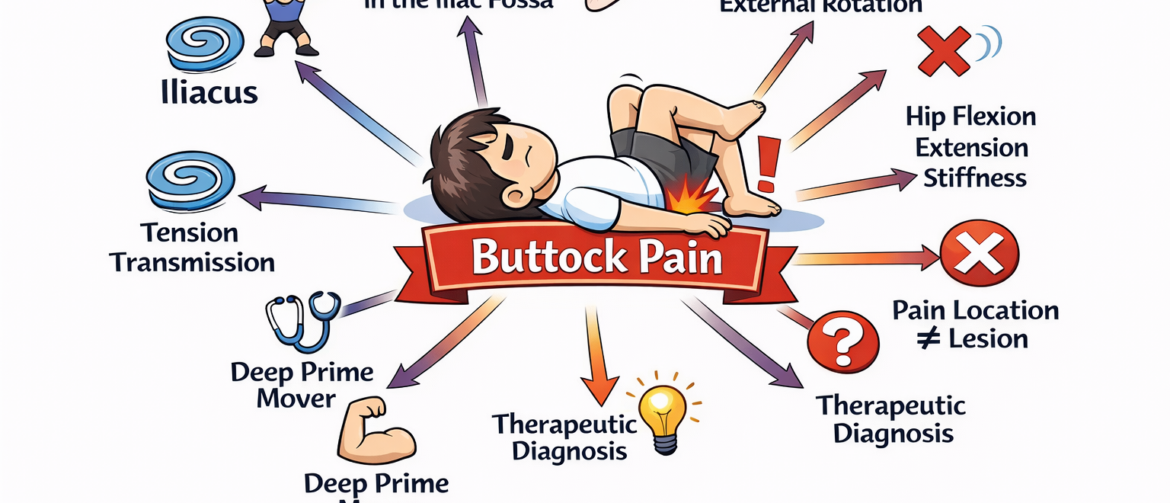
Pain in the Buttock, Problem in the Abdomen: A Counter-Intuitive Diagnosis of Iliacus Strain
This case is not complicated, but it is highly instructive. It challenges a common clinical misconception:
The location of pain is not equal to the location of the lesion.
If you focus only on “buttock pain,” your treatment direction will drift further and further away from the real problem. Once you shift to a tension and force-line perspective, the answer begins to reveal itself naturally.
1 | Case Background: “Looks Like a Gluteal Muscle Strain”
Three days before presentation, the patient stepped over a fence and suddenly felt as if his right buttock had been “pulled.” That same evening, he participated in several hours of continuous dancing. The next day, he developed right buttock pain. Walking, climbing stairs, or certain movements would suddenly trigger a sharp pain.
He believed this was a “lumbar–gluteal muscle strain,” yet he could not find any specific tender point on palpation.
He then received massage focused on the lower back and buttock region. The area even became bruised, but instead of improving, the pain worsened.
This detail is crucial: when external work makes the pain worse, it often means the source is not external.
2 | First Clinical Instinct: Check the Most Common Sources of Buttock Pain (All Negative)
With a chief complaint of buttock pain, the natural clinical approach is to examine:
-
Paraspinal muscles and quadratus lumborum — no tenderness
-
Gluteus maximus, medius, minimus — no tenderness
-
Sacroiliac joint — no tenderness
A true muscle strain almost always presents with a clear tender point.
Here, nothing hurt where it was supposed to hurt.
When the “expected painful structures” are not painful, it indicates we may be working at the wrong level.
3 | Change Direction: If Not Muscle, Could It Be Nerve?
A common trap in buttock pain is the superior cluneal nerve. Sensory testing was normal and symmetrical, ruling out a nerve source.
At this point, a typical clinical dilemma appears:
The patient is clearly in pain, but you cannot find any structure that explains it.
Continuing symptomatic treatment at the buttock (more massage, more release, more local work) would only repeat the previous mistake.
4 | The Turning Point: Hip Range of Motion Reveals the Hidden Source
With the patient supine, hip examination revealed the real clue:
-
Right hip flexion–extension was noticeably stiffer than the left
-
Right hip external rotation was restricted — the left knee easily dropped outward to the bed, the right could not
-
External rotation reproduced the buttock pain
Importantly, the hip joint itself was not painful.
The key finding was: restricted external rotation with resistance.
When external rotation is being “held back,” the question is not what is wrong with the hip joint, but:
What is pulling on the lesser trochanter?
5 | The Iliacus Enters the Picture
Textbooks often associate iliacus problems with groin pain.
This patient had no groin pain.
If one relies on textbook patterns alone, the diagnosis will be missed.
Following the force line deeper:
-
Psoas palpation — unremarkable
-
Deep palpation into the iliac fossa — severe deep pain
-
Marked tenderness at Biguan (ST31), just inferior to the ASIS
At this point, the picture became clear:
This was not a gluteal muscle strain.
It was an acute iliacus strain that had gone into protective high tension, locking the hip mechanics.
6 | Therapeutic Diagnosis: Release the Iliacus, Unlock the Hip
Two interventions were performed:
-
Deep manual release of the iliacus through the abdomen
-
Needling and cupping at Biguan (ST31)
Immediately after treatment, three diagnostic changes occurred:
-
Hip flexion–extension became much easier
-
External rotation no longer met resistance
-
On standing and walking, the buttock pain was nearly gone
This is a classic example of therapeutic diagnosis:
when the true source is treated, function returns instantly.
7 | What This Case Teaches
(1) Pain location is unreliable; tension source is reliable
Pain was in the buttock. The problem was in the iliac fossa.
(2) “Worse after massage” is a diagnostic clue
The outer tissues were victims, not the source.
(3) Restricted hip external rotation is a key sign of iliacus involvement
When the hip joint is painless but movement is blocked, think of deep prime movers.
8 | A Clinical Conclusion Worth Remembering
Pain in the buttock does not mean the problem is in the buttock.
When buttock structures show no findings, always examine the iliac fossa.



 中文微信:nzacupunctureclinic

Leave a reply