
Case Study | Persistent Ankle Pain After a Fall — But the Problem Was Not the Ankle
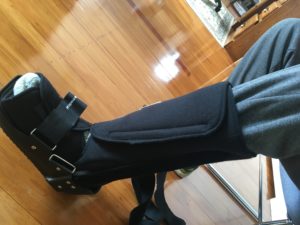
看看医生给他穿的固定靴
看看理疗医生给他的胶带固定

一次治疗后,患者疼痛减轻大半,高兴的和我留影。

This patient was a Fijian Indian man who had fallen from a height of about one metre two months earlier.
After the fall, he developed pain around the ankle.
Because there was a clear injury history and the pain was located around the ankle, the problem was initially treated as an ankle sprain.
He was given a walking boot and pain medication.
However, the pain remained severe and he was still unable to walk normally.
He later saw an orthopaedic specialist and received physiotherapy. X-rays showed no fracture, and the ankle was also supported with taping.
Despite these treatments, two months later he was still in significant pain and had spent much of that time resting at home.
His wife eventually found my clinic online and brought him in for another assessment.
Why I Began to Question the Ankle Diagnosis
The strongest clue in this case was also the easiest one to become trapped by:
he had fallen, and the pain was around the ankle.
Naturally, the first diagnosis was an ankle sprain.
That was a reasonable starting point.
But when pain remains severe for two months, imaging shows no fracture, and treatment directed at the ankle produces little improvement, the diagnosis needs to be reconsidered.
I reassessed the history, the ankle itself and the related nerve pathway.
The clinical presentation did not behave like a typical ankle sprain.
The pain was located around the ankle, but the findings suggested that the source might be more proximal.
At the time, I considered the presentation more consistent with an atypical nerve-related pain pattern, possibly involving the sciatic nerve pathway.
First Treatment
Treatment was therefore directed according to this new clinical interpretation rather than continuing to focus only on the ankle.
After the first treatment, the patient reported that the pain had reduced by more than half.
He was extremely pleased with the change and repeatedly gave me a thumbs-up after the session.
Clinical Reflection
This case is a good example of how an injury history can influence clinical thinking.
The patient fell.
The ankle hurt.
So everyone naturally began with the diagnosis of ankle sprain.
There is nothing wrong with that.
The important question is what happens when the expected recovery does not occur.
At that point, we need to go back and ask:
Is there swelling?
Is there clear local tenderness?
Does ankle movement reproduce the pain?
Does weight-bearing behave like a local ankle injury?
Is the pain mechanical, inflammatory or neurological?
Could the pain be coming from somewhere higher along the nerve pathway?
This patient reminded me of a principle that has become increasingly important in my clinical work:
the place where a patient feels pain is not always the place where the problem begins.
Sometimes the biggest change in treatment does not come from choosing a different acupuncture technique.
It comes from reconsidering the diagnosis.
Published on: Aug 13, 2018 at 19:26
Revised for Website 2.0: 14 November 2026



 中文微信:nzacupunctureclinic


Leave a reply