
Knee Pain for 6 Months… The Problem Was Not Inside the Joint
Medial Knee Pain Treatment Case | PhD Win Acupuncture Clinic Auckland
This patient was a man in his thirties working as a plumber.
About six months earlier, he developed severe knee pain after a long-distance trip.
He had been drinking, and during the drive he sat in the back seat with his leg stretched forward against the front seat for several hours while sleeping.
When he got out of the car, he could barely walk.
An MRI was later performed.
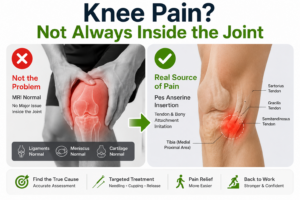
The meniscus, cruciate ligaments, cartilage, and other internal knee joint structures all appeared essentially normal.
Over the following months, he tried physiotherapy, acupuncture, and conservative management.
When the pain became severe, he relied on painkillers.
But despite six months of treatment, the knee never truly recovered.
One of the biggest problems was work.
He had to wear heavy safety boots as part of his job.
After wearing them for a full day, the knee pain became significantly worse.
He also depended heavily on a tight knee brace.
Without it, walking became difficult.
The pain was especially severe when getting out of bed in the morning.
After moving around, it eased slightly.
Sitting for long periods and then standing up also triggered pain.
At first glance, this looked like a chronic knee sprain.
But the interesting part came during examination.
There was no major swelling, and overall knee movement was relatively preserved.
Tests for meniscus and cruciate ligament injury were unremarkable.
The key finding appeared elsewhere.
When pressure was applied to the proximal medial tibial attachment region — around the pes anserine insertion area — the patient reacted with extremely sharp pain.
The pain radiated through the entire knee.
👉 This strongly suggested that the main problem was not inside the joint itself.
Instead, the irritation appeared to involve the tendon attachment region, periosteal inflammation, and chronic local tension around the pes anserine area.
Treatment direction changed completely.
Rather than treating the knee as a general “joint sprain,” targeted bleeding and local cupping release were applied directly to the most painful attachment point.
The response was immediate.
After treatment, the patient reported that the knee felt significantly lighter.
Before treatment, he needed to hold the handrail while climbing stairs.
After treatment, he could walk downstairs much more comfortably without support.
Even the tight knee brace suddenly felt less necessary.
Clinically, that type of immediate functional change is highly meaningful.
Clinical Insight
This case highlights an important clinical reality:
Many chronic knee pain cases are not difficult because they are “severe.”
They are difficult because the treatment direction never truly matched the real structure involved.
When treatment remains focused only on “inside the joint,” improvement may stay limited.
But once the actual pain generator is identified — such as tendon attachment irritation, periosteal inflammation, or local mechanical tension — the response can become very different.
This case also reflects the difference between non-specific and highly targeted treatment.
General acupuncture approaches may help broad functional problems.
But chronic tendon-bone attachment irritation often requires far more specific assessment and treatment.
The key is not simply inserting needles.
The key is identifying which structure continues to drive the pain.
Why Choose Us
At PhD Win Acupuncture Clinic, we focus not only on where pain appears, but also on which tissue is truly responsible for the ongoing irritation.
Many chronic knee pain cases are not primarily joint problems.
They involve tendon attachment regions, periosteal irritation, fascial tension, and long-term mechanical overload.



 中文微信:nzacupunctureclinic

Leave a reply