
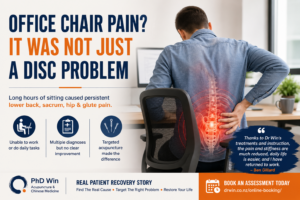
Office Chair Pain?
It Was Not Just a “Disc Problem”
He Thought It Was a Disc Problem
Ben works as a computer programmer.
Most of his day was spent sitting in front of a computer. Even outside work, he often watched films or played games, so sitting became a normal part of daily life.
In March 2025, he first noticed stiffness and soreness in his lower back before bed.
Within days, the pain became much worse.
Soon, he could not sit for more than 10–15 minutes without developing burning pain around the lower back, sacrum, hips and glutes. Even after standing up, the pain remained.
Standing too long also became difficult.
Simple activities like washing dishes, cooking food, or working at the computer started triggering pain.
Lying down was the only position that felt relatively comfortable.
At one stage, the symptoms became so severe that he had to stop working and temporarily move back to his parents’ house because daily life became difficult to manage alone.
Multiple Diagnoses, But No Clear Improvement
Over the following months, Ben tried many different approaches.
He first visited a chiropractor and was told it might be an L5-S1 disc tear.
Later, another opinion suggested L4-L5 disc swelling or sprain.
An X-ray did not show anything significant.
His GP later suspected sacroiliac joint arthritis and prescribed painkillers, anti-inflammatory medication, vitamin supplements, and core exercises.
He also saw a physiotherapist, who introduced stretching, muscle release work, and nerve flossing exercises.
Some treatments gave temporary relief.
But the improvement never became stable.
Whenever he tried to return to normal work, the symptoms often came back again.
The Problem Was Not Just the Spine
When he finally came to PhD Win Acupuncture Clinic, one important detail stood out:
The pain pattern did not behave like a simple disc problem alone.
His symptoms were strongly aggravated by prolonged sitting.
The sacrum and glute region remained highly sensitive.
The surrounding muscles stayed constantly tight, almost as if the body was continuously trying to “protect” the lower back and pelvis.
Clinically, this type of presentation is often related not only to the spine itself, but also to chronic tension and irritation around the gluteal muscles, sacral region, fascial system, and nerve pathways.
Sometimes the biggest issue is not where the MRI looks abnormal.
The real issue is where the body is continuously being irritated.
Gradual Improvement
With regular acupuncture treatment, movement guidance, and gradual activity adjustment, Ben slowly began improving.
The pain and stiffness reduced.
Daily function became easier.
Eventually, he was able to return to work again.
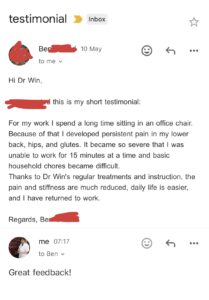
In his own words:
“Thanks to Dr Win’s regular treatments and instruction, the pain and stiffness are much reduced, daily life is easier, and I have returned to work.”
Many Office-Related “Back Problems” Are More Complex Than They Look
Long-term sitting pain is not always just a simple “disc problem.”
Sometimes the body develops a persistent protective tension pattern involving:
- sacrum and pelvic stabilising muscles
- gluteal muscle tension
- nerve pathway irritation
- fascial tightness
- prolonged sitting-related loading stress
When the real irritation source is identified and reduced, symptoms often improve much more effectively.
👉 If your lower back or glute pain keeps returning after long periods of sitting, it may be worth reassessing the problem from a different angle.
Book Online:
PhD Win Clinic Online Booking



 中文微信:nzacupunctureclinic

Leave a reply